How a taped-up banana became a $6 million art sensation
How a taped-up banana became a $6 million art sensation
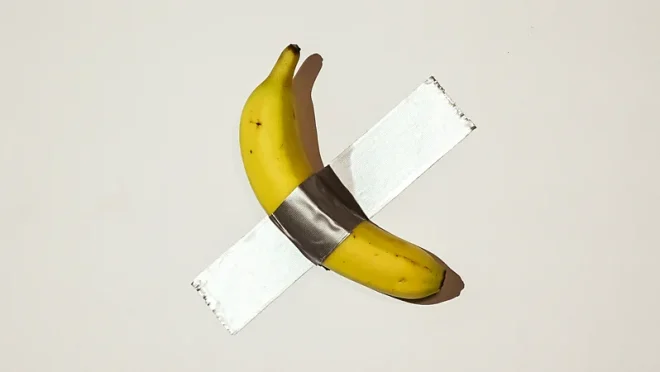
A banana fixed to a wall with silver duct tape sounds more like an office prank than a multimillion-dollar artwork. Yet Maurizio Cattelan’s “Comedian” became one of the most talked-about works of contemporary art, attracting both ridicule and serious money.
When the artwork appeared at Art Basel Miami Beach on 4 December 2019, the reaction was immediate. Celebrities including Leonardo DiCaprio, Michael Bay and Travis Scott were attending the fair, where paintings by established artists were being offered for millions of dollars.
Then there was Cattelan’s banana.
ArtNet News reporter Sarah Cascone wrote one of the first major reports on the piece, revealing that two editions had already sold for $120,000 each. A third and final edition followed, selling for $150,000.
The buyers did not simply walk away with a banana. Each received a certificate of authenticity and instructions explaining how the work should be displayed, including the rather practical requirement that the banana be replaced periodically.
Within days, “Comedian” had escaped the confines of the art world. Visitors photographed it, posted their reactions online and turned the piece into a meme. Some mocked it, others defended it, but almost everyone seemed to have an opinion.
And that may have been precisely the point.
The art of getting people talking
Cattelan had already built a reputation for provoking audiences.
His strategy was not entirely new. Art history is full of artists who discovered that upsetting the public could be just as effective as pleasing it.
More than four centuries ago, Caravaggio shocked viewers with religious paintings filled with violence, darkness and sexual tension. Later, artists such as JMW Turner, John Constable, Édouard Manet, Claude Monet, Paul Gauguin, James McNeill Whistler and Paul Cézanne faced ridicule for challenging conventional ideas about what art should look like.
By the beginning of the 20th Century, controversy had become closely associated with artistic experimentation. For some artists, public hostility was evidence that they were pushing boundaries. For others, it was simply an effective way of attracting attention.
Cattelan took that tradition and made it his own.
Rather than relying on complicated theories or obscure references, many of his most provocative works use instantly recognisable figures and ideas.
In “La Nona Ora” from 1999, Pope John Paul II is shown after being struck by a meteorite. “Him”, created in 2001, depicts a praying schoolboy whose face belongs to Adolf Hitler.
Both works use humour and shock to confront institutions and powerful figures. In that sense, Cattelan’s work sits comfortably within the long tradition of satire associated with artists such as James Gillray and Honoré Daumier.
Before the banana, there was a dealer on the wall
Perhaps the biggest clue to understanding “Comedian” can be found in one of Cattelan’s earlier works.
In “A Perfect Day”, created in 1999, he had his Milan art dealer Massimo De Carlo taped to a gallery wall.
The joke was aimed directly at the art market. Instead of presenting another valuable object for sale, Cattelan turned the person responsible for selling art into the artwork.
Two decades later, he returned to the same visual language.
The silver duct tape in “Comedian” echoed “A Perfect Day”, signalling that the banana was not simply a random object stuck to a wall. It was another joke aimed at the machinery and values of the contemporary art world.
At Art Basel Miami Beach, an event built around buying, selling and displaying expensive art, the banana became a kind of punchline.
Why a banana?
The choice of a banana was hardly accidental.
Bananas are familiar, visually distinctive and have long appeared in popular culture and art. Artists including Giorgio de Chirico, Andy Warhol and the Guerrilla Girls have used them in their work.
There is also something deliberately ordinary about presenting food as art. Still-life painting has been a recognised genre since the 1500s, often using everyday objects to explore ideas about mortality, time and the fleeting nature of life.
One early example is Jacopo de’ Barbari’s “Still-Life with Partridge and Gauntlets”, painted in 1501.
Cattelan’s banana and de’ Barbari’s painting may be separated by more than five centuries, but they share a basic idea: taking an ordinary object and placing it before an audience for contemplation.
In that sense, “Comedian” was not as revolutionary as it first appeared. It was borrowing from a very old artistic tradition while pretending to be completely ridiculous.
The $6 million punchline
The banana itself is temporary. It rots and has to be replaced after several days. What makes “Comedian” valuable is not the fruit, but the concept, certificate and history attached to it.
That concept became considerably more expensive in 2024, when one of the three editions sold at auction for $6.24 million.
The sale predictably reignited the debate surrounding the work. Why would anyone spend millions on something that can be bought at a supermarket?
But the enormous price may actually be part of Cattelan’s joke.
“Comedian” was designed to provoke questions about what qualifies as art, who gets to decide its value and why certain objects become enormously expensive simply because they are placed inside the right institutions.
And Cattelan had already spent decades learning how to make people ask those questions.
By combining satire, shock, recognisable imagery, the traditions of still life and the century-old idea of the “readymade”, he created something that looked radically new while relying heavily on ideas artists had been exploring for generations.
The real trick behind “Comedian”, then, may not be that Cattelan convinced the world a banana was worth millions.
It is that he convinced the world to keep talking about it.
And perhaps the strangest thing about the artwork is also the simplest: beneath all the controversy, there is surprisingly little that is genuinely new about it.