BRAC Frugal Innovation Challenge: Rethinking climate adaption through innovation
BRAC Frugal Innovation Challenge: Rethinking climate adaption through innovation
Climate change is often discussed in rather intimidating terms. Rising temperatures, disappearing coastlines, unpredictable rainfall, melting ice caps and increasingly destructive natural disasters. The conversations usually involve scientists, policymakers, international organisations and people with the authority to make decisions.
But what if some of the answers came from university students?
Not necessarily climate scientists or engineers, but students studying business, sociology, agriculture, economics or pretty much anything else. People who might look at a problem in their neighbourhood and think, surely, there must be a better way to deal with this.
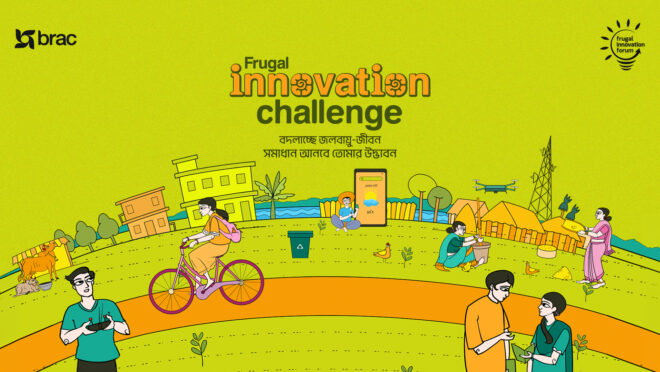
That is the thinking behind BRAC’s Frugal Innovation Challenge, a national initiative inviting Bangladeshi university students and recent graduates to develop practical ideas that help communities adapt to climate change.
Organised by BRAC’s Social Innovation Lab (SIL) under the Frugal Innovation Forum (FIF), the challenge is built around a relatively simple premise: identifying a problem is one thing, but finding an affordable, locally relevant way to solve it is another.
And that is where students come in.
What exactly is Frugal Innovation?
Frugal innovation is about finding practical ways to solve problems without necessarily relying on expensive technology, massive investments or complicated systems. The goal is to develop solutions that people can actually use, particularly in communities where resources are limited.
It could be a product, a service, a financial arrangement, a community initiative or even a change in how people approach an everyday problem.
For this year’s challenge, BRAC wants participants to explore these possibilities through the lens of Climate Information Services (CIS).
Think about a farmer who knows that heavy rainfall is expected in the coming days. That information is useful, but it becomes considerably more valuable when the farmer also knows whether to harvest early, delay planting or protect crops from potential damage.
The difference is between simply knowing what the weather might do and knowing what to do about it.
That gap between climate information and practical decision-making is what the challenge hopes to address.
Five problems, plenty of possibilities
Participants can develop ideas across five broad areas: agriculture and livelihoods, health and resilience, water resource management, financial protection, and urban life and work.
Each comes with its own set of everyday challenges.
In agriculture, for instance, farmers often have to make decisions about planting, harvesting and irrigation while dealing with increasingly unpredictable weather. A useful solution could help them make those decisions with better information.
In health, the focus could be on protecting people from extreme heat or ensuring access to essential medicines when climate-related disruptions affect healthcare services.
Water resource management opens up possibilities around safe drinking water, floods, droughts and salinity, particularly for communities that struggle with access to reliable water sources.
Financial protection, meanwhile, looks at how households can prepare for unexpected expenses and income losses caused by climate-related events. This could involve savings, insurance, emergency financing or more flexible repayment systems.
Then there is urban life and work. From outdoor workers exposed to extreme heat to commuters dealing with flooded streets and disrupted transport, climate change is already interfering with how people live and earn a living in cities.
The interesting part is that participants do not have to limit themselves to technological solutions. A community-based warning system, an affordable financial service or a new business model could be just as relevant as an app or a piece of hardware.
You don’t have to be a climate scientist
One of the more interesting aspects of the challenge is its openness to students from different academic backgrounds.
Bangladeshi university students currently in their third year or above, along with recent undergraduate and postgraduate graduates, are eligible to apply. Students from public, private and national universities can participate, regardless of their academic discipline.
Teams must consist of three to five members, and students from different universities and disciplines are welcome to work together. Multidisciplinary teams bringing together perspectives from areas such as climate, agriculture, social sciences and business are particularly encouraged.
Applicants are not expected to arrive with fully developed proposals or extensive knowledge of climate science. The initial application requires a concept, with the challenge designed to help participants develop it further.
The process will take participants through problem identification, initial concept development, proposal writing, field immersion, mentorship and a final pitching stage.
Along the way, they will have opportunities to learn from BRAC and other practitioners, engage with communities connected to their proposed ideas and interact with people working in climate and development.
As part of its outreach, BRAC Social Innovation Lab has already visited Rangamati Science and Technology University, Asian University for Women and the University of Rajshahi to introduce the challenge and hear students’ perspectives on local climate problems.
The outreach is also continuing beyond these visits, with BRAC collaborating with university clubs and conducting online roadshows across campuses nationwide. Upcoming engagements are planned with Daffodil International University, BUP, North South University, Cumilla University and several other universities.
Three winning teams will each receive Tk 1 lakh in recognition of their ideas and efforts.
While the challenge may open doors to further opportunities within the Frugal Innovation Forum ecosystem, it does not guarantee incubation, implementation or additional funding.
An opportunity to take learning outside the classroom
University students are often encouraged to think critically, question existing systems and develop solutions to problems. But finding opportunities to apply those skills to challenges outside academic assignments is not always straightforward.
The Frugal Innovation Challenge offers one such opportunity.
A business student might approach climate adaptation through financial services, while someone studying sociology might identify how communities receive and respond to weather warnings. An agriculture student could bring an understanding of the challenges farmers face, while someone from a technology background might help turn an idea into a workable service.
None of these perspectives necessarily works in isolation. Together, however, they could lead to something useful.
The challenge is also a reminder that innovation does not always have to mean inventing something nobody has ever seen before. Sometimes, it means taking something that already exists and making it more accessible, affordable and relevant to the people who need it.
Applications for the Frugal Innovation Challenge 2026 are open from 29 October to 25 November. Interested students and recent graduates can apply in teams of three to five through BRAC’s official website at https://innovation.brac.net/fif/innovationchallenge.
For students who have ever looked at a problem in their community and wondered why nobody has figured out a better way to deal with it, this might be a good place to start.