Can summer camps teach what classrooms cannot?
For the past couple of decades, childhood in Dhaka has been as such: a competitive sport where the only trophy is a flawless report card. Sounds familiar, doesn’t it?
Can summer camps teach what classrooms cannot?
For the past couple of decades, childhood in Dhaka has been as such: a competitive sport where the only trophy is a flawless report card. Sounds familiar, doesn’t it?
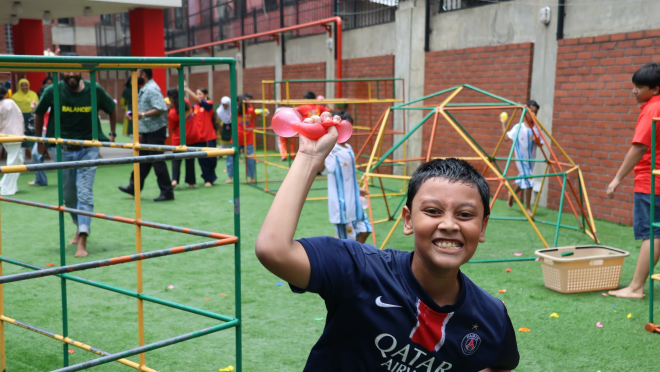
We live in a city built entirely out of grey blocks and concrete flyovers, where open space is practically a myth.
Yet, instead of letting kids breathe during their breaks, the standard parental reaction is to immediately book their kids into the next term’s coaching.
This relentless routine explains why the recent emergence of summer camps across the city has caught so many people off guard.
Suddenly, a few campuses are clearing out their desks to make room for pottery wheels, public speaking mics, origami, and sports. For a culture that has historically treated vacations as just an advance semester, this can be considered a massive shift. Schools like Bangladesh International Tutorial (BIT) and International Hope School Bangladesh (IHSB) were among the first to formalise summer programmes, but the landscape is widening.
Still, trying to introduce unstructured, creative play to a community that calculates a child’s worth solely through GPA metrics is causing some immediate friction.
To see how this cultural disconnect is playing out, I talked with a teacher at my alma mater, BIT, who is part of the operations of the upcoming summer session. It turns out that the hardest part of the job is convincing the parents to sign up rather than plan for the kids’ activities.
When asked if local families were actually excited about kids exploring non-academic skills, the educator said: “From my experience, yes, I feel that parents are still hesitant regarding activities aside from conventional academic teaching.”
This hesitation makes sense when you look at how we are raised here. In Bangladesh, academic progress has always been tied to tangible, visible proof, usually an exam paper or a certificate. If there is no test at the end of a programme, parents naturally start questioning its value.
However, the tide is turning. For the families who did take the leap, many parents noted that the experience was well beyond their expectations. Since the previous sessions were heavily tech-based, parents explicitly requested a wider variety of physical and creative outlets. The organisers listened very well, packing this year’s line-up with the very activities they asked for.
That is a classic, deeply localised critique. The default instinct of the current parental generation is to treat an extracurricular hobby exactly like a school subject. You hire a private tutor, isolate the child in their bedroom, and keep the environment completely controlled and quiet.
But a private home tutor completely misses the point. A bedroom cannot replicate the social dynamic of a shared camp, which is a big deal when you consider how incredibly isolated growing up in Dhaka has become. Most kids spend their lives bouncing between high-rises, school buses, and digital screens, with little to no opportunities for independent exploration. If some parents could, they would choose their children’s personalities to their own preferences as well.
Compounding the issue is the fact that the regular school year, with its rigid seating charts and strict discipline, is built for instruction rather than discovery.
“Hands-on learning is very crucial for learning development,” the BIT teacher emphasised. “It teaches learners how to deal with things as they would in the real world. A creative outlet is important for learning development. Learners need to learn what is outside the box instead of only focusing on what is on the inside.”
Then, they pointed out a harsh reality regarding our educational infrastructure: “It is, however, implausible to create an efficient hands-on learning environment in the current classroom structure of the schools in Dhaka city and Bangladesh.”
This is exactly where the camp format fills the gap. By completely removing uniform requirements, rigid desk layouts, and the constant threat of a bad grade, the internal chemistry of the classroom shifts. Modules like Interactive English and Public Speaking stop feeling like intimidating chores the moment the traditional academic hierarchy disappears.
“A session in a summer camp is set in a more relaxed way,” the teacher explained. “Learners are not bound by the traditional system of a classroom, no uniforms, no seating structure, less conformed. This allows the learner to be more free about what they want to say and express.”
When that structural conformity is demolished, language stops being a terrifying test where every mistake is penalised. It becomes a tool for self-expression.
Ultimately, though, the most compelling argument for these programmes serves as a necessary antidote to the intense social isolation that our hyper-competitive culture naturally breeds. In a standard classroom, students are conditioned to view their peers as rivals. In private tutoring, they are completely alone. A camp environment forces an entirely different social dynamic.
When I asked the educator what they were personally looking forward to as the upcoming session kicks off, they didn’t say a word about lesson plans or final presentations. They focused entirely on the human element.
“One of the more great achievements from a summer camp session is to see learners of different kinds come together and bond and, at the end of the session, become friends,” they shared. “Helping each other in their strengths and weaknesses. I am looking forward to seeing that, when more shy learners open up. This is overseen in most conventional classroom situations and not noticed in one-on-one learning.”
Summer camps in Bangladesh are still navigating the fine line between novelty and long-term utility. While parental scepticism and a preference for traditional, isolated tutoring remain strong, the steady growth of these programmes proves something vital. Giving children a temporary break from the concrete grid and the pressure of constant evaluation might be the only way to help them actually think outside the box.