Digital identity is becoming the infrastructure of governance
Digital identity is becoming the infrastructure of governance
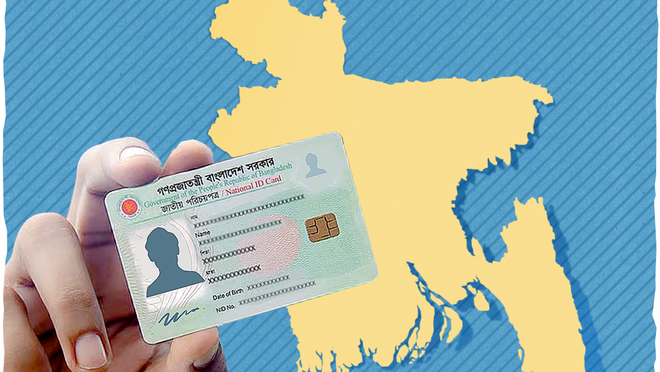
Across South Asia, digital ID systems are reshaping how people access public services, making inclusion, privacy and accountability increasingly important
Across South Asia, the way people establish and verify their identity is changing rapidly. Paper documents and face-to-face procedures remain important, but they now sit alongside digital databases, biometrics, unique identification numbers, and electronic authentication.
India’s Aadhaar, Pakistan’s National Database and Registration Authority (NADRA), and Bangladesh’s National Identity (NID) system reflect different legal foundations, institutional histories, and purposes. Yet they point the same way: identity is becoming more closely tied to public service delivery and digital government.
There are good reasons for this. Digital identification can speed up administration, reduce duplication, improve the verification of beneficiaries, and make it easier to deal with public institutions.
But something more significant is also underway: identity is becoming part of the infrastructure through which people interact with the state.
A new architecture of governance
Traditional identity systems rely on physical documents: birth certificates, passports, voter cards, and national identity cards. Digital identity adds a layer, storing and verifying identity through systems that may hold demographic records, photographs, fingerprints, iris scans, or other biometric data.
Aadhaar is perhaps the region’s best-known example. It combines a unique identification number with biometric and demographic data, and supports electronic authentication across a wide range of services. In its 2018 judgment, the Supreme Court of India examined the system in relation to privacy, biometrics, consent, data protection, and the legitimate uses of identity information.
That debate shows that digital identity is not simply paper replaced by technology. Once identity can be verified electronically, it can be linked to welfare, financial services, taxation, telecommunications, and other areas of administration. It becomes one of the underlying systems through which government works, even though most people never see the databases and software behind it.
Inclusion and its promises
One of the strongest arguments for digital identity is efficiency. South Asian countries manage very large populations and complex service delivery, where duplicate records, delays, and fragmented databases make it hard to confirm who the beneficiaries are.
In India, Aadhaar is widely used to authenticate identity for public and private services. Pakistan’s NADRA maintains a national identity database that supports banking, telecommunications, social protection, and e-governance, and is expanding through PakID, digital credentials, and interoperable verification services.
Bangladesh has taken its own path. The Election Commission’s NID infrastructure offers online services, correction mechanisms, and smart cards nationwide, and has grown beyond voter identification into the wider digital public-service environment.
For individuals, the benefits can be real: easier access to services and banks, and proof of identity without repeatedly producing several documents. For people who have struggled to enter formal administrative systems, it can offer meaningful recognition.
But inclusion cannot be measured by whether a name appears in a database. The more important question is whether the system works for the person when they need it.
When inclusion creates new barriers
Digital identity depends on far more than technology: electricity, connectivity, working equipment, accurate records, accessible enrolment, trained staff, and effective ways to correct mistakes. When these work, verification simplifies life. When they do not, the same system becomes an obstacle.
A person may be legally entitled to a benefit yet unable to claim it because data was entered incorrectly, biometric authentication failed, connectivity was poor, or they did not know how to navigate the process. People in remote areas, older people, persons with disabilities, those with limited digital literacy, and those whose biometrics are hard to capture may face particular barriers.
This does not make digital identity inherently exclusionary. It shows that existing inequalities can be reproduced digitally unless safeguards are built in: accessible assistance, clear grievance and appeal mechanisms, alternative ways of verifying identity, and officials who can intervene when the system fails.
Privacy, data protection, and trust
Large identity databases hold highly sensitive information, including biometrics that cannot be replaced the way a password can. Governance therefore matters greatly.
As of 2026, India operates under its Digital Personal Data Protection framework, including the Rules adopted in 2025. Bangladesh enacted its Personal Data Protection Act in 2026. Pakistan is still developing a comprehensive framework while NADRA’s infrastructure expands.
These laws matter because the more closely identity systems connect to other services, the more pressing questions of access, sharing, purpose, retention, correction, and accountability become. Integration brings convenience, but also complexity.
It would be simplistic to assume that centralised digital identity automatically leads to surveillance or misuse. A more useful question is whether meaningful safeguards exist. Who can access personal information, and under what legal authority? For what purpose? Can people correct inaccurate data? What remedies exist if data is misused? Is there effective oversight?
Trust depends not only on what the technology can do, but on whether people understand how their information is handled and whether institutions remain accountable.
Identity, eligibility, and administrative power
Perhaps the most important distinction in this debate is between identity and eligibility. An identity system answers one question: who is this person? Public institutions must often answer another: what is this person entitled to?
Holding a digital identity does not itself create citizenship, legal status, benefits, or rights. Those come from laws, policies, and institutional decisions. In practice, though, the two become closely linked. Where access to a service requires successful authentication, the identity system may not decide whether someone has a right to the service, but it can determine whether they can reach it.
For the person at the service counter, the legal distinction offers little comfort: if the system cannot verify them, the service is unavailable.
People outside formal identity systems deserve attention too. Stateless persons, undocumented populations, and others who cannot easily establish a recognised legal identity face a different problem: not failed authentication, but difficulty entering the system at all.
South Asia as a comparative space
India, Pakistan, and Bangladesh have not created a common model. Aadhaar is not NADRA, and Bangladesh’s NID developed in a different institutional and legal context. Comparison is still useful, because each country faces the same questions: how to establish identity at scale, integrate services, reduce duplication, and balance efficiency with privacy and accessibility.
The differences may prove as revealing as the similarities. How does each system handle errors and failed authentication? How transparent is data sharing? How easily can people correct records or challenge an administrative decision? These questions say more than asking whether a country has adopted a digital ID programme.
From technical systems to public institutions
These systems are not only technological platforms; they are public institutions. Their design shapes how people experience government and how easily mistakes are corrected. A technically advanced system can still fail people if there is no practical way to correct a record, appeal a decision, or reach a human official.
Successful digital identity therefore requires transparency, human oversight, legal safeguards, and workable alternatives when technology fails. Governance may ultimately matter as much as technology.
The human side of digital governance
Digital identity is easily discussed in technical terms: authentication, interoperability, platforms, biometrics. People experience it far more immediately. For an institution, a failed authentication is a technical exception. For a person, it may mean a delayed payment, an incomplete registration, or lost access to an important service.
Efficiency matters, but it cannot be the only measure of success. A good identity system should be understandable, accessible, correctable, and fair. People should be able to know what information is held about them, correct mistakes without unreasonable difficulty, and use another route when technology does not work.
The strongest systems will perhaps be those that accept from the outset that technology will sometimes fail, and build humane alternatives into their design.
The road ahead
Digital identity will likely grow in importance as South Asian countries expand digital public services. The benefits are considerable: better service delivery, less duplication, stronger financial inclusion, and easier dealings with public institutions. But greater dependence brings new responsibilities. When access to services hinges on successful authentication, errors can have consequences far beyond inconvenience.
The challenge is to treat digital identity neither as an automatic solution to exclusion nor as inherently a tool of state control, but to examine the conditions under which it operates. Can people correct mistakes? Are alternatives available when authentication fails? Are personal data protected? Can decisions be challenged?
Ultimately, the central issue is not whether digital identity works, but how it works, for whom, and what safeguards exist when it does not. As identity becomes part of the infrastructure of governance, its legitimacy will depend not only on technological efficiency but on whether it strengthens inclusion, accountability, fairness, and trust.
Mobassherul Alam is a humanitarian and protection professional with extensive experience in refugee protection, displacement, and community-based programming.
Disclaimer : The views and opinions expressed in this article are those of the authors and do not necessarily reflect the opinions and views of The Business Standard.