Give them flowers, then what?
Every year on 5 October, the world honours our teachers with garlands, snaps a group picture, and declares it Teachers’ Day, a lovely gesture indeed. But in some cases in our country, the same hand that took the flower then takes up the cane again the next day.
Give them flowers, then what?
Every year on 5 October, the world honours our teachers with garlands, snaps a group picture, and declares it Teachers’ Day, a lovely gesture indeed. But in some cases in our country, the same hand that took the flower then takes up the cane again the next day.
After Unesco established actual guidelines for teacher training and treatment in 1966, World Teachers’ Day was established in 1994. For whatever reason, we lost the reform entirely while keeping the roses. That is why I want to highlight a conversation that will surely get sidelined on a day we’re supposed to celebrate our teachers, a conversation far too uncomfortable, but nonetheless a necessary one to have openly.
Let’s discuss the word, strict. “Strict” is essentially a compliment that parents give a teacher in Bangladesh.
“Oh, Sir is very strict.”
Strict is now a mask. If you hit a youngster hard enough (not just physically, but mentally as well), it will still be referred to as ensuring discipline. Someone might still refer to humiliating a child in front of the entire class as motivation. We don’t call it what it is, which is simply cruelty standing in front of a blackboard.
Consider the actual environment inside a classroom. When a boy makes a single mistake in his multiplication table, a scale is slapped across his palm, causing an hour-long sting. When a girl forgets her homework merely once, she is forced to stand outside the classroom door in front of every student who passes by for the duration of the class session.
When a child asks a sincere question, they are reprimanded for “wasting time,” as if curiosity was the offence rather than the lesson that was never taught correctly in the first place. This is not a terrible school. Any Bangladeshi, regardless of location or age, can quickly come up with a story similar to this. That should scare us. It doesn’t, because we’ve normalised it into a joke we tell at reunions.
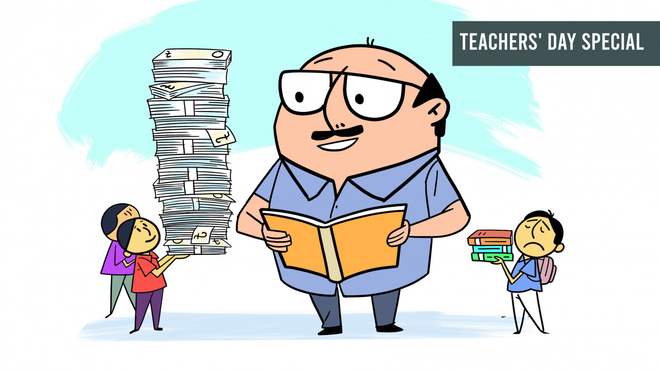
Here’s the stricter trick, though, the one that really stings. Some teachers don’t finish the chapter. Not by chance. Intentionally. Conveniently, the “real” explanation takes place that evening in the same teacher’s house during the paid private tutoring sessions. Parents pay it quietly because what choice do they have? Their child’s whole year depends on it. You can refer to this as strict as well, but the term “business model built on holding education hostage” would be more accurate.
And who gets protected from all this strictness? Usually the same front-bench students whose parents already know the teacher, know when to send gifts at the right time, casually getting smiled at in the hallway. The back-bench kid with the torn school bag and the wrong accent gets the ruler. The front-bench kid with the right surname gets a pat on the head. Call that whatever you like, it isn’t a made-up scenario. All of it is favouritism wearing a school uniform.
None of this means every teacher is cruel. A lot of them aren’t. Some stayed back after class for free, just to help a slow kid catch up. Some noticed when a quiet student stopped talking and actually asked why, instead of assuming laziness. Those teachers deserve real respect, not just once a year.
But good teachers existing doesn’t erase the bad habits the system keeps protecting. It just proves the system can be better, and currently chooses not to be.
So if we’re serious about this day, let’s quit pretending “appreciation” and celebrations do anything. Prohibit physical punishment in practice, not only in theory. Enough money should be paid to teachers so they won’t have to hold lessons hostage in exchange for tuition. Before putting them in a classroom full of kids, provide them with the required training. Penalise those who breach the line rather than simply moving them to another school to repeat the offence.
Give flowers to the good instructors; they deserve it. However, we haven’t honoured anyone if the ritual ends there. We merely gave out roses and put the same terrified children back into the same terrible classroom tomorrow.