How Bangladesh went from 3 points to 6 medals at the international math olympiad
A programme that once struggled for want of olympiad-style training now finds students gravitating towards the very subjects that once seemed beyond its reach, growing around the Bangladesh Mathematical Olympiad and the people and organisations that have kept it going
How Bangladesh went from 3 points to 6 medals at the international math olympiad
A programme that once struggled for want of olympiad-style training now finds students gravitating towards the very subjects that once seemed beyond its reach, growing around the Bangladesh Mathematical Olympiad and the people and organisations that have kept it going
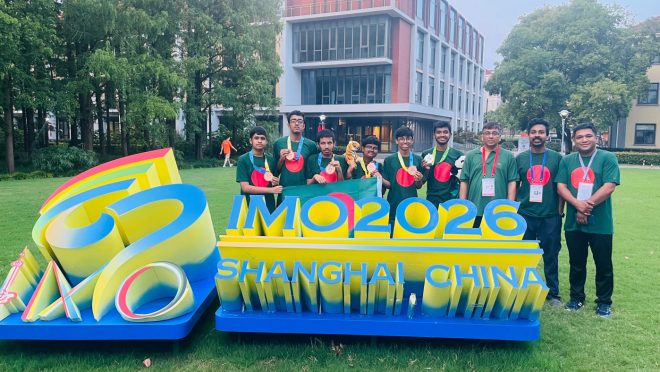
When six Bangladeshi teenagers walked into Shanghai High School on 15 July, they were entering a room filled with some of the sharpest young mathematical minds in the world.
Md Raihan Siddiquee, Monamy Zaman, Jawad Hameem Chowdhury, M Zamiul Hossain, Mohammed Marzuq Rahman and Tahsin Khan were among 666 contestants from 117 countries and regions gathered for the 67th International Mathematical Olympiad.
The olympiad had kicked off a day earlier, on 14 July, with a ceremony at the West Bund International Convention and Exhibition Center in Shanghai. Then came the real test: across two days, the contestants faced nine hours of examinations and six problems spanning number theory, geometry, algebra, and combinatorics.
These were not problems with familiar classroom formulas to fall back on. They required patience, imagination and the ability to stay with a problem long after the obvious approaches had failed.
When the results came, all six had something to show for it: Raihan Siddiquee won silver; the other five won bronze. Together, they scored 121 points and placed Bangladesh 39th among 117 countries and regions — the country’s highest team score and its strongest overall performance in the olympiad’s history.
But this achievement was part of a much longer journey. This year, 51,532 students registered for the online selection round for the olympiad. Those who qualified moved through Regional Mathematics Festivals in 12 cities, narrowing the field to 1,200 students at the National Mathematics Festival in Dhaka. From there, 87 advanced to a 40-student National Mathematics Camp. After the camp and the final selection test, six remained.
By the time they arrived in Shanghai, the six had already made it through one of the country’s most demanding selection pipelines. But Bangladesh’s journey to this point began much earlier, with a far smaller pool of students and a much harder road.
Where it started
Rewind to 2005. Bangladesh was appearing at the International Mathematical Olympiad for the first time. The result was three points out of 252, ranking 85th among 91 participating countries.
“Solving one problem gets you seven points. One student might have gotten one point, another got two, and I think everyone else got zero,” said Mahbubul Alam Majumdar, who has been leading Bangladesh’s International Mathematical Olympiad team since 2006. “This year, every single team member got a medal. You can see the difference.”
The early result was hardly surprising. Bangladesh was only beginning to build an Olympiad culture, and the mathematics demanded at the IMO was unlike what students encountered in school and college. The country had traditionally been stronger in geometry, partly because it was the kind of mathematics students were most familiar with through the regular curriculum. Number theory and combinatorics, by contrast, were relatively unexplored territory.
That began to change around 2014. As more students started training for Olympiads, they were exposed to a wider range of problems and began venturing beyond mathematics from the specific curriculum.
“Now we’re good at everything. In fact, our geometry skills have actually declined a bit, because people are less focused on it now,” Mahbub said, with a touch of sarcasm. “They find it a little boring compared to combinatorics and number theory, which are, frankly, very beautiful subjects. That’s modern mathematics.”
A programme that once struggled for want of olympiad-style training now finds its students gravitating towards the very subjects that once seemed beyond its reach. The change did not come from a large national system of specialised training. It grew instead around the Bangladesh Mathematical Olympiad and the people and organisations that kept it going.
Dutch-Bangla Bank became the programme’s long-term financial sponsor while Prothom Alo provided management and logistical support. Much of the coaching, training and organising, however, has remained volunteer-driven.
“Now we have a large group of alumni outside Bangladesh, people from MIT, Harvard, Stanford. That whole community helps out when they have time. We have built a real community, and they do extraordinary things.”
According to Mahbub, volunteering, passion and exceptionally talented students brought Bangladesh this far. The results show a journey that was anything but linear.
After the three points Bangladesh scored in its first international olympiad appearance in 2005, the team gradually began to find its footing, crossing 60 points in 2009 and 100 in 2015. It reached 112 points in 2016 and 114 in 2018 — the year Bangladesh won its first-ever IMO gold medal.
The years since have been less predictable. Bangladesh scored 118 points in 2020, then dropped to 68 the following year, before returning above 100 in 2022 and 2023. After another dip to 83 in 2024, the team recovered to 113 in 2025.
Then came 2026. All six members of the national team won medals and scored its highest total in the history of the competition. The numbers trace not a smooth rise, but a programme that kept finding its way back up.
For Mahbub, however, the credit belongs to the students.
“India has 1.5 billion people, so it doesn’t really count as a fair comparison. We’ve won a gold medal. Pakistan has never won a gold medal. Sri Lanka, Bhutan, Myanmar — none of them have. This year we even beat Indonesia, which usually beats us, and Indonesia is a much richer country. Among all the countries classified as developing countries, we are the top-performing one.” Mahbubul Alam Majumdar, National Coach, Bangladesh Mathematical Olympiad Team and Dean, School of Data and Computational Sciences, BRAC University
“What we and the organisation try to do is simply not create barriers for them. We encourage them, give them materials, give them opportunities.”
Those opportunities include the national olympiad and training camps, as well as sending students abroad for intensive preparation. This year, the team spent nearly three weeks in China for mathematics summer camp. But much of what comes after, Mahbub believes, cannot be taught by any coach or classroom. The students learn from one another.
For this year’s bronze medallist Marzuq Rahman, the national camp was where the possibilities first became clearer — what to practise, how to practise and how to make use of the resources available to them. Much of that learning continues outside the camp. Alongside regular schoolwork, the students solve problems together online, often teaching one another in the process.
The Beijing camp offered another kind of preparation. “The mock tests were especially useful, as were the exams and other activities,” Marzuq says.
That kind of peer learning has had to fill some of the gaps left by Bangladesh’s limited formal infrastructure for mathematics training. Bangladesh does not yet have the kind of specialised, institutionalised training systems that exist in some of the region’s stronger olympiad countries.
“Asian countries — China, Singapore, Korea, Taiwan — have special training, special programmes for talented students. We don’t have that,” says Mahbub. “Given the manpower shortage, we can’t pay people. Everything is volunteer-based.”
And yet, that loose network has produced a remarkable result.
That is what makes the 2026 result striking. Bangladesh has managed to compete and, at times, outperform countries with considerably larger and more formal mathematics programmes, despite having far fewer resources behind its own. Its rise has been built less on a national system than on a network of organisers, volunteers, alumni and, increasingly, students who teach one another.
How Bangladesh stacks up against competitors
Put Bangladesh next to its neighbours, and the scale of the achievement becomes clearer.
India, for instance, has almost the same GDP per capita as Bangladesh — $2,702 against roughly $2,600 in 2025, yet its Olympiad record is on another scale: 25 gold, 80 silver and 80 bronze medals. Its Olympiad pipeline runs through the Homi Bhabha Centre for Science Education, backed by the National Board for Higher Mathematics under the Department of Atomic Energy.
For Mahbub, though, India’s enormous population makes the comparison imperfect. “India has 1.5 billion people, so it doesn’t really count as a fair comparison,” he says. “We’ve won a gold medal. Pakistan has never won a gold medal. Sri Lanka, Bhutan, Myanmar — none of them have. This year we even beat Indonesia, which usually beats us, and Indonesia is a much richer country. Among all the countries classified as developing countries, we are the top-performing one.”
Pakistan makes the comparison more interesting. Despite a lower GDP per capita than Bangladesh, it has a formal, state-backed olympiad pipeline through the Higher Education Commission’s STEM Careers Programme and the Pakistan Institute of Engineering and Applied Science. Yet its IMO record stands at 0 gold, 2 silver and 11 bronze medals.
The comparisons also need to be read against time. Bangladesh has been competing at the IMO since 2005. India began in 1989 and Vietnam in 1974, giving both countries decades more for their training systems and mathematical communities to develop.
Vietnam’s trajectory shows what that kind of time can build. With a GDP per capita of around $4,800, it has accumulated 73 gold, 123 silver and 87 bronze medals across five decades of participation. Its system is built in part around state-run High Schools for the Gifted. At the 2026 IMO, Vietnam ranked fifth out of 117 countries, with all six team members winning medals, including two golds.
Against countries with longer histories, deeper institutional structures or both, Bangladesh’s record looks striking not because it has matched their resources, but because of how far a comparatively young, largely volunteer-driven programme has managed to come.

Raihan Siddiquee wins Silver at the International Mathematical Olympiad.
Beyond the financial and institutional barriers
The lack of structure is felt most sharply by the students themselves. The obstacles begin long before an IMO team is selected — in classrooms where Olympiad mathematics can be seen as a distraction from board exams, and at home, where not every student gets the same freedom to participate.
“Schools and colleges generally don’t appreciate Math Olympiad,” Mahbub says. “Most teachers don’t like their students participating in these kinds of activities. Maybe because they want them focused on HSC or SSC exams instead.”
For Marzuq Rahman, there is another problem: many students and teachers simply do not know what the Olympiad is asking of them. Its problems require a different way of thinking from those found in academic examinations, and that difference can be enough to keep talented students from trying.
“It is important to be clear about the kind of questions asked and how they differ from academic questions. Many of our good students don’t understand this concept, so they don’t even try,” he says.
For girls, the barriers can begin at home. Monamy Zaman, the only girl on this year’s team, said she did not personally face difficulties participating, but she had seen other girls kept away from residential camps because their families were uncomfortable sending them.
“I think it would have been nice to have more girls. I personally didn’t face any problems, but I’ve seen some girls whose families don’t want them to attend these camps,” she says.
Mahbub sees the girls’ Olympiad as one way of widening that path. Bangladesh’s participation in the European Girls’ Mathematical Olympiad has given girls a space of their own to train, compete and travel for mathematics. “Our girls started to get more focus,” he says. That has also helped bring more girls into the national Olympiad pipeline and, eventually, into contention for the national team. For Mahbub, the separate stream is a way to address the barriers that girls face in countries such as Bangladesh; barriers that can keep them from reaching the national team in the first place.
For the medallists, the experience has also changed how they approach problems beyond mathematics. Some now see themselves studying computer science, mathematics and other fields where the habits they built through the Olympiad may follow them.
For Mahbub, the value of the Olympiad is not measured only in medals. It has also created a culture around mathematics – one built on sharing rather than keeping knowledge to oneself.
“Olympiad maths are not speed problems. These are problems that are enormously difficult, but our students are so talented they can solve them,” Mahbub says. Yet what distinguishes them, he believes, goes beyond talent. “Our students are humble people. As they volunteer for the Math Olympiad, their mindset is to help other people..”
On the global stage, Mahbub says, Bangladesh is demonstrating not only that its students can solve some of the world’s hardest mathematics problems, but that brilliance can come with a willingness to help others.
For now, the medallists are still teenagers who spent much of the year solving problems together, travelling for camps and learning from one another. Their medals have added a new line to Bangladesh’s IMO history. But perhaps their bigger legacy will be what happens beyond the scoreboard: a generation of students who make mathematics feel less like a school subject and more like a shared pursuit – something to be curious about, to love, and to pass on.