How the ice-cream conquered the world
Long before anyone thought to call it dessert, ice was power. In the sweltering courts of ancient China, Persia, and Rome, nothing announced a ruler’s dominion over nature quite like serving something frozen in the dead of summer.
How the ice-cream conquered the world
Long before anyone thought to call it dessert, ice was power. In the sweltering courts of ancient China, Persia, and Rome, nothing announced a ruler’s dominion over nature quite like serving something frozen in the dead of summer.

Legend holds that the Chinese emperor Tang of Shang kept a corps of ice harvesters cutting blocks from frozen rivers, stored deep underground in insulated pits so the cold could survive the punishing heat of the months ahead. In Persia, sherbet-like concoctions of fruit syrups chilled with mountain snow were poured for royalty who never once had to ask how the impossible had been arranged.
And in Rome, historians tell us Emperor Nero dispatched runners into the Apennine Mountains to fetch snow, which servants then flavoured with honey and wine, a dessert so labour-intensive that a single bowl represented an entire relay of human effort, sweat traded for someone else’s sweetness. To offer a guest frozen fruit in July wasn’t hospitality. It was a demonstration of command over geography itself, proof that even the seasons bent to imperial will.
For centuries afterward, that basic equation held: ice was a luxury only the powerful could summon on demand, and frozen desserts stayed locked behind palace walls. As the concept drifted west into Europe, it arrived wrapped in secrecy and rumour. Popular legend credits Catherine de’ Medici with carrying Italian ice recipes to the French court when she married into royalty in the sixteenth century, and later, England’s Charles I reportedly guarded his own frozen cream so jealously that he is said to have paid his chef a handsome pension purely to keep the recipe out of common hands. Whether or not these particular tales survive strict historical scrutiny, they capture something true about the era: recipes for frozen desserts were treated less like cooking instructions and more like state secrets, hoarded the way a kingdom might hoard gold.
What finally cracked that vault wasn’t a chef at all… it was chemistry. Someone, somewhere in the 1500s or 1600s, made the discovery that would reshape the entire future of dessert: pack ice with salt, and something remarkable happens. The salt lowers the temperature at which the surrounding ice-water mixture freezes, pulling heat out of whatever sits inside it far faster and far colder than plain ice ever could. Suddenly, cooks weren’t just chilling cream; they were freezing it solid, transforming liquid into something with body, texture, a spoonable resistance. That single insight, salt plus ice equals genuine freezing power, is the quiet scientific hinge on which the entire history of ice cream turns. Everything indulgent and creamy that came after, the churned custards, the smooth sorbets, the dense royal confections, became possible only because someone figured out how to cheat winter into existence on command.
Ice cream might have stayed a rich man’s parlour trick indefinitely if not for a wave of nineteenth-century tinkerers who cared less about impressing kings and more about getting dessert into ordinary hands. In 1843, an American woman named Nancy Johnson patented the hand-cranked ice cream churn, a deceptively simple wooden bucket-and-paddle contraption that let anyone with strong arms and a little patience make a batch at home, no palace kitchen required. It was the kind of invention that quietly rewires an entire culture: what had been the exclusive province of aristocrats and their overworked chefs was now within reach of a farmhouse kitchen table.
The streets did the rest. Across industrialising cities in Britain and America, working-class vendors began pushing carts through crowded, coal-smoked neighbourhoods, selling penny-sized scoops to factory workers and street children who had never tasted anything so cold or so sweet in their lives. In Britain, these hawkers became known as “hokey pokey men”, their sing-song cries turning frozen cream into a genuine street phenomenon… cheap, immediate, communal joy sold by the scoop to people who had spent their whole lives being told luxury wasn’t meant for them.
Then came the accident that finished the democratisation the hokey pokey men had started. At the 1904 World’s Fair in St. Louis, the story goes, an ice cream vendor ran out of paper cups in the middle of a blistering rush, and a nearby waffle-stand owner, thinking fast, rolled one of his thin waffles into a cone and handed it over as an improvised dish. The crowd loved it. Suddenly, ice cream wasn’t just something you ate with a spoon while seated; rather, it was something you could hold, walk with, chase down a street with, an edible vessel that turned dessert into pure portable delight.
From there, the story simply widened. Refrigeration replaced ice houses, factories replaced hand cranks, and flavours multiplied into the hundreds. But strip away the freezers and the fancy toppings, and ice cream’s real history is a very human one: a story of rulers who wanted to prove they controlled even the weather, scientists who cracked a simple trick of salt and ice, and ordinary people who, scoop by hard-won scoop, insisted that something this good belonged to everyone, not just to kings.
Bonus information: There’s an ice cream fest going on in Unimart until 21 July! You can go and check it out as well!
We need all the heavy eaters at the forefront.
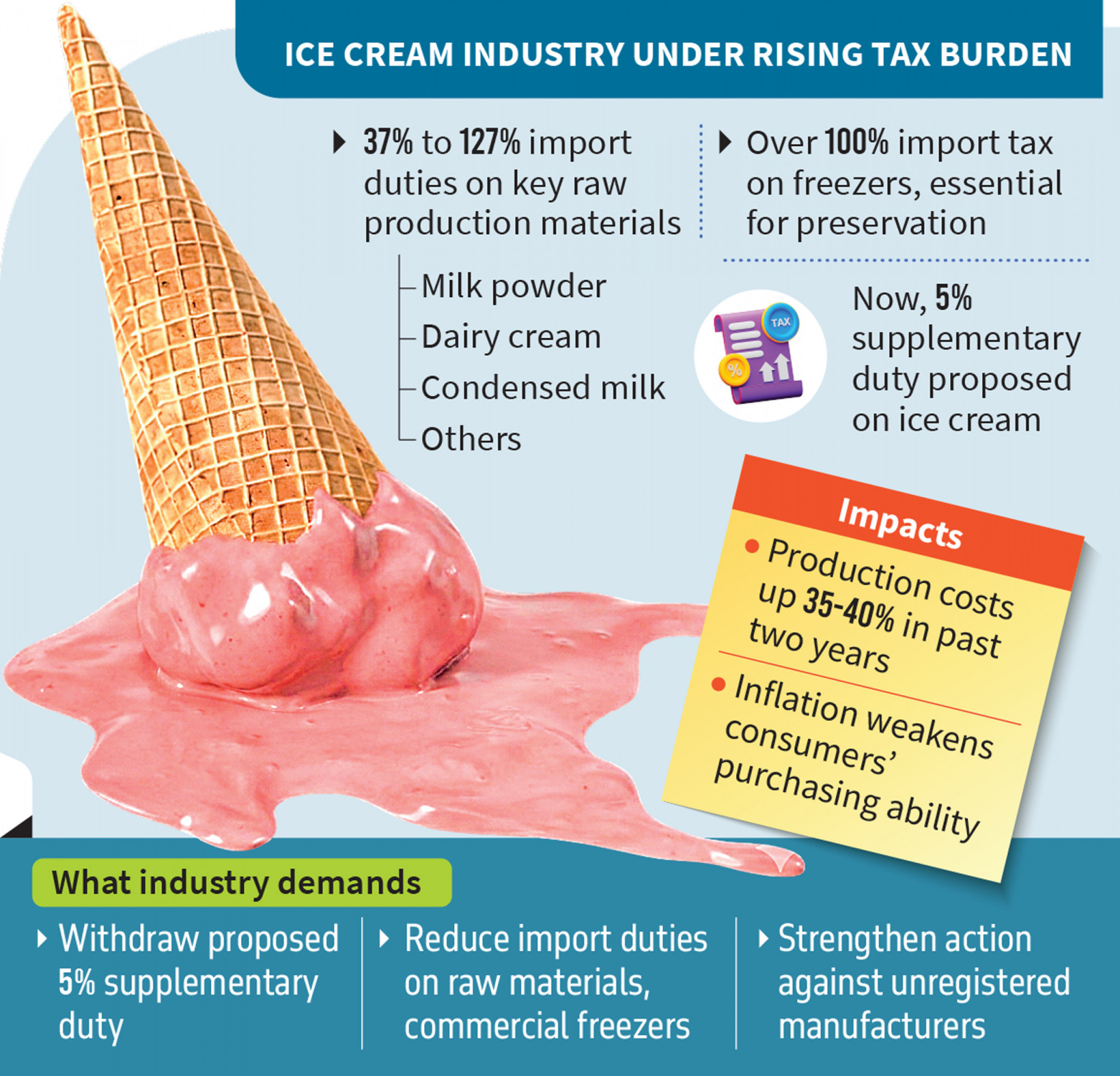
Recently Bangladesh is experiences a tough time when it comes to enjoying to oozing delicacy. The Bangladesh Ice Cream Manufacturers’ Owners Association recently urged the finance ministry to withdraw the proposed 5% supplementary duty on ice cream, saying the measure would further strain an industry already grappling with rising costs.
According to the association, around 70% of the country’s ice cream market is controlled by small, largely informal producers that often do not pay VAT or fully comply with food safety standards.
“Our members pay VAT, import duties and regulatory costs, while many informal producers operate at much lower expenses and sell at cheaper prices,” said association president Niaz Ahmed to TBS. “This uneven tax structure discourages investment, weakens compliant businesses and ultimately reduces government revenue.”
Kamrul Hasan, chief executive officer of Igloo, said the company’s sales have remained largely flat over the past two years.
“Global raw material prices have increased by 15-20%, while local taxes and operating costs have risen sharply. At the same time, inflation has weakened consumers’ purchasing power,” he said.
Kamrul called for separate harmonised system codes for ice cream machinery and raw materials, along with lower import duties to improve the industry’s competitiveness.
Shah Masud Imam, chief operating officer of Polar Ice Cream, said ice cream should not be treated as a luxury product.
“It is fundamentally a dairy product with nutritional value. Given the high cost of maintaining food safety standards, the supplementary duty should be reconsidered,” he said.
Infograph: TBS