I thought Economics was simple, then it got personal
It happens every so often that one thinks of an idea and it seems so original that you start to believe you might just be a genius, only to find that the idea has been around for the last two hundred years.
I thought Economics was simple, then it got personal
It happens every so often that one thinks of an idea and it seems so original that you start to believe you might just be a genius, only to find that the idea has been around for the last two hundred years.
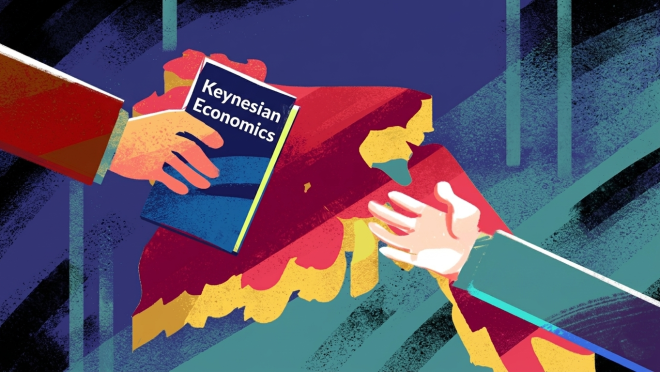
The reality of being late is harsh, but a silver lining is that you probably were on the right path of thinking. When I was first introduced to Keynesian economics, it often felt that the notion was simply ‘spend, and watch the economy flourish’.
Stretching the intuition, if only spending was what actually ran the economy, certain calamities should be considered as economic policies since they do bring upon spending.
Rationally it made no sense, and some further courses later I realised that Keynes was perhaps right about spending and creating progress. While my guts told me that Keynes might be wrong, I never figured why it was so.
“It is an ill wind that blows nobody any good”, the saying was a central piece around which French economist Frederic Bastiat wrote his famous 1850 essay titled ‘That Which Is Seen, and That Which Is Not Seen’.
The idea was that people have always looked for a silver lining amidst adversities, especially economic ones. If one were to consider the first idea as true, then breaking one’s own windows would serve to be a masterstroke. When you break a window, the glazier (the glassworker) fixes the window and charges money, that money is then spent by the glazier to buy clothes, the tailor then spends it on food and so on.
It is perceivable that the damage does actually create more income throughout the economy, leading to the eventual conclusion, at least for me, that indeed certain misfortunes cannot be as bad as it seems.
However, Bastiat argued that this was the part of the economic activity that was ‘seen’ and the unseen part is what actually mattered more. When the window breaks, the individual pays the glazier his fee. While it does seem that the economy is showing more transactions, it is simply just a short-term stimulus that prompts the owner of the glass to spend on fixing the glass.
In reality, had the owner been given some time, he himself would have spent the money on clothes, then on food, and so on. Both scenarios lead to creation of income across the economy, but in the latter the economy sees all of that income and an extra piece of window. The cost of creating growth by breaking a glass is, ironically, the cost of a glass. In this case, the destruction of resources only reaps an eventual misery.
Whenever disasters or wars hit, the idea of rebuilding the economy is always in the air. The public has a general positive feeling about the economy returning back to where it was, but even after reparations and stimulus packages, does the economy ever really return to how it was?
Bastiat would argue that it does not, as the costs of damage still make society poorer, but what fundamentally matters is not what is lost, but what is used to replace the loss.
While Bastiat refuted the idea of destruction, Austrian economist Joseph Schumpeter took the idea of destruction and created a special classification for it.
He said that ‘creative destruction’ was the engine that fuels capitalistic societies, replacing the old with the new. They did not disagree on the fact that ‘destructive’ destruction was inherently bad, but Schumpeter’s classification emphasised that endogenous innovation was to be welcomed, and exogenous calamities were to be ruled out.
But one wonders what actually makes an economic destruction ‘creative’? It is simply when innovation drives out outdated, now inefficient industries out of the economy, replacing them with newer ones.
While the older industry is destroyed, the one built on its ruins is more often than not a thriving reality. I think of a time when I was a six-year-old and my father would buy me movie cassettes to play on our house DVD.
Those DVDs are a distant memory. But it is not that people have stopped watching films, but online streaming has meant that rather than buying a DVD and then a cassette for just a single movie, people stream collections of films in a single place.
At its surface, it seems to be a zero-sum game where one industry dies to give birth to another, but on a larger lens it is anything but. When Netflix provides an endless bundle of entertainment for a single payment, the per unit cost of entertainment for a viewer is much lower for the same bundle if he had paid for it during the DVD era. That lower cost makes people wealthier, and hence society.
If one was to imagine capitalism as this vehicle of progress, the wheels would include this very cycle of bust and boom. When one end of the wheel goes down, the other goes up; those uneven internal dips and rises push the car forward despite instability.
In essence, the argument on how we interpret destruction in its economic sense has always been obvious. It can easily be deduced by the rational mind that both Bastiat and Schumpeter were right in their own worlds, but Schumpeter’s classifications about it give us a different perspective on how we see the end of industries when their demise comes through innovation and not unbounded reckless breaking of glass windows.

Bhuiyan Mohammad Siyam is a student at North South University in the Economics Department. He is the winner of the Admission Test Writeup Contest in 2025. His interests range from sports, economics, cinema to fiction and more.