PEDP-5: Big budget, unequal priorities
PEDP-5: Big budget, unequal priorities
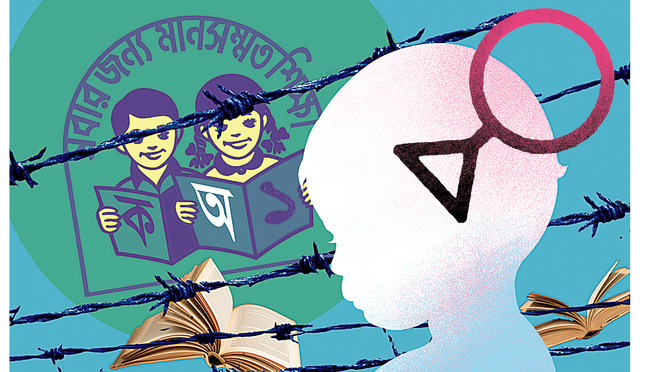
The Government of Bangladesh has approved its Fifth Primary Education Development Program (PEDP-5), with an estimated budget of Tk41,090 crore. Following the previous four phases, PEDP-5 was approved by the Executive Committee of the National Economic Council (ECNEC) on 4 November 2026, and it is expected to run from July 2026 to June 2031.
PEDP-5 aims to improve primary education through infrastructure development, teacher training, digital learning and student welfare programmes across the country. Additionally, PEDP-5 introduced its flagship initiatives called “One Child, One Tree” and “One Teacher, One Tab”.
The major share of the PEDP-5 budget goes to infrastructure, uniforms and digital tools. Around 26.4 percent of the funds will go towards building 15,641 need-based classrooms, 1,500 wash blocks and 10,000 boundary walls. These changes are definitely necessary, but Bangladesh is not one single picture when it comes to primary education. There are considerable differences between urban, rural and remote areas.
People in urban areas are mostly privileged and have access to good facilities compared to those in rural and remote areas.
Remote areas are the ones we hardly talk about, and in my view, those schools do not need digital screens and tablets right now; they need better teachers and facilities. The same can be said for rural areas that are somewhere in between.
These three areas clearly need specific programmes and diverse investments when it comes to addressing core issues.
From PEDP-1 to PEDP-5, I think the one thing constantly missing is this distinction. Just as private and government schools do not need the same upgrades, urban, rural and remote schools need different kinds of upgrades.
Take “One Teacher, One Tab”, for example. About 20,000 government primary schools will get multimedia classrooms with interactive flat panels, Wi-Fi and internet, and teachers will receive tablets, with Tk1,183.46 crore proposed for these devices, panels and ICT equipment for field offices.
It sounds great only if the programme were meant for urban schools alone. When we talk about Bangladesh as a whole, we need to understand that there are areas where neither electricity nor network is steady. What would a teacher do with a tablet there? Before giving every teacher a tab, it is necessary to comprehend the infrastructure and capability of both students and teachers in those areas.
The base of primary education in Bangladesh is not yet strong, and the main reason is that we fail to identify the needs of rural and remote areas.
According to the Directorate of Primary Education (DPE), 684 of the 1,738 government primary schools in the three hill districts still have no electricity. Where 684 schools don’t even have power, what will a teacher do with a tablet? What will students do with a multimedia classroom?
Before we talk about digital classrooms, we need to ask whether the basics, like electricity, qualified teachers and a stable connection, have reached these schools at all. A programme that cannot answer this will keep widening the gap between urban, rural and remote Bangladesh, no matter how big its budget is.
The same goes for uniforms. About Tk10,065.21 crore is set aside for uniforms, bags, shoes and socks, while training for teachers and officials gets approximately Tk3,100 crore.
Accessories are important, but the discrepancy between the allocation for uniforms and training in PEDP-5 almost acts as if Bangladesh were a developed country whose only gap is accessories.
For a country like ours, educating people should be the bigger priority. Primary dropout rose from 13.15 percent in 2023 to 16.25 percent in 2024, even with free textbooks and stipends already in place. The DPE report links this to inflation-driven financial pressure and children entering the labour market early, while other reports add child marriage, natural disasters, difficulty reaching school, declining quality of education, reduced interest in learning and parental disinterest.
While uniforms and accessories can ease some of that cost, most of these causes sit outside a bag or a pair of shoes.
Another issue arises when it comes to training: it can only help when there are teachers to train. Across 65,567 government primary schools, 36,235 headteacher posts are vacant, and 12,935 schools have four or fewer teachers, with 133 of them having only one. An entire school with just one teacher!
In order to actually educate, we first need enough teachers, and definitely more than 7.6 percent of Tk3,100 crore of the entire budget to train them.
The World Bank has approved $300 million to support PEDP-5, with training for teachers and headteachers, lesson plans and remedial learning for lagging districts. This is a welcome step, and the World Bank itself says around 50 percent of 10-year-olds in Bangladesh cannot read a simple text.
Therefore, recruiting teachers and training them should definitely be among the most serious initiatives of the entire project plan.
PEDP so far
PEDP started back in 1998, and since then five phases have been introduced, each focused on expanding access, improving enrolment, developing teachers, strengthening infrastructure and raising the quality of education. These programmes undoubtedly helped increase enrolment, improve school facilities and promote gender parity, but they struggled to ensure consistent learning outcomes and to reduce the gap between urban, rural and remote schools.
Out of the total proposed cost, Tk33,203.2 crore will come from government funds, while Tk7,887.3 crore will be sourced from foreign loans and grants.
As far as digital tools are concerned, in urban areas where the basic needs are already met, “One Teacher, One Tab” and multimedia classrooms are a welcome step. But for the areas where even the basics are not fulfilled, PEDP must create another flagship initiative.
Three distinct initiatives, each crafted for urban, rural and remote areas, could be a way out.
Understanding that gap and providing a development plan for all three is exceptionally necessary.
The views and opinions expressed in this article are those of the author and do not necessarily reflect the opinions and views of The Business Standard and TBS Graduates