Where do children go when society breaks down?
Bangladesh is not facing only a legal crisis; the deeper rupture lies in its social, moral, and protective foundations.
Where do children go when society breaks down?
Bangladesh is not facing only a legal crisis; the deeper rupture lies in its social, moral, and protective foundations.
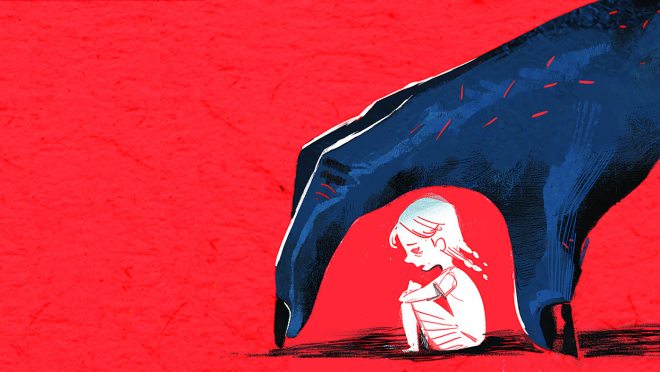
A farmer may sow the best seeds, water the field on time, and wait for harvest with hope. But if the land itself has turned toxic, what can grow there?
A society is also cultivated. Children grow not only under laws, family names, and school routines, but within a social soil shaped by trust, restraint, conscience, responsibility, and collective care. When that soil weakens, a child may still have a home, a school, neighbours, relatives, and a community — yet none of them necessarily remains a place of safety.
Following the rape and killing of eight-year-old Ramisa Akter in Dhaka’s Pallabi, the country erupted in anger. But Ramisa’s case unsettled people not only because of the brutality of the crime; it also disturbed them because of where it happened.
She was not taken from a distant road or an unfamiliar place. She lived with her family beside the residence of the accused couple. Reports say that while her family was searching for her, one of her shoes was found near the neighbour’s flat. Police later recovered her mutilated body from inside the apartment. The main accused, Sohel Rana, was arrested and later gave a confessional statement before a Dhaka court, according to police and court officials.
The fear has now entered ordinary family conversations. My mother recalls a childhood when children moved freely from one neighbourhood to another, climbed trees, played in open spaces, and returned home when someone called them back.
“We were scolded for playing too much or coming home late. Now parents are afraid of who their children are with,” she said.
My own childhood reflected a different version of that freedom. Rooftops were once shared spaces where neighbours gathered, children played, and families knew one another. Today, I barely visit my neighbours’ homes, and they rarely visit ours. The social closeness that once made neighbourhoods feel familiar has thinned into distance and suspicion.
That loss of trust would be painful enough if it came from a single case. But Ramisa is not an isolated wound.
Ain o Salish Kendra (ASK) reported that from January to 20 May this year, at least 118 children were victims of rape, while 46 others faced attempted rape. During the same period, 14 children were killed following rape, three were killed after failed rape attempts, and two reportedly died by suicide after rape.
ASK said these incidents expose severe weaknesses in the country’s child protection system and reflect a broader crisis of social accountability.
Recent reports show the same fear spreading across familiar spaces. In Banasree, the death of a 10-year-old madrasa student is being investigated in a case involving rape allegations and abetment to suicide.
In Munshiganj’s Sirajdikhan, a man allegedly raped and strangled his 10-year-old niece. In Netrokona’s Madan upazila, an 11-year-old madrasa student became pregnant after allegedly being raped by a madrasa teacher. A year earlier, eight-year-old Asiya died in Magura after being raped while visiting her elder sister’s in-laws’ house; a court later sentenced the prime accused to death.
If one case horrifies a nation, a chain of cases should force it to examine itself.
Yet the public conversation almost always returns to punishment: death penalty, speedy trial, special tribunals, and maximum punishment. In some public discussions, even Sharia-based punishment is proposed as a solution. The anger is understandable. People are tired of promises. They want fear to return to the minds of offenders. They want the state to show that a child’s life cannot be destroyed without consequence.
But punishment answers only what should happen after the crime. It does not explain why the crime became possible in the first place.
This is where the question becomes deeper than law.
Bangladesh is not facing only a legal crisis. It is facing a crisis of social structure, conscience, and restraint. The danger is repeatedly emerging from within the circle of trust — relatives, neighbours, teachers, madrasa-linked figures, local youths, and familiar adults.
Disclaimer: The views and opinions expressed in this article are those of the authors and do not necessarily reflect the opinions and views of The Business Standard.