Pahari Haat: Taking on inorganic farming with hill-sourced produce
The initiative was founded to not only ensure safe consumption, but also to guarantee farmers a fair price for their labour, bringing agriculture back into harmony with nature
Pahari Haat: Taking on inorganic farming with hill-sourced produce
The initiative was founded to not only ensure safe consumption, but also to guarantee farmers a fair price for their labour, bringing agriculture back into harmony with nature
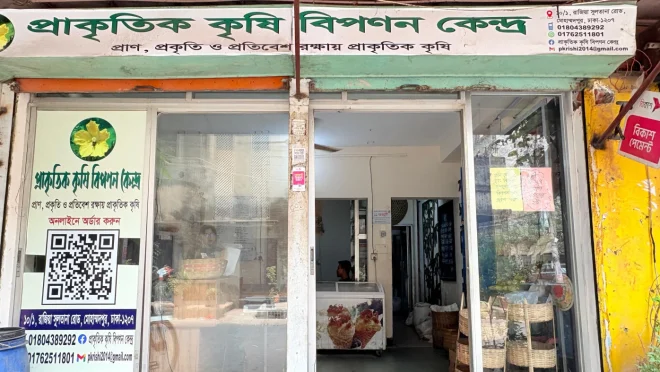
It was around 2011–12. The dominance of chemical fertilisers in agriculture was steadily increasing. Behind the bright, glossy appearance of vegetables, their nutritional value was diminishing, and concerns over food safety were intensifying.
At such a time, Delowar Jahan envisioned making organic food accessible to people, at any cost. His aim was not only to ensure safe consumption but also to guarantee that farmers received a fair price for their labour, bringing agriculture back into harmony with nature.
With this vision, he and a few associates founded Prakritik Krishi Biponon Kendra (Natural Agriculture Marketing Centre) in 2012, choosing Manikganj as their starting point.
The initiative soon expanded to Mohammadpur in Dhaka. From 24 October 2014, selling of organic produce began on an experimental basis on Salimullah Road. This phase continued until March 2015, after which the centre relocated to Razia Sultana Road, where it operates today.
From wild harvests to ‘Pahari Haat’
In its early days, produce was sourced from the Agmundia natural agricultural farm in Kaliganj, Jhenaidah, along with three surrounding villages. The market initially operated once a week. Today, products arrive from 15 districts, and the shop remains open daily from 9am to 9pm.
Yet Delowar Jahan’s ambition extended beyond cultivated crops. He wanted to work with wild produce, vegetables and fruits that grow naturally in forests without human intervention.
“During my time at Chattogram University, I had many indigenous friends,” he recalls. “Through them, I became familiar with their food habits. I realised that the nutritional value of wild fruits and vegetables is often far higher than that of commonly cultivated crops.”

Pahari Haat in Dhaka operates exclusively on Sundays, featuring around 20-30 varieties of produce.
As interest grew not only among indigenous communities but also among Bangali consumers, the demand for wild produce increased. In response, the concept of Pahari Haat (Hill Market) emerged in 2017. Before adopting this name, the initiative was informally known as a market for uncultivated wild crops.
While produce in Manikganj is sold throughout the week, Pahari Haat in Dhaka operates exclusively on Sundays.
A diverse basket from the hills
Umong Sing, assistant marketing manager of Pahari Haat and a decade-long member of the initiative, explains that supplies began arriving in 2017 from Dighinala and Khagrachhari Sadar, with smaller quantities from Bandarban. Most of the produce still comes from Dighinala.
Farmers in these areas practise natural farming, often guided by training and ongoing support from Delowar Jahan. Additionally, local representatives venture deep into the hills to collect produce from jhum cultivators. These goods are then transported to Dighinala before being sent onward to Dhaka.
Some of these products are harvested from untouched forests, while others are cultivated using natural methods.
“We may not always provide formal, hands-on training,” said Delowar Jahan. “But we maintain constant communication, by phone and in-person. We track seasonal crops and stay in touch with indigenous orchardists who update us regularly.”
Each Sunday, Pahari Haat features around 20-30 varieties of produce. These include hill wood apple, indigenous maize, tara (similar to amaranth stems), khyang potato, hill sweet potato, hill ginger, jhum pumpkin, chillies, aubergine, tomatoes, radhuni leaves, okra, bitter gourd, hill bananas, dheki shak (fern), roktogot fruit, pineapple, lemon, taro stolons, garlic, onions, ridge gourd, and various other fruits and vegetables.
Leafy greens such as dheki shak, kattol dingi shak, taro leaves, and sour greens are also popular. Alongside these, a range of hill rice varieties is available, including Bhawaladigha, Ganjia, Lakhai, Kalijira, Banshful, black rice, and traditionally milled rice.
Among these, Bhawaladigha (Tk68 per kg) and Ganjia (Tk98 per kg) are particularly sought after, though limited in supply.
Trust over price
Over the years, Umong Sing has noticed a pattern that many first-time visitors become regulars. On Sundays alone, around 40 to 50 customers visit the Pahari Haat, many travelling from across Dhaka — from Uttara, Mirpur, Bashundhara, and Gulshan.
Yasmin Ara, a resident of Noorjahan Road, is one such regular. Despite having markets nearby, she continues to shop here, prioritising safe food for her family.
“I mainly buy eggs, milk, red wholemeal flour, roasted gram flour, and local vegetables,” she said. “The prices are slightly higher, but the quality makes it worthwhile.”
She is particularly drawn to hill produce, rice, wild vegetables, and leafy greens.

The higher prices of hill produce are largely due to transportation costs yet demand continues to grow, driven by consumer trust.
“Even if the vegetables have insect bitemarks, I still buy them. That reassures me they are genuinely organic. I also use radhuni leaves instead of coriander, it gives a different flavour. My children enjoy trying new foods, like the blood fruit. And of course, the nutritional value is there.”
She added, “I usually buy eggs and milk from here. I have doubts about the nutritional quality of processed products in conventional markets. Eggs cost Tk288 per dozen here, which is high, but I trust their quality. When it comes to children’s health, you have to be careful.”
High demand, limited supply
According to Umong Sing, the higher prices of hill produce are largely due to transportation costs. Goods must pass through three to four stages before reaching Dhaka.
“Collecting produce from remote hilly areas is time-consuming and labour-intensive,” he explained. “We also ensure that farmers are paid fairly. All of this adds to the cost.”
As a result, a product priced at Tk20 in a local market may cost Tk40–50 or more at Pahari Haat. Yet demand continues to grow, driven by consumer trust.
However, supply remains limited. One major reason is the declining number of farmers practising natural agriculture in the hills. Younger generations are increasingly disinterested in farming, leading to reduced production.
Ethical sourcing is another key principle. “If there is a shortage of a particular food in the hills, we reduce our collection,” said Delowar Jahan. “At one point, when rice was scarce, we stopped bringing rice altogether.”
Seasonal variation also plays a role. Between December and January, the peak period for jhum cultivation, production increases significantly, resulting in a greater variety at the market.
Balancing ideals and reality
Interestingly, many of the buyers at Pahari Haat are from indigenous communities themselves. Although the footfall is lower compared to other market days, most products sell out due to limited supply. Weekly transactions amount to around Tk40,000.
Delowar Jahan also noted that not all hill produce can be marketed easily. Attempts to introduce wild poultry and fish from Kaptai were unsuccessful, as consumer preferences differ.
“Food habits are shaped by region,” he explained. “Wild roosters, for example, are much larger and not suited to Bengali tastes. Transport and processing challenges also make it difficult to bring non-vegetarian items.”
Importantly, he cautions against the assumption that all hill produce is entirely organic.
“There is significant use of chemical fertilisers and pesticides in the hills,” he admits. “I have seen warehouses myself. Hybrid seeds are also becoming more common.”
In response, the initiative sometimes supplies indigenous seeds to hill farmers and continues to promote natural agriculture practices within these communities.
“Our work is ongoing,” mentioned Delowar Jahan. “We are trying to expand natural farming, not just in the plains, but in the hills as well.”