A critical review of Samuel P. Huntington’s The Clash of Civilisations
When Samuel P. Huntington published his 1993 essay “The Clash of Civilisations” in Foreign Affairs, it quickly became one of the most influential yet controversial explanations of the post–Cold War world.
A critical review of Samuel P. Huntington’s The Clash of Civilisations
When Samuel P. Huntington published his 1993 essay “The Clash of Civilisations” in Foreign Affairs, it quickly became one of the most influential yet controversial explanations of the post–Cold War world.
Later being expanded into a book, Huntington’s thesis proposed that global conflict would no longer be driven primarily by ideology or economics, but by cultural and civilizational divisions.
Humanity, he argued, was organised into large cultural blocs Western, Islamic, Hindu, Confucian, and others each governed by its own values, assumptions, and political instincts.
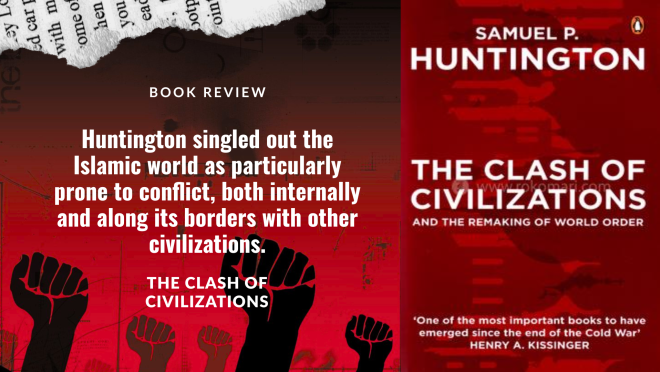
Among these, Huntington singled out the Islamic world as particularly prone to conflict, both internally and along its borders with other civilizations. This is where it became controversial, as Huntington extended his argument towards his abhorrence of this specific belief.
The backdrop
In lieu of the political upheavals that swept the Arab world beginning in 2010–2011, Huntington’s work invites renewed scrutiny not merely to judge whether he was right or wrong, but to assess the assumptions underlying his analysis.
This is one way to say he was pseudo-Islamophobic; however, he indeed shed light on how we view basic economics and our naive understanding of geopolitics.
In retrospect, while he correctly anticipated the fragile nature of authoritarian regimes in the Middle East and their economic stagnation, his broader civilisational conclusions appeared to be problematic, so to speak.
Now, whether someone is far-right or far-left solely depends on their political beliefs and position. It will not be so condescending in my opinion, due to the rise of anti-intellectualism.
However, to understand what had happened, one needs to find out the intention or the policies that backed it in the first place.
Similarly, Huntington argued that societies in the Arab and Muslim world were fundamentally distinct from the West in their political inclinations.
According to his view, people in such societies were less attached to the state and more likely to be bound by religious identity.
It is noteworthy that they are also culturally resistant to liberal values such as pluralism, individualism, and democracy.
Even if dictatorships were to fall, he believed, political change would not lead toward Western-style modernisation.
Instead, any borrowing from Western institutions would be selective, filtered through non-Western cultural frameworks, and likely to intensify civilizational tensions rather than resolve them.
Huntington errs
What subsequent and corresponding events revealed, however, is the extent to which Huntington committed what social psychologists call the fundamental attribution error.
Yet the mass mobilisations of the Arab uprisings suggested a different explanation, that these behaviours were largely products of fear, repression, and constrained political environments that even the media couldn’t cover at times.
As the fragilities of authoritarian regimes surfaced, protesters across Tunisia, Egypt, Libya, Syria, and beyond expressed fierce attachments to national identity, a touch of nationalism, and a clear demand for accountable governance.
Far from rejecting democracy and pluralism, millions risked their lives precisely in their name.
These movements are the testament to the authentic identities and desires which are shared or suppressed depending on historical context.
These movements revealed that individuals possess multiple, equally authentic identities and desires, which are activated or suppressed depending on historical circumstances.
Beyond the flows
Finally, Huntington’s model of historical change was notably linear and deterministic.
Civilizations, in his account, moved along predictable trajectories shaped by enduring cultural logics.
Phases of conflict rarely unfold this way.
Such moments can rapidly awaken political passions and moral commitments that even seasoned analysts assumed to be dormant or absent.
None of this is to dismiss Huntington as a thinker of minor importance.
On the contrary, his work remains influential precisely because it forced policymakers and scholars to take culture seriously in international affairs.
This shifted viewpoints from a lot of different perspectives.
Yet, he may be partially liberated if the Arab world’s political evolution follows paths distinct from Western liberal models.
Still, this is highly speculative.
My two cents on Huntington is a comprehensive analysis of his other works.
The criticism of Edward Said, writer of his famous work “Orientalism”, was the most thorough that I have found as of now.
He thought that Huntington had oversimplified his argument of civilisation clashes and failed to point out that the real modern conflict remains solely ideological in nature.
Cogen thought Huntington’s thesis is a good start for any beginners to understand international politics and conflicts, therefore his thesis is useful.
In my opinion, this piece is a great example of how critics of different ideological spectrums can come and have a healthy debate on what today’s geopolitical model truly looks like.