'Malcolm X' through Spike Lee’s lens
Before America diluted Malcolm X into a quote on posters on university walls, it treated him like a threat. Not just to white America, but to the comforting story the country preferred over the complicated, ugly ones it consciously avoided.
'Malcolm X' through Spike Lee’s lens
Before America diluted Malcolm X into a quote on posters on university walls, it treated him like a threat. Not just to white America, but to the comforting story the country preferred over the complicated, ugly ones it consciously avoided.
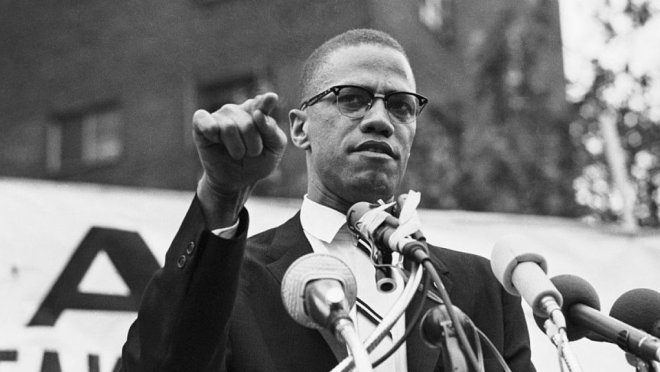
That story usually frames racism as something America gradually overcame through progress, protest, and legislation.
Malcolm never believed history moved that neatly. He looked at police violence, segregation, poverty, prisons, and urban decay as carefully built systems rather than accidents. To him, racism was not a temporary flaw in America. It was formed into the structure itself, a belief that made him frightening, but also one of the most honest political voices America ever produced.
And on his birthday, that contradiction becomes impossible to ignore. Malcolm is now celebrated as an icon by a country that once viewed him as dangerous, yet much of what he spoke about still remains unresolved.
Spike Lee’s 1992 biography “Malcolm X” understands this immediately.
It does not try to calm Malcolm down for mainstream audiences and turn him into a safe inspirational figure. Lee presents him as unstable in the most human sense, constantly shifting between charisma and anger, certainty and doubt, control and collapse. And still changing until the day he died.
And that is what makes the film feel alive and worth talking about on this birthday.
By the early 1990s, Malcolm’s image had already begun changing. Martin Luther King Jr. had largely been absorbed into America’s official moral language. His sharper politics, especially his criticisms of capitalism and war, had been softened into broad messages about unity and kindness. Malcolm remained harder to absorb. Large sections of white America still viewed him as dangerous and hateful.
But among younger Black Americans, especially during the Reagan and Bush years, Malcolm’s reputation was growing fast. His autobiography exploded in popularity again. Rappers, activists, academics, and students embraced him as a figure of dignity and resistance during a period shaped by racist panic about crime, welfare, and “super predators”.
The film carries all of that pressure inside it.
The opening alone tells you exactly what kind of filmmaker Spike Lee is. Malcolm speaks while an American flag burns until only an “X” remains, intercut with footage of the 1991 beating of Rodney King by Los Angeles police officers.
Over the course of the movie, Malcolm X’s character arc shows three stages: from the aesthetic life to the ethical life to the spiritual life. The progression almost resembles Søren Kierkegaard’s three stages of existence.
The film follows Malcolm X’s life from his troubled youth to his transformation into a major civil rights leader. As a young man, he struggles with identity, relationships, and crime, eventually leading to his imprisonment. While in prison, he is introduced to the Nation of Islam, converts, and becomes a powerful activist and street preacher under Elijah Muhammad.
As he rises in influence, tensions grow within the organisation, leading to his departure. He later travels to Mecca, where he experiences a spiritual shift toward Sunni Islam and universal brotherhood. After returning to the United States, he becomes increasingly controversial, and his fate ultimately raises questions about the forces that shaped and ended his journey.
The violence surrounding Malcolm’s childhood hangs over the entire film. His father is murdered, likely by white supremacists. His house burns down. His mother collapses psychologically under poverty and racism. Malcolm excels at school only to be told by a white teacher that becoming a lawyer is unrealistic for “a Negro”.
His trajectory towards crime feels almost predetermined. He hustles, steals, takes drugs, runs numbers, and straightens his hair chemically. Prison was eventually the consequence.
In prison, Malcolm begins the long process of remaking himself. The “clown suit” image and the chemically straightened hair disappear. What replaces it is discipline, and then education, starting with language itself. He studies the dictionary and starts noticing how even definitions carry bias, how meaning itself is shaped by power.
He is told to “take everything the white man says and use it against him”, and over time this becomes more than advice, it becomes a way of thinking. His worldview tightens into something structured and certain. Religion enters this space not as vague faith, but as order and identity. The Nation of Islam gives him both, along with a rewritten history in which Blackness is not a mark of inferiority but something central, even sacred.
As Malcolm rises within the Nation of Islam, he becomes too visible, too powerful, too independent. His relationship with Elijah Muhammad begins to fracture. The questions that begin as organisational disputes expand into something larger, a rethinking of authority, belief, and truth itself.
The idea that “this is too much power for one man to have” becomes a wider question about power itself.
His pilgrimage to Mecca became the turning point. Seeing Muslims of different races praying together changes how he understands race. It separates whiteness from white supremacy in his thinking. After that, his perspective expands further through travel in Africa and the Middle East, where he meets political leaders and begins to link Black struggle in America with wider anti-colonial movements.
The film does not suggest that Malcolm becomes moderate. He remains committed to structural critique, self-defence, and radical honesty about American racism. What changes is not his political urgency, but the scale of his understanding.
This makes the final act profoundly heartbreaking. The film suggests Malcolm was still in transition at the time of his death in 1965, still developing a more global and complex political language.
The final montage of children saying “I am Malcolm X” and Nelson Mandela quoting his words turns the film outward.
Denzel Washington anchors all of this with extraordinary control, holding together Malcolm’s contradictions without reducing him to a single idea. And Spike Lee uses all his power in this one. He has this talent for making everything engaging, even for a 3-hour-plus film. He keeps connecting Malcolm’s life to cinema, politics, media, and collective memory all at once.
Malcolm inspired generations to reclaim dignity and self-respect. He pushed Black political thought towards internationalism and self-determination. He exposed hypocrisies many liberals preferred ignoring. But he could also become trapped inside absolutist thinking. His anger sometimes narrowed human beings into categories rather than individuals.
Spike Lee’s film works because it refuses to simplify any of that.
It does not turn Malcolm into a saint. It does not reduce him to a villain. It leaves him unfinished.
And maybe that unfinished quality is exactly why both Malcolm X and Spike Lee’s film still matter. They force America to confront questions it still has not answered.