Mickey 17: What if you could die and start again?
What if you suddenly came to realise that you can perish repeatedly only to be reprinted to be perished repeatedly? Welcome to the world of Bong Joon-ho, the director of the 2019 South Korean film Parasite, and let’s delve into an unhinged sci-fi.
Mickey 17: What if you could die and start again?
What if you suddenly came to realise that you can perish repeatedly only to be reprinted to be perished repeatedly? Welcome to the world of Bong Joon-ho, the director of the 2019 South Korean film Parasite, and let’s delve into an unhinged sci-fi.
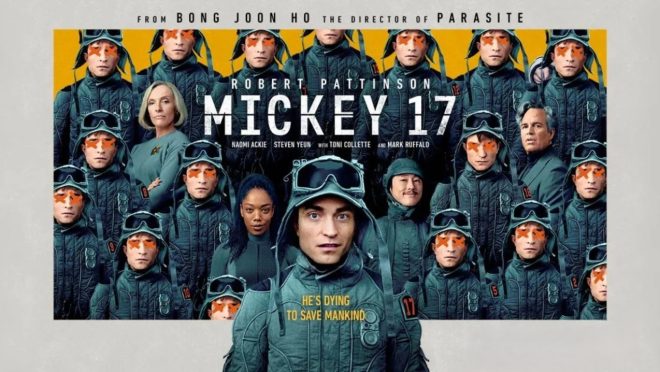
If you’ve watched enough Bong Joon-ho movies, like me, you would expect something strange. Well, somehow, I still wasn’t prepared for this kind of strange. There are films that carefully guide you towards their point.
Mickey 17 occasionally seems to forget where the point is, takes a detour, finds something strange and interesting, and decides that this is probably better.
The movie starred the famous actor Robert Pattinson, who has spent the better part of his career running away from being easily defined. From the tortured glamour of Twilight to the gothic seriousness of Batman, he has repeatedly chosen characters who seem to exist at some distance from ordinary human behaviour.
But in Mickey 17, he finds something even more interesting: a man whose humanity is constantly questioned, despite being perhaps the most emotionally human person in the room.
Mickey is funny, frustrating, vulnerable and deeply human, which is precisely why the performance works. In a film filled with power, spectacle, ideology and strange creatures, Robert Pattinson achieves the most difficult thing of all.
Another star, Mark Ruffalo, meanwhile, is a fascinating surprise. We are used to seeing him as the Hulk or in heroic and comparatively anti-heroic roles, but here he reveals a far darker, crueler and almost psychopathic side. His character’s frightening lack of empathy and enormous ego make the performance both absurd and unsettling.
The film’s biggest achievement is how casually it makes its darkest ideas entertaining.
It deals with questions that could easily become exhausting. For example, what makes an individual unique, how much of a person survives beyond the body and at what point repeated suffering becomes socially acceptable. Yet, strangely enough, Bong approaches them with the energy of someone who has little patience for philosophical twists.
Like it made me understand that satire does not need to be polite to be intelligent.
Mickey 17 is looser, louder and occasionally appears to be chasing different versions of itself at once. Some jokes linger beyond their welcome, while certain political observations are delivered with the subtlety of a spaceship crashing through another planet. But perhaps subtlety was never the assignment.
This film forced me to accept (which I commonly try to ignore, otherwise, mental dilemmas may catch me) about social systems that divide human beings into categories: those above and those below. Those protected and those sacrificed.
Mickey 17 pushes that idea into science fiction and asks what happens when a society becomes so comfortable with replacing people that the person being replaced is expected to cooperate?
The answer is not particularly reassuring.
I would foresee, for all its bizarre humour and science-fiction spectacle, Mickey 17 carries a distinctly familiar anxiety.
We already live in a world where people are often valued according to their usefulness, productivity and convenience. We see it in workplaces where an employee can dedicate years to a company but become easily replaceable once they are no longer considered productive enough. In many industries, human beings are increasingly reduced to targets, numbers and output.
We can see the same mentality beyond workplaces too. People are often valued for what they can offer, contribute or provide rather than simply for who they are. Mickey 17 takes this very real and familiar attitude to an extreme, turning it into science fiction. Yet beneath all its absurdity lies something uncomfortably close to reality: a world where being useful can sometimes matter more than being human.
The film may be imperfect, but I immensely enjoyed it. Perhaps, too chaotic to be called elegant, too strange to be conventional and too clever to be dismissed as simple sci-fi entertainment.
It is funny in the way that it makes you laugh before realising what you are laughing at. It is disturbing without always announcing itself as disturbing. And beneath its absurdity lies a rather uncomfortable question about human worth: how much value does a person really have when the world decides they are replaceable?