Pasher Bashar Auntie: The unholy cow we finally sacrificed this Eid
Every Eid-ul-Adha, the men of my family argue about which cow to buy. Too thin, too expensive, does not look healthy enough are some of the clichés.
Pasher Bashar Auntie: The unholy cow we finally sacrificed this Eid
Every Eid-ul-Adha, the men of my family argue about which cow to buy. Too thin, too expensive, does not look healthy enough are some of the clichés.
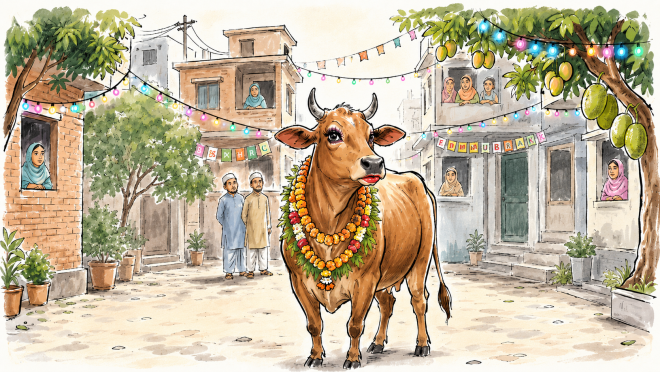
This year, mid-argument, my uncle dropped an information. The neighbourhood butcher, he said, was selling his own cow. At a very low price. We all knew who we were talking about.
There was silence. Then glances were shared. The kind of glances that travel around a room and say, are you thinking what I am thinking? And the answer is yes, obviously yes, we are all thinking exactly the same thing. Let alone this family, the entire neighbourhood has been thinking about it for forty-two years.
I should introduce her properly. We call her Pasher Bashar Auntie. This name was not given by one person. It emerged, organically, through unanimous democratic consensus, six neighbours pointing at her simultaneously, and the fact that when she mooed, it sounded, with uncanny precision, like:
“Vabi, apnar meyer CG naki kom asche ei semester e. Kahini ki?”
Pasher Bashar Auntie was not from somewhere else. She was not imported, inherited, or accidentally acquired. She was born in this very neighbourhood as some blessing of God. She had lived here for forty-two years. It was her dream, by all indications, to die in this neighbourhood, ideally while in the middle of telling someone their parenting choices were statistically likely to produce disappointing results.
Characteristics
Pasher Bashar Auntie is a magnificent animal. Broad in the shoulders. Built like a woman who has never once carried her own problems but has developed extraordinary upper-body strength from carrying everyone else’s without being asked to, without being thanked for, and without once putting them down.
Her neck was her greatest achievement. Architectural, really. It could extend at angles that suggested either a mutation or a deep personal calling. Scientists who studied her movements estimated she could see into a fourth-floor apartment from street level while appearing to graze. She was never just grazing.
Come on, she is a productive cow. She was always gathering something. Her eyes: large, wet, permanently open. The butcher once mentioned he had never seen her blink. “She is always watching,” he said. As if we did not know.
Her skin had the texture of someone who has not moisturised since 1983 but has extremely detailed opinions about your skincare, your posture, your haircut, your CGPA, your major, your university, your future, your husband’s salary (which she had estimated incorrectly and shared immediately and never updated), and your mother’s korma, which was apparently a little off. She could not say exactly how. She was just saying.
The local butcher had described her to us as: “Bhai, sei taja. Onek shokti.”
Of course she was taja. Of course she had shokti. When your entire diet is other people’s business, your entire exercise routine is injecting it into conversations at maximum velocity, and your primary cardio is the sprint from rumour to recipient, you are going to be, physically speaking, in tremendous shape.
When the men of the house came to assess her for Qurbani, she did not flinch. Pasher Bashar Auntie had not flinched since 1983. Flinching was for people who entertained the possibility of being wrong, and she had retired that possibility decades ago.
My uncle walked around her. He noted the neck, long, magnificently engineered, built for maximum craning over maximum fences to observe maximum amounts of information that were none of her concern. He noted the jaw, wide, tireless, constructed for decades of sustained chewing on matters belonging entirely to other people. He noted the eyes, wide, unblinking, the eyes of an animal that processed everything she saw as a resource, raw material, something to be refined and redistributed at the appropriate moment.
He noted the tail. Perpetually raised at an angle that indicated she was always, at any given second, preparing to dispense an opinion in the direction of whoever happened to be nearest. Then there was her veil, long enough to hide all the gossip she had beneath.
Activities
And if I were to share a brief and entirely accurate biography of Pasher Bashar Auntie from her birth to now, she had produced no milk. She had ploughed no field. She had, in forty-two years, contributed to the local ecosystem in zero measurable ways, yet she had not stayed idle for a single day.
Her primary occupation and vocation, the thing she would have listed on a CV if she had ever paused long enough to write one, was: Observation. Secondary occupation: Distribution. Tertiary occupation: Re-distribution to people who had already heard it, with corrections, updates, and supplementary material that had not technically occurred but she felt it would make the situation a bit more spicy.
She observed that Riya from Building 121 had received a 3.8 GPA instead of a 4.0, and she mooed about it with the urgency of a cow who had personally been wronged by that 0.2. Riya’s mother heard it from the kitchen, the bathroom, and scientists have been studying this since, even from her office in Motijheel, twelve kilometres away, windows closed, phone on silent, door shut, headphones on.
She observed that first-year student Arif had chosen to study Literature instead of Engineering, and she followed him through the courtyard bellowing “English niye ki hobe? Khaba ki? Porba ki?” And as if that was not enough, she went to Arif’s mother, radiated her aura, and made her talk to Arif about changing his major.
She observed that Nisha wore a sleeveless kameez on a 38-degree April afternoon, a temperature at which the sun itself was considering removing its shirt, and she stood at the corner and eyed her with her precious eyes. That was enough to make Nisha uncomfortable, go back home, change her clothes and go to work. She did not even need to moo.
She observed all of this for free. Enthusiastically. Because she believed, with her whole enormous chest, that this was love. That she was, in fact, the only thing standing between this neighbourhood and its complete moral collapse.
The price
My uncle asked the butcher: why so cheap? The butcher hesitated.
Eventually telling us the following:
Pasher Bashar Auntie, despite a diet consisting exclusively of gossip, had a catastrophic digestive system. She grazed on other people’s business, processed it internally into something much worse, and then, this is the part that caused the problem, radiated it outward.
The gas, the waste, the lingering atmospheric malice of it all: it was making the other cows sick. Her own little Bachur was ill. The vet had been called. He had looked at the situation, looked at Pasher Bashar Auntie, and said: the only way to stop the contamination is to remove the source.
We looked at each other. We were doing a good deed, we agreed. A community service, really.
She spent her last night tethered to the guava tree in our courtyard. The neighbourhood was doing Eid things. Nobody came to the guava tree to ask the cow what she thought. This was, historically, unprecedented.
The holy moment
Eid-ul-Adha arrived the way it always does, with the smell of semai, children already in their Eid clothes before Fajr and already somehow dirty before breakfast, and the particular Eid chaos of every desi household.
Pasher Bashar Auntie was led from under the guava tree. She walked, it must be said, with tremendous dignity. The dignity of an animal who had lived exactly as she had intended to live, and had no apologies to make, and would not be making any.
The butcher did what the butcher does, with the speed and the mercy and the Bismillah that good men bring to such things.
A child said: “Auntie gelo?” Several adults had to excuse themselves briefly. For air. For composure. For reasons they preferred not to explain. It still felt weird that Pasher Bashar Auntie could radiate so much aura that played with the minds of perfectly sensible adults even after her departure.
Scholars say that Qurbani is not only about blood. It never was. It is about what you slaughter within yourself. Ibrahim (AS) did not merely raise a blade, he raised it against his own attachment, his own certainty, the deep human conviction that he knew best. Pasher Bashar Auntie had made this lesson extremely easy to visualise.
We distributed the meat in the traditional way. One third for family. One third for neighbours. One third for those in need. Even in departure, she was distributed among the community without her consent. Which, if you think about it carefully, was exactly how she had always operated.
Shanti. It was, by all accounts, a very good Eid.
Eid Mubarak. May your meat be distributed well. And if there is something inside you that also spends its days craning its neck over other people’s fences, then remember that the scholars say: slaughter what is within you.
You know what is within you. Get to work.