Behind the screen: How urban Bangladeshi teens navigate the digital world
A qualitative study of urban Bangladeshi teenagers reveals a growing gap between digital participation and online safety awareness.
Behind the screen: How urban Bangladeshi teens navigate the digital world
A qualitative study of urban Bangladeshi teenagers reveals a growing gap between digital participation and online safety awareness.
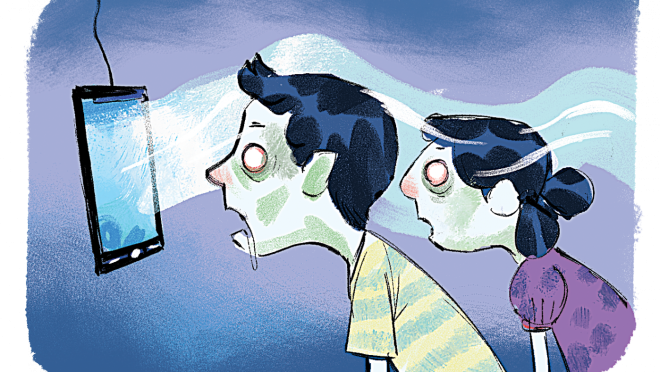
While social media and online platforms have become central to teenage life, the ability to navigate risks such as impersonation, data misuse, and unsafe interactions remains limited.
Based on in-depth focus group discussions with 28 teens from Dhaka, the study explores how adolescents engage with digital spaces, the risks they encounter, and the informal strategies they develop to protect themselves.
A highly connected but vulnerable generation
The participants, aged 13 to 15, were drawn from both English and Bengali medium schools. Despite differences in socioeconomic backgrounds and education systems, their digital behaviour showed striking similarities.
Most teens reported regular access to smartphones and other digital devices, using them for entertainment, communication, gaming, and increasingly for academic coordination. Facebook, Instagram, and Snapchat were the most commonly used platforms, alongside gaming networks such as PlayStation and mobile gaming communities.
However, this high level of connectivity did not translate into digital safety awareness.
Strangers, popularity, and risky trust
A dominant trend observed in the study was the normalisation of adding strangers on social media. Many teens viewed the number of friends or followers as a measure of popularity rather than trust.
Some participants admitted to connecting with unknown users for entertainment, while others described interactions that led to romantic relationships initiated online. In gaming environments, anonymity often encouraged more aggressive or “toxic” engagement styles.
More concerning was the sharing of sensitive information. A small but significant number of teens reported sharing passwords with close friends, believing it to be a form of emergency support rather than a security risk.
Impersonation and intentional misuse
The study found that impersonation and account misuse were not only experienced as harm but sometimes practiced as a form of experimentation or revenge.
Some teens described hacking or accessing accounts as a demonstration of skill or as retaliation after being bullied online. Others engaged in anonymous posting that led to unintended consequences such as harassment or social conflict.
These behaviours highlight how digital risk-taking is often shaped by peer dynamics, curiosity, and a lack of formal education on cyber ethics.
Low awareness, high confidence
A notable finding was the presence of intentional unawareness. Some teens openly stated that they did not see the need to worry about online safety, believing such concerns were relevant only in adulthood.
This attitude was often linked to short-term thinking, where viral attention or online popularity was valued more than long-term consequences such as privacy breaches or identity misuse.
Negative experiences and emotional impact
Nearly two-fifths of participants reported negative online experiences. These included hacked accounts, impersonation, misunderstandings in school settings, and parental conflict over internet usage.
In several cases, impersonation led to real-world consequences, including teacher misunderstandings and peer conflict. The emotional impact of these incidents was significant, particularly when teens were unable to explain or resolve the situation.
Coping without formal support
Despite limited awareness, teens were not entirely passive. Many developed informal coping strategies based on personal experience.
These included:
- Hiding personal information from public profiles
- Adjusting privacy settings
- Unfollowing or blocking unknown users
- Avoiding suspicious advertisements or platforms
However, these strategies were self-taught and inconsistent, often applied only after negative experiences had already occurred.
Parents, privacy, and separation of worlds
A recurring theme was the separation of online spaces from family life. Many teens deliberately avoided adding parents to their social media networks, citing a desire for privacy and freedom.
At the same time, parental monitoring was seen as intrusive, leading some adolescents to create hidden or secondary accounts.
This reflects a broader tension between digital independence and safety oversight in South Asian family contexts.
The awareness gap in schools
The study highlights a critical gap in formal education. While ICT curricula exist in Bangladesh, they largely focus on technical skills rather than online safety, digital ethics, or cyber vulnerability awareness.
As a result, teens often enter digital spaces without structured guidance, learning through trial, error, and exposure to risk.
The research proposes a multi-layered approach to improving teen online safety:
- Awareness programmes through discussion-based platforms led by youth mentors
- Curriculum integration of cybersecurity, digital behaviour, and online ethics
- Policy development focused on child online protection and accountability
The study emphasises that effective intervention must be culturally grounded and involve collaboration between educators, policymakers, and families.
Urban Bangladeshi teens are active participants in the digital world, but their engagement is marked by uneven awareness and exposure to significant risks. While they demonstrate adaptability through informal coping strategies, the absence of structured education and support systems leaves them vulnerable.
The findings point to an urgent need for coordinated action to build digital literacy and safety awareness before teenagers fully immerse themselves in online ecosystems.