The unfulfilled dream of a cricket museum in Bangladesh
Bangladesh has dedicated museums for its liberation struggle, military history, and currency. Yet, it completely lacks a permanent space for the one cultural force that unites its people across lines of religion, class, and politics more than anything else: cricket.
The unfulfilled dream of a cricket museum in Bangladesh
Bangladesh has dedicated museums for its liberation struggle, military history, and currency. Yet, it completely lacks a permanent space for the one cultural force that unites its people across lines of religion, class, and politics more than anything else: cricket.
Yesterday (18 May) was International Museum Day. This year’s theme, “Museums Uniting a Divided World,” carries a powerful message. In a fracturing world, museums are not merely static storehouses. They are vital cultural bridges that connect history with the present, fostering shared understanding and empathy across generations.
Bangladesh has dedicated museums for its liberation struggle, military history, and currency. Yet, it completely lacks a permanent space for the one cultural force that unites its people across lines of religion, class, and politics more than anything else: cricket.
Since independence, our shared cricketing journey has brought us collective joy, heartbreak, and immense national pride. Behind these emotions lie decades of sacrifice and achievement. Yet, the Bangladesh Cricket Board (BCB) lacks a proper institutional archive. As someone who has spent over 25 years collecting cricket memorabilia, I see plainly what history we are losing every day we delay.
The global culture of preserving cricketing heritage is well-established. Since the Marylebone Cricket Club opened the world’s most celebrated museum at Lord’s in 1953, nearly every Test-playing nation has built institutional or personal memory palaces. From the Bradman Museum in Australia to the newly established Sri Lanka Cricket Museum, the world honors its sporting heroes.
Private collectors have done the same. In Colombo, the Cricket Club Cafe displays Sir Garry Sobers’ historic 1968 six-sixes bat alongside signed memorabilia from Sachin Tendulkar and Don Bradman. In Dubai, industrialist Sham Bhattia’s museum houses an unrivaled collection featuring every cricket great, including our own Shakib Al Hasan. In Kolkata, historian Boria Majumdar’s Fanatic Sports Museum places historic letters and match-worn gear within arm’s reach of the public.
When visiting these global institutions, the absence of Bangladesh is glaring. At Lord’s, our rich history is represented by a single item: the bat Aminul Islam Bulbul used to score his historic century in our debut Test. In New Zealand, records of Shakib and Mushfiqur Rahim’s partnerships hang on foreign walls. The very moments that made millions of Bangladeshis leap from their chairs are commemorated in London, Wellington, and Dubai but not in Dhaka.

Photo: Courtesy
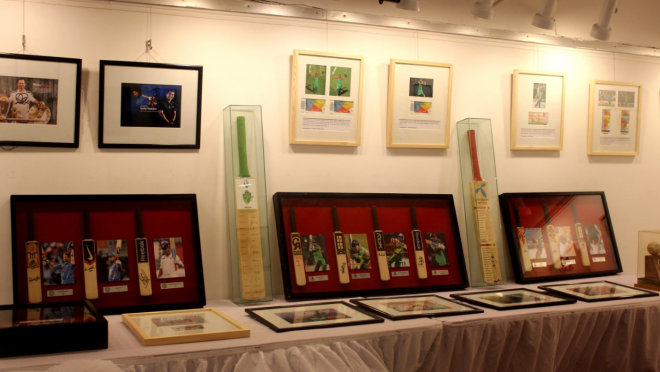
We have tried to fill this void temporarily. In 2011, I organised Bangladesh’s first cricket memorabilia exhibition at the Russian Cultural Centre, followed by a 2013 exhibition at the National Museum. The Bangladesh Cricket Supporters’ Association (BCSA) later hosted festivals at the Drik Gallery and National Museum between 2014 and 2017.
These events showcased extraordinary local and international treasures: signed bats from Tendulkar, Lara and Sobers, signed balls from Warne, Wasim and Ambrose, the bat of the late Bir Bikram Shaheed Jewel and historic tickets from our first ODI victory and the iconic 2008 win over India. Crucially, they featured the evolution of our national team, showcasing jerseys and gear worn by legends like Tamim, Shakib and Mushfiq alongside match items from our modern stars like Litton Das and Shanto.
The public response was overwhelming. The wonder on visitors’ faces revealed a deep, unfulfilled hunger for their own sporting history. But temporary exhibitions cannot safeguard a legacy. Each time the galleries closed, these invaluable pieces of our national heritage, bridging the pioneering generation to today’s young icons, went back into cardboard boxes.
Establishing a permanent museum requires meticulous research, institutional will, and financial planning. It can start small, perhaps as a dedicated wing at the Sher-e-Bangla National Stadium and eventually sustain itself through ticketing and tourism. What is missing is not the material, but the political will to begin.
To the leadership of the BCB and the Ministry of Youth and Sports: the time is now. We have the history, the artifacts, and the passionate curators. We only lack a home for them.
The painter Pablo Picasso once famously said, “Give me a museum and I will fill it.” After decades of collecting and dreaming, I offer the same promise to our authorities. Give Bangladesh a cricket museum and we will fill it.
The writer is a cricket memorabilia collector and founding President of the Bangladesh Cricket Supporters’ Association (BCSA).