Uttara's 'village' reputation meets Dhaka's drainage reality
There are only three things in Dhaka which have remained constant for 415 years since its birth: traffic, unsolicited opinions, and the unwavering belief that Uttara is a “gram”.
Uttara's 'village' reputation meets Dhaka's drainage reality
There are only three things in Dhaka which have remained constant for 415 years since its birth: traffic, unsolicited opinions, and the unwavering belief that Uttara is a “gram”.
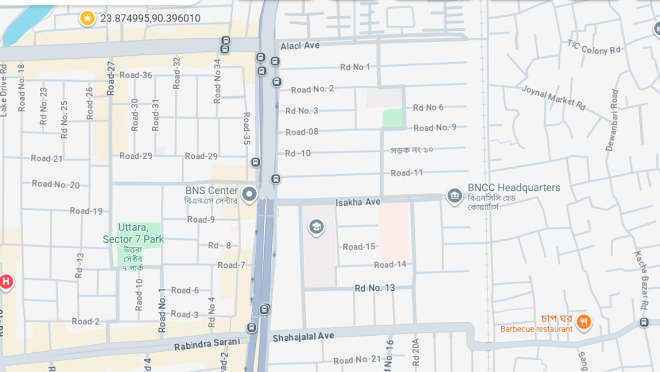
If you mention that you live in Uttara, someone from Dhanmondi, Banani, or a posh man from Gulshan will instinctively ask whether you need a passport to visit your own home. Others will wonder if you still commute by bullock cart or whether Wi-Fi has finally reached the countryside!
It is perhaps the longest-running inside joke in Dhaka. The irony, however, is that this year’s torrential July rainfall may have delivered the punchline to everyone except the people who kept telling the joke.
As relentless monsoon rain battered Bangladesh, leaving vast stretches of the country inundated, Dhaka once again found itself struggling with a familiar enemy: rainwater that simply refused to drain.
News reports documented severe waterlogging across several parts of the capital, disrupting daily life and exposing, yet again, the fragility of Dhaka’s drainage infrastructure.
Thanks to the civilians of the country.
Meanwhile, somewhere in the north of the city, the so-called gram committed an unforgivable crime, not fully but surely. What? Don’t be restless to find the answer. It has recovered.
To be fair, Uttara was not magically immune. Several sectors experienced temporary waterlogging, and residents and media cells shared videos and frustrations like everyone else. But in most locations, the accumulated water receded relatively quickly compared to the prolonged flooding witnessed elsewhere in the capital and across the country.
The village, it seemed, had remembered that roads are supposed to become roads again. And suddenly, decades of urban arrogance began looking slightly damp.
The great Dhaka identity crisis
Dhaka has always had an interesting definition of modernity. Apparently, a city becomes elite if it has expensive cafés, rooftop restaurants, imported trees, skyscrapers, valet parking, and 3,000 or 4,000 square foot apartments whose prices require both kidneys and an ancestral property to afford.
Drainage? Oh! That can wait. Canals? Come on, they’re optional. Stormwater management? We’ll think about it after opening another commercial space.
Urban planners, however, have been saying something entirely different for years. Experts have repeatedly warned that Dhaka’s chronic waterlogging is not merely the result of heavy rainfall. It is the consequence of decades of encroached canals, disappearing wetlands, inadequate drainage capacity, disastrous maintenance, and rapid urbanisation that often ignored the natural flow of water.
Nature has an excellent memory. It always earns a gold medal when taking a memory test. Unfortunately, city planning often does not.
Congratulations! You have successfully built a swimming pool.
Every heavy rainfall in Dhaka follows a predictable script.
Act One: Our skilful meteorological department predicts heavy rain. Everyone ignores it.
Act Two: Rain begins. Social media fills with aesthetic photos captioned, “What beautiful weather!”
Act Three: Thirty minutes later.
The aesthetic disappears. Someone’s motorcycle becomes a submarine. Someone’s cart becomes Aladdin’s carpet. Rickshaw pullers suddenly qualify as ferry operators. Parents call their children asking whether they have reached home. Office workers calculate whether swimming is faster than waiting in traffic. Spotify goes to Canva for designing “Most Used App Time is Bangladesh”.
Television channels begin interviewing experts who have been saying the exact same thing every monsoon for the past 15 years.
Nothing changes. Curtain falls. Repeat next year. Waiting wins.
This section is dedicated to every resident who has ever proudly declared: “Uttara? That’s basically outside Dhaka.”
How does it feel when the area you lovingly referred to as a village occasionally drains rainwater faster than your sophisticated neighbourhood? This must be emotionally difficult.
Years of carefully constructed superiority have been washed away by something as ordinary as functioning drainage in parts of a planned neighbourhood.
Nobody prepared you for this. Certainly not the rain itself.
Let us acknowledge something that is neither controversial nor revolutionary. Uttara was largely developed as a planned township. Its sector-based design, comparatively wider roads, reserved spaces, and relatively organised layout differ from many older parts of Dhaka that expanded organically over decades.
Does this mean Uttara is perfect? Absolutely not. Anyone who has travelled through Airport Road during rush hour would laugh at that suggestion. Construction dust still exists. Traffic still exists. Mosquitoes continue their democratic rule. Temporary waterlogging still occurs. But planning, even imperfect planning, matters.
The rain merely exposed what urban planners have been arguing all along. The reason is obvious. Dhaka’s favourite hobby is mocking geography.
Bangladesh is perhaps the only country where someone who spends three hours travelling from Mirpur to Motijheel will confidently tell an Uttara resident: “Brother, your house is too far.” Distance, apparently, is measured emotionally rather than geographically.
Uttara has evolved into one of Dhaka’s largest residential and commercial centres. Metro Rail connectivity, business districts, educational institutions, hospitals, and continuous urban sector growth have transformed the area over the years.
Yet the nickname gram survives despite so many attempts on its life. Luck! Not because it is accurate. Because traditions are difficult to retire.
Perhaps the greatest lesson from every monsoon is that rain is wonderfully impartial. It does not ask whether you live in Gulshan, Dhanmondi, Mirpur, Mohammadpur, Badda, Uttara, or Old Dhaka.
It simply falls. Everything after that becomes a test of governance. Rain merely reveals what already exists beneath the asphalt: a functioning drainage system or the lack of one.
Imagine if Uttara Could Speak
“Dear Dhaka,
Thank you for calling me a village for nearly three decades. While you were busy debating whether civilisation ends after Gulshan, I was quietly trying to remain a reasonably planned residential area. Yes, I also experience waterlogging. Yes, some of my sectors went underwater. But if recovering comparatively quickly from heavy rainfall qualifies me as a village, perhaps the definition of urban sophistication requires revision.
Warm regards,
Your favourite gram,
Uttara”
The joke
The real satire is not that Uttara is called a village. The real satire is that Bangladesh has become so accustomed to dysfunctional urban infrastructure that merely seeing roads become usable shortly after heavy rain now feels like a miracle.
Think about that. We celebrate what should be normal. A drainage system doing its job. Roads remaining roads. Citizens reaching home without needing rescue boats. Our expectations have become so modest that competence feels extraordinary. That is not a compliment. It is an indictment.
Reality remains stubborn.
Researchers and urban planners have repeatedly stressed that Dhaka cannot continue filling wetlands, neglecting canals, expanding without coordinated drainage planning, and then expressing annual surprise when the city floods.
Rainfall is becoming increasingly intense due to changing climatic conditions. Cities cannot negotiate with clouds. They can only prepare. That preparation requires investment, maintenance, accountability, and long-term planning, not seasonal blame games like poker.
Perhaps it is finally time to retire one joke and replace it with another.
The next time someone says, “Uttara is a gram,” smile politely. Then ask, “Is your neighbourhood still underwater?” Not because Uttara is flawless. Not because every sector escaped flooding. But because this year’s flood and rainfall reminded us of a simple truth:
Being modern is not determined by cafés, luxury apartments, fashionable postcodes, or infrastructure. A truly modern city is one where rainwater knows how to leave.
Until Dhaka collectively learns that lesson, the so-called village may continue teaching the metropolis what urban planning was supposed to look like all along.
And perhaps that is the greatest irony of all. For years, people laughed at Uttara for being Dhaka’s gram. This monsoon, the joke quietly shifted its address.