How a millennial is turning rare collectibles into profit
Hong Kong-based commercial pilot Kenneth Ho, 36, spends his days flying planes. But when he’s not in the cockpit, he is growing and managing a Pokémon collection worth an estimated $1.5 million-2 million in today’s market.
How a millennial is turning rare collectibles into profit
Hong Kong-based commercial pilot Kenneth Ho, 36, spends his days flying planes. But when he’s not in the cockpit, he is growing and managing a Pokémon collection worth an estimated $1.5 million-2 million in today’s market.
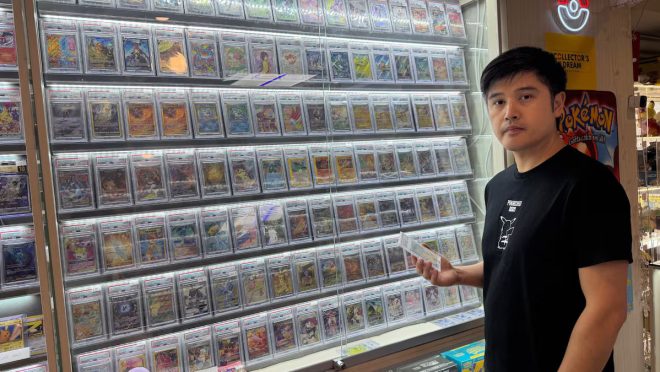
“Right now, I see there’s a huge potential and financial gains from these childhood memories of mine,” he says.
Ho’s collecting journey, like that of many others his age, started in the 1990s when Pokémon trading cards debuted and quickly became a popular hobby among children and enthusiasts.
Ho fell out of Pokémon collecting during high school and university. Then COVID lockdowns hit — a time when many people turned to hobbies that brought them joy — and Ho returned to serious collecting. Since then, he regularly attends new releases to buy new cards, which Pokémon rolls out every two to three months. “In the last 10 years, I would say, from 2016, it got popular again in the Japanese market,” he says.
Pokémon cards and sealed boxes — unopened Pokémon card boxes that contain mixed packs of Pokémon cards that may hold valuable ones, known as booster packs — are only produced for a limited time, about every two to three years. After that, they go out of print, making them harder to find. As supply decreases while demand from collectors remains strong, their value often rises. Cards graded 10 out of 10 by authenticators are the most desirable; even small flaws, such as creases or bends, can lower their value.
Some of Ho’s most valuable cards include Poncho-Wearing Pikachu Charizard X and a Mario Pikachu promo — both made in 2016 — which he says have recently sold for $27,000 and $34,200, respectively. Sealed boxes, some of which he says were purchased for just $100, can be worth thousands. Cards that are signed by the artist who illustrated them can increase their value by 10 times.
As enjoyable as this hobby-turned-investment has been for Ho, he says it is not easy money. Prices can fall, and money can get tied up in collectibles, which may be difficult to sell quickly if cash is needed. Ho said that he saw the cards as an alternative investment that over the next five to 10 years would “become quite significant.”
The Wider Trend
As of 2023, 68% of collectibles buyers in the U.S. were millennials, according to a 2026 report by ZipDo, while 35% of Gen Z had purchased collectibles in the past year.
Thomas Ravert, the managing director of Pathway Capital Corp, says the healthiest way to approach collectible investing is to first ask how much enjoyment you get from it, then assess both the most likely and worst-case scenarios for your financial plan.
“There is a possibility that this thing will not be popular in four years, and I’m going to sell it for a loss or sell it without a gain,” Ravert says, adding that it is important not to confuse possible profit with a real investment strategy. “It is a hope that just buying the thing you like will make you financially secure.”
Emotional Currency
Key Takeaways
Hobbies can be turned into profit. Ho started collecting Pokémon cards as a kid in Toronto and now has a collection worth close to $2 million. He treats his hobby as both personal and financial.
Scarcity is what drives value. Ho explains that Pokémon products are usually printed for only a period of two to three years. After that, they go out of print, making sealed boxes and rare cards harder to find — which can push prices higher.
Collectibles only make sense if your financial foundation is already strong. If you are already saving well, investing for retirement, and can afford the loss, collectibles can fit as a small part of your spending. They make the most sense when bought for enjoyment, with any profit seen as a bonus.