BRAC JPGSPH launches major research on self-care interventions
BRAC JPGSPH launches major research on self-care interventions
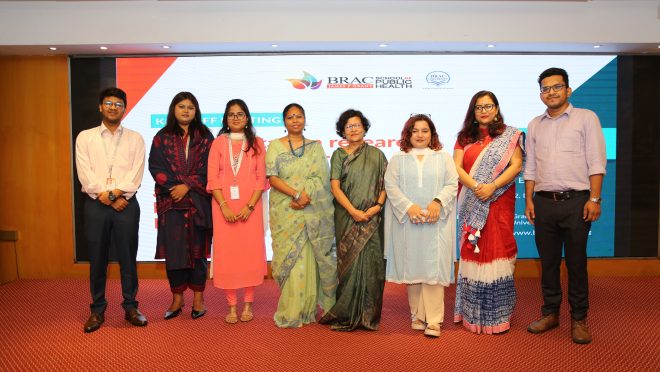
BRAC James P Grant School of Public Health (BRAC JPGSPH), BRAC University, hosted the kickoff meeting for a major implementation research study on self-care interventions for sexual and reproductive health and rights (SRHR) on 23 April 2026 at Amari Dhaka.
Supported by the World Health Organization (WHO) and the HRP special research programme, the study will examine how oral contraceptive pills (OCPs) and emergency contraceptive pills (ECPs) can be strengthened as self-care tools to improve access, utilisation, and health outcomes, particularly among underserved populations in Bangladesh.
Led by Kaosar Afsana, the research aims to identify context-specific barriers and enabling factors affecting access to contraceptives. The findings are expected to inform more effective policies and programme design in the country’s reproductive health system.
The event brought together stakeholders from government, international organisations, civil society, and academia. Senior officials from the Directorate General of Family Planning (DGFP) and the Directorate General of Health Services (DGHS) were in attendance.
As chief guest, Ashrafi Ahmad emphasised that despite limited public funding, many individuals continue to access contraceptives independently, highlighting the need to better understand these access pathways. She noted that persistent stigma around contraceptive use, particularly among young and unmarried individuals, must be addressed to improve public health outcomes.
Experts at the session raised concerns over gaps in counselling and awareness. Nasir Ahmed pointed out that while field-level distribution of contraceptives once included guidance from health workers, pharmacy-based access has reduced opportunities for proper counselling, despite accounting for a significant share of contraceptive distribution.
Highlighting policy implications, Sayed Kamrul Islam stressed the importance of user choice as a cornerstone of reproductive healthcare, while noting that implementation research is critical to translating policy into real-world impact.
From a global perspective, Rajesh Narwal underscored the gap between policy and practice, calling for stronger collaboration to ensure research findings are effectively integrated into national health systems.
Public health experts also pointed to behavioural and social challenges. Sameena Chowdhury and Farhana Dewan highlighted the lack of awareness around proper contraceptive use and the need for continued linkage with healthcare systems. Issues such as misuse of emergency contraceptives, discontinuation of regular contraceptive use, and lack of user satisfaction were identified as areas requiring further investigation.
Concerns around gender dynamics were also raised. Experts noted that decision-making power within households often limits women’s ability to access contraceptives, even when they intend to delay pregnancy. These structural challenges underscore the importance of community-informed solutions.
Concluding the session, Kaosar Afsana noted that self-care in reproductive health remains underexplored in Bangladesh. She expressed hope that the study would not only generate actionable evidence on contraceptive use but also pave the way for broader research into other areas of SRHR self-care.
The initiative marks a significant step towards strengthening evidence-based approaches to reproductive health, with the potential to improve access, autonomy, and health outcomes for women across Bangladesh.