Economics of love: The diminishing utility theory
In the current world order, relationships are a constant variable amongst the younger generations, or have been so due to the advent of hedonistic culture and values, meaning that someone has to be in our life regardless of whether you need them or not.
Economics of love: The diminishing utility theory
In the current world order, relationships are a constant variable amongst the younger generations, or have been so due to the advent of hedonistic culture and values, meaning that someone has to be in our life regardless of whether you need them or not.
What has been a rising concern in such relationships is the lack of emotional accountability and the prevalence of unavailability that is deeply embedded in the psychology of people.
However, science and economics can help us better understand why and when such things can happen.
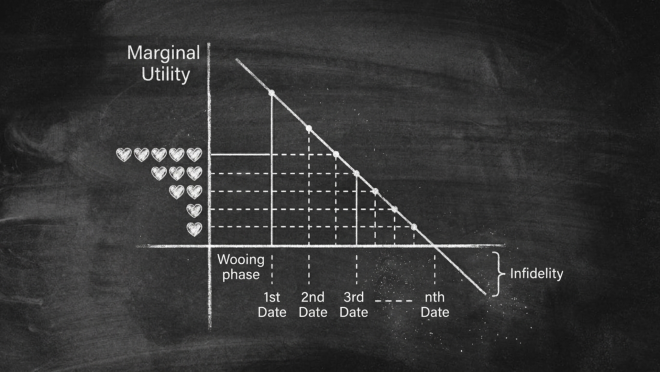
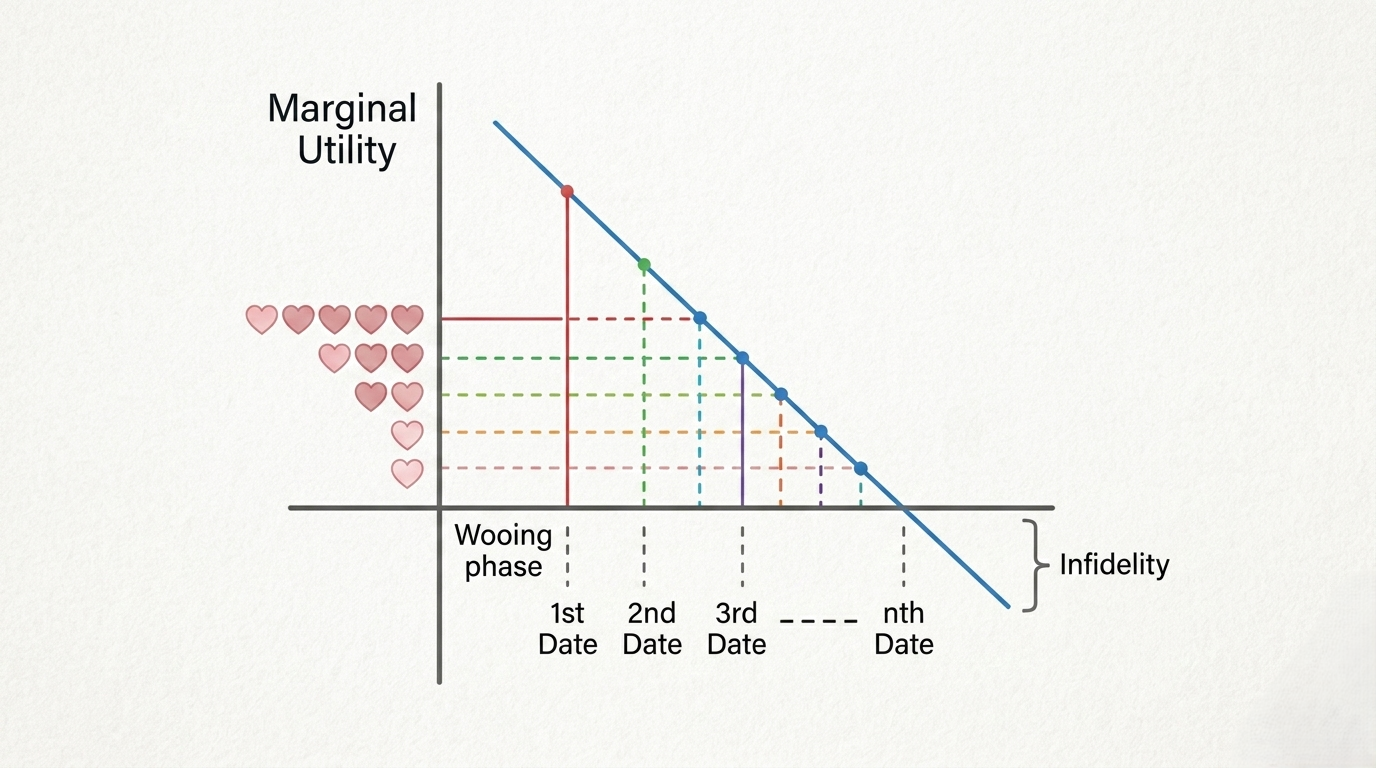
In economics, there is a term called diminishing marginal utility. It means that when one consumes a good or service that has been provided to them constantly, keeping all other factors the same (ceteris paribus), he or she will reach a point beyond which additional increases will result in a progressive decline in satisfaction or in what economists call utility.
Let’s say one of your dates with your girlfriend is a single unit of production of happiness in your life. According to the diminishing rate of return, your first date will always be superior to the fifth one, as the more time you spend with the person, the point will reach a progressive decline, and such is why the “excitement” or the “honeymoon phase” of a relationship seemingly bursts.
At the very core of this model is the idea that a relationship is not a single good, but a bundle of goods and services offering attention, validation, intimacy, stability, novelty, and perhaps emotional security.
Each of these components carries its own function and has its own necessity. However, like most elements that fall under the recognised 4 types of resources in economics, it does not revolve at the same rate over time. Stability tends to generate increasing or is “upward sloping”, then novelty, or the lack of it (being in the same relationship for months) is perfectly subject to diminishing marginal utility.
From a consumer theory perspective, individuals in relationships are continuously maximising utility under constraints, it could be their time, emotional energy or even social expectations such as saying good night every day, having a gift ready for every overhyped monthly anniversary or something else (mostly for young adults like you and me, our friends), and most importantly, their “opportunity cost”, meaning the feeling you feel while a prettier or more handsome person catches your eye.
The relationship is both a consumption good (as the dopamine is under entertainment that is a resource) and an investment good (it promises future returns in the form of companionship and in most cases, perhaps shared capital – that too could be monetary or emotional). The tension or the unit loses its value because the two functions, the opportunity cost and diminishing marginal rate of utility, will often entertain conflicts that are something you cannot go past.
Gary Becker, an economist who made tremendous contributions in marital economics and demographics, famously said: “Stay in a relationship if its utility exceeds your outside option.” You see, the opportunity cost of choosing someone over the other is a phenomenon that will not exist in the behavioural cycle of a relationship. When the consumption of a good has only just started, you will not be able to tell if you “need/want” another person or not.
Sadly, due to the perverted nature of human civilisation, we have perverted the idea of love and how we perceive it – such is the case here, as you will not recognise an opportunity cost even as an opportunity unless you’ve been seeing them for a while.
The perceived utility of alternative interactions and the newer and fresher conversations will cannibalise you and your temptation to a point where you will fall into a validation loop. That begins a new set of problems, as the presence of outside options introduces unexplored dynamics – in more bookish terms, the presence of more options (eligible partners outside the current relationship) will trigger a “reservation utility” (roster): the minimum level of satisfaction the current relationship must provide to remain preferable.
At this point, a rigid rational “variable” would reallocate their time and emotional investment in another “venture”. This model is a fundamental collapse of utility, or in other words, cheating.
If there is a present bias, the immediate gratification of a new interaction is disproportionately weighted against the long-term benefits of an existing relationship. This is exactly why this model would explain how people, to chase said validation, behave in a manner that might be economically or unitarily viable and feasible, but morally questionable.
Another layer is the concept of dynamic efficiency. A relationship is dynamically efficient if it adapts and grows over time, if it continues to reinvest in its novelty and renegotiates expectations and reallocates effort to maintain the fundamental justice of its utility. Most relationships, however, behave like static systems.
That’s why, under this framework, cheating is less an anomaly and more a predictable outcome of competing utility curves under imperfect information and behavioural bias. The tragedy is the fact that, from a long-term perspective, it is often, to an extent, “optimal”. The new “venture” will most inevitably follow the same diminishing trajectory, resetting the cycle rather than escaping it.
This is not a cynical claim, rather a structural observation: sustaining the relationship will require conscious intervention both rationally and “irrationally”. Left to their natural dynamics, they will bend towards a plateau or an eventual reallocation of compound interest. The only way to counter the diminishing marginal rate of utility is to alter the production itself. Novelty will always emerge as the only recalibrated solution.
I.e: spend time with your significant other and always keep reinventing special moments/interest with said partner.
In other words, the relationship must be managed less like a passive consumption of goods and services and more like an actively maintained investment. Because, if the hypothetical system truly exists and it is governed by the diminishing marginal rate of utility, stability is definitely not the default outcome, rather, more often than not, a rigorous optimisation and adaptation process.