Inside the DAAD Scholarship: How two Bangladeshi scholars secured Germany's prestigious scholarship
Chances are you have heard the name DAAD thrown around in some study abroad or scholarship Facebook group, or next to a screenshot of someone’s acceptance email.
Inside the DAAD Scholarship: How two Bangladeshi scholars secured Germany's prestigious scholarship
Chances are you have heard the name DAAD thrown around in some study abroad or scholarship Facebook group, or next to a screenshot of someone’s acceptance email.
What you probably have not heard is what actually separates the people who get that email from the people who do not.
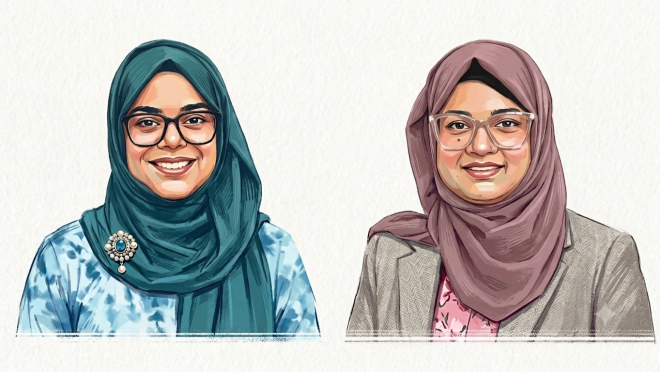
Rukaia Parveen Tuba and Khondokar Afrina Hoque both got it. Tuba went in through DAAD-EPOS for a master’s. Khondokar Afrina went in through DAAD’s doctoral research grant, as a sitting Assistant Professor at Comilla University with a stack of publications behind her.
Their paths through the same organisation looked almost nothing alike. Between the two of them, though, they cover nearly everything you need to know to apply.
Two scholars, two programmes
Tuba grew up in Patharghata, a coastal town in southern Bangladesh. “Since childhood, I have experienced flash floods, river erosion, cyclones, and many other natural disasters,” she says. “I have seen people lose their lives, homes, and livelihoods because of these events.”
That is what pulled her toward disaster management, then a BSc at DIU, an MSc at Jahangirnagar University, and more than three years at the Refugee and Migratory Movements Research Unit (RMMRU). It was there, working under a University of Exeter project, that her focus narrowed: “I realized that the qualitative research methods I had learned through my academic and professional experiences were quite different from the approaches used in international research.”
She is now doing her master’s in Geography of Environmental Risks and Human Security, jointly run by the University of Bonn and United Nations University (UNU-EHS).
Khondokar Afrina did not choose chemistry so much as land in it. “Chemistry was never part of my original plan,” she says. “My father always encouraged me by saying, ‘It doesn’t matter which subject you study; whatever you do, enjoy it and give it your best.'” As an undergraduate in Comilla University’s third-ever chemistry batch, she ran into a hard limit fast: “I faced significant limitations in laboratory facilities.”
Rather than wait for better equipment, she built her own: “I collected the necessary software, invested in a better laptop, and gradually built my own small research environment in computational chemistry.” That workaround became her research identity, and years later, a full-time faculty position, a stack of international publications, and a PhD in Sustainable Energy Materials at the Technical University of Munich (TUM).
The reason their stories matter side by side is this: DAAD is not one scholarship. It is an umbrella over many, and the programme you apply to change almost everything about what the application wants from you.
What DAAD actually is
DAAD stands for Deutscher Akademischer Austauschdienst, the German Academic Exchange Service. Funded largely by the German federal government, it is, by scale, the world’s largest funding body for international academic exchange, covering fully funded master’s programmes, PhD scholarships, research grants, and short-term exchanges.
The two paths: EPOS vs. the doctoral research grant
EPOS (Development-Related Postgraduate Courses) is DAAD’s flagship scheme for master’s-level applicants from developing countries. It targets working professionals and evaluates them on academic performance, professional experience, leadership potential, and what Khondokar Afrina calls “development impact”: how the degree will feed back into your home country.
The DAAD Research Grants Doctoral Programme is a different animal. It is not for students; it is for researchers with an already defined project and a confirmed German supervisor. The evaluation is almost entirely about your research proposal: its originality, feasibility, scientific relevance, plus your publication record. As Khondokar Afrina puts it: “For master’s scholarships, the focus is on identifying future professionals and leaders. In contrast, the DAAD Research Grants Doctoral Programme evaluates applicants primarily as researchers.”
What the application actually requires
For EPOS: a Europass CV, a strong motivation letter, a CGPA generally above 3.5 out of 4, IELTS 6.5 or above with no band below 6.0 (TOEFL also works), at least two years of relevant professional experience, two recommendation letters (one academic, one professional), work experience certificates, and no more than a six-year gap between finishing undergraduate studies and applying.
For the doctoral track, add: outstanding academic excellence, a completed master’s or verified equivalent, strong English proficiency, a study gap since the applicant’s last graduation of no more than six years, and a confirmed German supervisor and host institution. Khondokar Afrina’s MPhil from Buet had to be separately verified as equivalent to a two-year master’s degree by TUM through Germany’s Centre for Foreign Education (ZAB). Without a professor agreeing to supervise you, there is no doctoral application. So, you submit a detailed research proposal, timeline, and hosting agreement, not just a CV and personal statement.
One detail that trips people up: for EPOS, you do not contact professors yourself. You apply directly to the university, which handles initial selection before nominating you to DAAD. For the doctoral grant, it is the reverse, and you find your supervisor first. Khondokar Afrina found hers by “scrolling randomly” and spotting a PhD listing on LinkedIn from Professor Marc Ledendecker’s group at TUM.
She emailed him directly with her CV, cover letter, and motivation letter. The advertised post had already been filled, but the conversation was strong enough that he agreed to support a DAAD-funded project built around her instead.
Publications are not the gatekeeper you think they are
Tuba applied with zero publications. “Publications can strengthen an application, but they are certainly not mandatory,” she says. Khondokar Afrina, who had publications in Scientific Reports, Elsevier journals, and the Electrochemical Society before applying, says the same holds even for the doctoral grant: “A successful application is a combination of academic excellence, research experience, a strong motivation letter, a well-prepared research proposal, relevant professional experience, and the ability to clearly explain the significance and impact of the proposed research.” For doctoral applicants, the research proposal outweighs the publication count.
DAAD evaluates the whole profile, not one line item. A missing publication or a slightly lower CGPA is rarely fatal if the rest holds together.
The motivation letter and why “do not write it in one evening” is the best advice you will get
Both scholars name the same document as the real decision-maker. Tuba’s course guidelines told her outright not to draft it in one sitting: “I took that advice seriously. I rewrote it several times and shared it with one of my colleagues.” Her advice on structure is to open with why the programme connects to your background, explain why it matters at this exact career stage, walk through relevant experience, and close with why Germany specifically. “Rather than trying to convince the committee that I was the best candidate, I focused on explaining why the programme was the right fit for me.”
For a research proposal instead of a personal statement, Khondokar Afrina’s version of the same advice is: lead with evidence, not ambition. “My motivation letter therefore focused less on proving my potential and more on showing a clear progression of research interests.” The core narrative does not change whether you have two publications or twenty. What changes is how much evidence you have to back it up.
References
EPOS asks for two letters (one academic and one professional) from people who know your work well enough to write specifically. Tuba’s came from her RMMRU supervisor and her thesis supervisor, both briefed on the programme so the letters could speak directly to the fit.
The doctoral track asks for fewer, more targeted references. Khondokar Afrina submitted just one, from her MPhil supervisor, chosen because his research area lined up with her proposed project: “Having supervised my research directly, he was well acquainted with my research abilities, academic growth, and potential for doctoral-level research.”
The interview
Both tracks interview shortlisted candidates, though the format and stakes differ. After being shortlisted, Tuba was invited to an online interview lasting about 30 minutes. The panel had five members: two representatives from the University of Bonn, two from UNU-EHS, and the programme coordinator. Her case did not end there. Because she already held another master’s degree and had accepted the scholarship later than expected, she faced a second, individual interview with a DAAD representative, specific to her circumstances and not a standard part of the process for other applicants.
Afrina’s doctoral interview worked differently from the start. Her selection ran through DAAD’s Regional Office in New Delhi, where candidates from across South Asia were evaluated in a single pool: document screening first, then a comprehensive interview for those shortlisted.
The eight-member panel combined DAAD representatives with academic experts in her field, and a significant portion of the conversation stayed on her research proposal, its methodology, its feasibility, its scientific significance, and how deeply she understood the project she was proposing to carry out. She was also asked directly whether she had study leave from her university and how she planned to use the training once she returned to her faculty position.
The difference in what each interview tests reflects the difference in what each track is for. Tuba’s panel was assessing fit: whether her background, motivation, and career direction matched a taught degree programme built for future professionals and leaders. Afrina’s panel was assessing capability: whether she could design and independently execute a piece of original research. As she put it herself, the doctoral process is built to evaluate applicants “primarily as researchers”, so the interview follows that logic all the way through.
What DAAD actually pays for
EPOS master’s students get a monthly living allowance of €992, full health and accident insurance, a travel allowance, and, depending on the programme, language course support and family allowances.
Doctoral researchers get roughly €1,400 a month, health, accident, and liability insurance, travel support, a research allowance, a German language course before the programme starts, conference and summer school funding, and an annual trip home. Rent subsidies kick in for expensive cities. Khondokar Afrina’s programme is in Munich, one of Germany’s costliest.
Tuition is a non-issue at German public universities either way. DAAD funds your life, not your degree.
The return question
DAAD encourages EPOS scholars to bring their expertise home. Tuba framed hers around climate-migration policy for female migrants in Bangladesh, but there is no hard rule forcing an immediate return. Germany grants an 18-month job-seeking visa after graduation, and DAAD’s alumni network circulates opportunities, including within Germany.
The doctoral programme is even more open-ended. DAAD never asked Khondokar Afrina to commit to a country or institution; the questions were about how she’d use the training to advance her career. If you’re worried this restriction will disqualify you, it almost certainly will not.
Beyond the classroom
Some of the most consequential experiences for both scholars happened outside the formal degree itself. Tuba’s EPOS programme requires a mandatory internship. She landed hers at the ICLEI World Secretariat in Bonn after a competitive internal application. “It was a highly international workplace,” she says. “I was able to build a very strong professional network.”
A separate, course-based opportunity took her further: a course in her second semester paired student groups with UN agencies based on submitted CVs, and Tuba’s group was placed with the UN Convention to Combat Desertification, researching the gendered impacts of sand and dust storms across Mali, Egypt, and Australia. The work was later cited by the UNCCD internationally and presented by the students themselves at CRIC 23 in Panama City in December 2025.
One of Afrina’s lifetime achievements was being selected for the Lindau Nobel Laureate Meeting, which later helped her decide to pursue a PhD in Germany and also enriched her profile for it. In June 2022, she was selected as one of roughly 600 young scientists worldwide to attend the Lindau Nobel Laureate Meeting, sharing a room with nearly 40 Chemistry Nobel laureates. It was funded by the Lindau Nobel Committee. “The most valuable part was hearing about their scientific journeys, the struggles, failures, rejected ideas, and persistence behind their achievements,” she says. The experience gave her a firsthand look at Germany’s research ecosystem years before she applied to TUM. For both scholars, the most formative moments abroad came not from the classroom, but from what they built on top of it.
The part nobody warns you about
Both flagged the same hurdle: adjusting to a European academic system after years inside a different one, regardless of how strong your application was.
Tuba’s cohort spans eighteen countries: “Adjusting to a European-standard classroom and curriculum is indeed challenging, at least to some extent, because it is not the way we were accustomed to learning.” Khondokar Afrina, further along and already an academic, says the value was never the credential itself: “Unless you see your own system from the outside, it is difficult to identify its limitations and opportunities for improvement.”
Neither treats this as a warning to stay home. Both treat it as the actual reward.
What you need before you apply: the short version
Starting from zero, have this ready before you touch an EPOS application: a CGPA above 3.5 out of 4, IELTS 6.5+ with no band below 6.0, more than two years of relevant work experience, two people who can write you specific letters, and a motivation letter you’ve rewritten more than once.
For the doctoral route, add: a completed master’s or verified equivalent, a research proposal you can defend in detail, and, before anything else, a German professor who has agreed to support your project. Without that last piece, nothing else matters yet.
Neither track needs a publication in Nature. Neither needs a lifelong plan. Both need a profile where the pieces connect past work, proposed programmes, and a plausible reason it matters beyond you.
“There is nothing to be afraid of,” Tuba says. “I would definitely encourage everyone to submit an application and move forward.”
So, all you need to do is start and not stop until you hit the submit button. What happens after that is luck, the result of your hard work, and something beyond your control. So make sure to use the time that is in your control while you can, even if that requires you to step outside your comfort zone.
Because Khondokar Afrina puts it the same way from the other side: “Sometimes the greatest growth comes from stepping outside our comfort zone.”