Tusk: When a bad podcast interview turns into a very bad day
Tusk: When a bad podcast interview turns into a very bad day
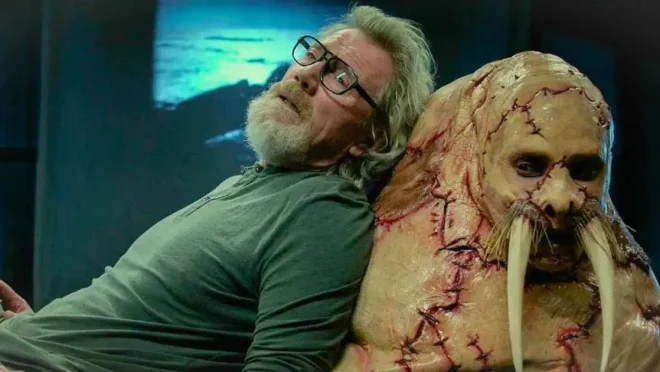
There are bad decisions, and then there is travelling to the middle of nowhere to interview a mysterious old man because he promised you a good story.
Wallace Bryton (Justin Long) makes that decision in Tusk (2014), Kevin Smith’s deeply bizarre horror-comedy about a podcaster who discovers that some interviews are better left unanswered.
Wallace hosts a podcast where he makes fun of unusual people and their stories. He travels to Canada hoping to interview a viral sensation, only to discover that the man has died. Rather than accepting defeat and returning home, Wallace goes looking for another story. Because, apparently, journalistic curiosity has no brakes.
He finds Howard Howe (Michael Parks), an elderly former sailor living alone in a remote mansion. Howard has an incredible story to tell about surviving a shipwreck and spending time with a walrus he calls Mr Tusk.
Wallace thinks he has found his next great episode. Instead, he has found his nightmare.
Howard drugs Wallace, kidnaps him and reveals his master plan: he intends to transform him into a walrus.
Not metaphorically. Not through some supernatural curse. Howard literally wants to surgically turn a human being into the animal he has spent years obsessing over.
And this is where Tusk stops being merely strange and becomes genuinely uncomfortable.
The genius, and perhaps the most disturbing part, of Tusk is that Wallace begins the film as someone who turns other people’s humiliation into entertainment.
He interviews strangers, laughs at their misfortunes and packages their pain for an audience.
Then Howard does exactly the same thing to him. Only this time, Wallace is the entertainment.
Howard gradually mutilates Wallace and replaces parts of his body with walrus-like features. As the transformation progresses, Wallace loses not only his physical appearance but also his ability to communicate and function as a human being. The film turns body horror into a twisted form of punishment.
Wallace spent his career treating people like spectacles. Now he has become one.
It is a surprisingly relevant idea in an age where almost anything can become content. Someone falls, embarrasses themselves or does something strange, and within minutes thousands of people are watching and laughing.
Tusk takes that culture of voyeurism to its most grotesque conclusion; what happens when the person behind the camera becomes the subject?
Justin Long carries much of the film’s horror.
Wallace begins as an arrogant, smug podcaster, but Long gradually strips that confidence away as his character becomes increasingly helpless.
The performance becomes almost entirely physical during the latter half of the film. There is something both horrifying and absurd about watching a grown man slowly lose his humanity while being forced to behave like a walrus.
And if Long sells the horror, Michael Parks sells the insanity.
As Howard Howe, Parks is calm, charming and strangely captivating. He doesn’t behave like a conventional horror villain. He speaks politely and tells stories with the enthusiasm of someone hosting a dinner party.
Except the dinner party involves human experimentation.
That contrast makes Howard particularly unsettling. He genuinely believes what he is doing is meaningful. In his mind, becoming Mr Tusk isn’t torture. It is a transformation, perhaps even a form of salvation.
The fact that Howard is so convinced of his own logic makes him considerably creepier than a villain who simply enjoys hurting people.
Perhaps the most fitting thing about Tusk is how ridiculous its origins are.
The idea reportedly came from a discussion on Kevin Smith and Scott Mosier’s podcast after they encountered a bizarre advertisement involving a man looking for someone willing to dress as a walrus. The pair joked about turning the premise into a film and asked listeners whether they should make it. The audience essentially said yes. So they did end up making it.
Most movies begin with carefully developed screenplays and years of planning. Tusk began with something close to: “What if a guy turned another guy into a walrus?”
And then somebody decided that this was absolutely worth $3 million. That decision deserves either applause or psychiatric evaluation. Or possibly both.
Unfortunately, Tusk isn’t always as clever as its central idea.
The film is frequently distracted by long conversations, side characters and jokes that go on far longer than they need to. Its tone also swings wildly between genuine horror, crude comedy and outright absurdity.
Then there is Johnny Depp’s Guy LaPointe, an eccentric detective investigating Howard. Depp’s performance is so exaggerated that it feels as though he has wandered into the film from an entirely different universe.
Sometimes it works. Sometimes you simply wonder what Kevin Smith was thinking.
The film could certainly have been shorter and more focused. Its best moments come when it commits to Wallace’s transformation and the psychological horror surrounding it.
Tusk isn’t the sort of horror film that will have you checking under the bed before going to sleep. Its horror comes from the sheer unpleasantness of its premise.
The surgery, the helplessness and the gradual loss of identity are what make it disturbing.
And then there is the final image of Wallace. It is ridiculous, tragic and horrifying.
It is also, somehow, a little funny.
That combination perfectly captures what Tusk is.
Tusk is not a perfect horror movie. Its pacing is uneven, some of its humour is painfully juvenile and its supporting characters can feel completely detached from the central story.
But it is almost impossible to call it boring.
There are very few films where you can genuinely say, “I’ve never seen anything quite like this.”
Tusk is one of them.
It is a film about ego, humiliation, obsession and the strange things people will do in search of entertainment. But above all, it is a film about a man who really should have just gone home after his first interview fell through.
You may forget some of its plot. You will not forget the walrus.