Musk launches steering-wheel-free Cybercab service in Austin
Musk launches steering-wheel-free Cybercab service in Austin
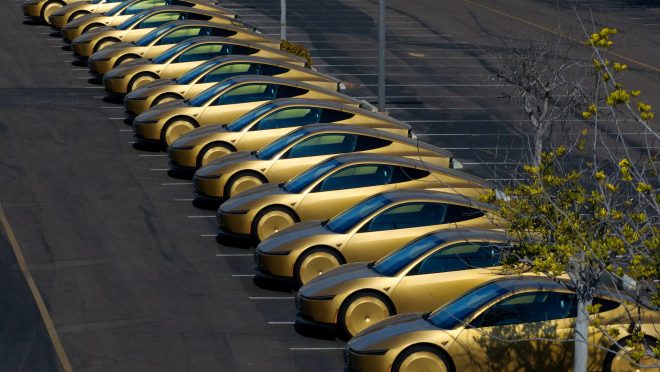
Elon Musk has launched Tesla’s steering-wheel-free Cybercab service in Austin, Texas, sending dozens of autonomous vehicles onto the city’s streets as the company seeks to convince passengers to trust cars they cannot control themselves.
The gold-coloured Cybercabs, which have neither steering wheels nor brake pedals, began operating on Thursday as Tesla prepares to expand its autonomous taxi service to other cities.
Tesla’s shares rose more than 5% on Thursday amid investor optimism that the futuristic taxis could help revive the company’s struggling vehicle business.
Tesla currently trails Waymo in the autonomous taxi market in both vehicles deployed and trips completed. The company will need to demonstrate that its camera-only system can safely navigate roads and avoid pedestrians.
Waymo and Amazon’s Zoox, meanwhile, use cameras alongside radar and lidar, a laser-based sensing technology.
Public scepticism remains another challenge for Tesla. A Pew Research Center survey conducted in February found that seven in 10 US adults were “not too” or “not at all” comfortable riding in a driverless car. Only 16% said they would be somewhat comfortable, while 7% said they would be extremely or very comfortable.
Tesla already operates a robotaxi service in Austin, launched in June 2025, but those vehicles have steering wheels and brake pedals. The service has since expanded to five other cities in Texas and Florida.
According to RobotaxiTracker, Tesla now has more than 200 unsupervised robotaxis operating in those cities. Waymo, by comparison, has more than 4,000 such vehicles across 14 cities.
Tesla’s push into autonomous driving comes after a difficult period for the company. Vehicle sales fell for a second consecutive year in 2025, while profits dropped and China’s BYD overtook Tesla as the world’s biggest seller of electric vehicles.
Musk’s political activities have also affected the company’s public image. His involvement in President Donald Trump’s government cost-cutting initiative, DOGE, and support for far-right political candidates triggered protests at Tesla showrooms and boycotts in several countries.
Musk has said he eventually wants hundreds of thousands of Tesla vehicles to receive full self-driving software through over-the-air updates, allowing owners to use their cars as autonomous taxis when they are not driving them.
However, regulatory and safety concerns remain.
Tesla has yet to receive approval for its partial self-driving software in most European Union countries. In the US, regulators have launched multiple investigations into crashes and other incidents involving the technology.
One investigation is examining crashes in fog, sun glare and other low-visibility conditions, including an incident in which a pedestrian was killed. Another is looking into dozens of cases involving Tesla vehicles running red lights or driving on the wrong side of the road while using partial self-driving software.
Regulators are also investigating whether Tesla failed to promptly report crashes as required.
The company will therefore have to overcome not only technological and regulatory hurdles, but also widespread public concerns about giving up control to autonomous vehicles.