The pink bus loses Tk60,000 a day. So what?
Apparently, a public bus losing money is a crisis demanding immediate answers. Projects consuming thousands of crores before being abandoned? Those require reports, reviews and another round of questions.
The pink bus loses Tk60,000 a day. So what?
Apparently, a public bus losing money is a crisis demanding immediate answers. Projects consuming thousands of crores before being abandoned? Those require reports, reviews and another round of questions.
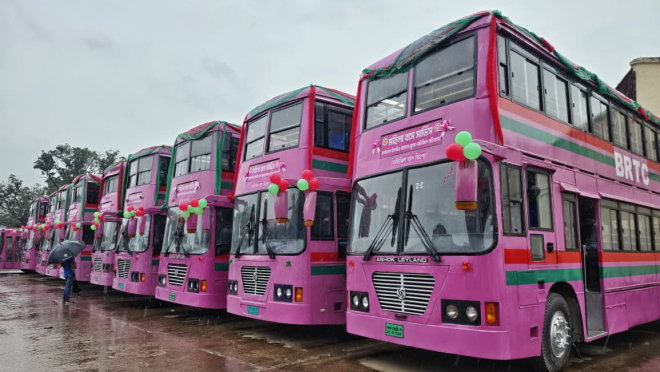
Living in Dhaka, I know that getting somewhere costs more than money. It costs time, patience and, for women, sometimes the additional effort of worrying about safety. So when the Govt introduced women-only pink buses on 18 August, I understood the purpose. I also understood why the service needed to be evaluated.
But the debate has quickly shifted towards whether these buses should continue because they reportedly lose Tk60,000 a day. Their passenger numbers are low, their operating costs are questioned, and their financial viability has become a public controversy or is being manufactured into being one.
Fine, scrutiny is expected. Public money is not free, and good intentions do not excuse bad planning. But why does a reported daily loss become an argument against a public service, while much larger failures of public spending rarely provoke the same immediate demand for consequences?
I am not asking taxpayers to finance an unsuccessful service forever. I am asking why we seem so eager to judge this one by its losses before establishing what it delivers, while the failures behind million-dollar decisions require us to dig through official reports to understand what went wrong.
But Tk60,000 does not explain why passenger numbers are low or whether the service could work with better planning. Various media reported that limited routes, inadequate publicity and only two daily trips were among the problems affecting passenger numbers. Some passengers said missing a scheduled trip forced them to use other transport.
If the routes are wrong, change them. If the schedules are inconvenient, fix them. If the service still cannot demonstrate sufficient public value after a proper evaluation, reconsider the model. What makes little sense is treating the deficit as though it has already answered every question.
And a larger question is: why does the colour pink suddenly evoke the responsibility of holding taxpayers’ money accountable? Where is this type of vigilantism in the media when it comes to evaluating every other govt project? Am I smelling a hint of misogyny?
Elsewhere, public transport is a public investment. Here, somehow, it has to defend every taka as if it were a profit-generating endeavour in the first place.
Of course, free transport is not cost-free; governments still have to pay for it. But that is precisely the point: public transport costs money whether passengers pay the fare or taxpayers cover the bill.
In the last fiscal year, 29 projects were abandoned despite Tk6,755 crore already being spent on them, according to the Implementation Monitoring and Evaluation Division’s review of the Annual Development Programme for FY2024-25. Their combined approved cost was Tk12,433 crore.
A proposed space observation centre in Bhanga, Faridpur, was approved at Tk213 crore but cancelled after approximately Tk6.64 crore had been spent. Officials cited a hastily prepared proposal and a weak survey.
A project to modernise the Paturia and Daulatdia river ports was cancelled after approximately Tk79.87 crore had been spent, with land-acquisition difficulties and technical challenges among the obstacles. These figures raise a basic question: what did the planning process fail to identify before public money was committed? The same problem appears in the Gazipur–Airport Bus Rapid Transit project. TBS reported that more than Tk2,800 crore had been spent and that dismantling the project could cost another Tk2,000 crore.
Billions in public transfers, billions in losses. A World Bank-backed study presented in May 2026 found that Bangladesh’s state-owned enterprises received net fiscal transfers of approximately Tk88,200 crore in FY2023-24. Non-financial state-owned enterprises recorded combined adjusted losses of around Tk44,100 crore, while the Bangladesh Power Development Board alone recorded losses exceeding Tk44,400 crore.
I have yet to see any explanation from the Govt, nor have I seen any article from the so-called “fourth pillar of democracy” questioning why such waste was being accepted.
Where is the sustained public outrage over the decisions that brought it here? Who approved the plans? Were the risks assessed? What consequences followed? The comparison is not that the pink buses lose less money, so their deficit should be ignored. It is that a daily operating loss should not be treated as a complete verdict while the causes and consequences of much larger failures remain unresolved.
Cancelling a project and publishing a report about it do not, by themselves, constitute accountability.
I also cannot hold down my anger seeing women drivers of the pink buses facing ridicule and questions about whether they are capable of doing the job.
A public service can waste money through poor management. A government can also fail its citizens by refusing to fund a necessary service because its benefits do not appear as commercial revenue.
One should possess the basic common sense to distinguish between the two through evidence. So yes, question the Tk60,000 daily loss. Ask whether the pink buses work, whether their operating model is cost-effective and whether women can rely on them.
But follow the money beyond the buses, too. Follow it into abandoned projects, failed infrastructure and institutions absorbing billions. Ask what was promised, what was delivered and who must answer for the difference.
Every taka matters. So why does our outrage seem to have a spending limit?