Making bad things look good
I have a problem with books about corporate scandal: by page fifty, you already know how the story ends. Executives get richer. Somebody down the org chart gets hurt. Nobody goes to prison. A spokesperson says the company takes the matter very seriously.
Making bad things look good
I have a problem with books about corporate scandal: by page fifty, you already know how the story ends. Executives get richer. Somebody down the org chart gets hurt. Nobody goes to prison. A spokesperson says the company takes the matter very seriously.
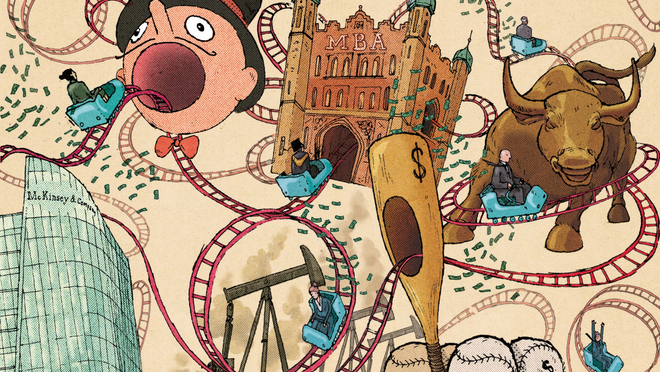
When McKinsey Comes to Town, Walt Bogdanich and Michael Forsythe’s five-hundred-page indictment of the world’s most famous consulting firm, commits this sin fourteen times, somewhere around chapter eight, the repetition itself becomes the point.
The book moves from client to client: U.S. Steel, Purdue Pharma, ICE, apartheid-era South Africa, Juul, Saudi Arabia, Britain’s public health service. Each chapter follows the same steps. A struggling company or government hires McKinsey. McKinsey makes a slide deck full of nice-sounding words. Real people get hurt. McKinsey takes its fee, makes everyone sign a secrecy deal, and moves on to the next job. Read one chapter and you have a case study. Read all fourteen and you have a playbook.
So what is this book really about, underneath all these clients? Not McKinsey’s specific sins, which vary a lot in size. It’s about washing away blame, not money, but responsibility. Bogdanich and Forsythe, both New York Times reporters, keep coming back to the same trick: McKinsey’s real product was never strategy. It was a way for smart, ambitious people to do bad things without feeling bad about it.
Take the opening scene, the strongest part of the book. Nothing later quite matches it, though the authors keep trying, fourteen times. In Gary, Indiana, there’s a stone memorial listing 513 steelworkers killed on the job at U.S. Steel, crushed, electrocuted, burned, some deaths so bad the coffins stayed closed. In 2014, the company hired McKinsey to run a “transformational” turnaround. What followed, the authors write, was mass layoffs, gutted maintenance crews, and workers dying in accidents that the cuts made more likely. It’s a hell of an opening.
The opioid chapter is the book’s moral centre, and it earns that spot.
In 2002, McKinsey published an article arguing that pharmaceutical companies were leaving money on the table by not using prescription data to target their highest-volume doctors. Purdue Pharma noticed. It hired the firm to help, in McKinsey’s own internal language, turbocharge OxyContin sales.
What followed doesn’t need dressing up: bankruptcy, a $600 million government settlement, and, by the authors’ count, citing government figures, some 750,000 deaths in the opioid epidemic that drug helped ignite. When two McKinsey consultants were caught discussing whether to purge records of their involvement, the firm fired them and issued a statement about its values.
That word, values, is doing a lot of work in this book, and the authors know it. McKinsey recruits from the top one or two percent of two hundred thousand annual applicants with a pitch the authors sum up perfectly: wealth without guilt. It’s a good pitch, tell idealistic twenty-two-year-olds they can get rich and do good at once, then teach them to write slides on which patients a drugmaker should target for addiction risk. One senior partner’s advice to new recruits, reproduced here, was to “wedge yourself in and spread like an amoeba.” Change that matters, indeed.
Here’s where I have to be fair to the authors and slightly less fair to myself: my opening complaint, that the book repeats itself, is basically the whole argument, and also its real weakness. Bogdanich and Forsythe are Times reporters through and through, meticulous, admirably even-handed (McKinsey’s denials get printed in full every time), occasionally airless.
The South Africa chapter, where a former partner described the firm’s negotiations with a captured state utility as being like clubbing seals, would make a terrific magazine piece. Stretched across sixty pages, it starts to read like discovery documents, which, structurally, this whole book sort of is.
But that repetition sharpens into something. The authors clearly want you angry at McKinsey specifically, hence the ominous subtitle. Yet every chapter has the same tell: someone else invited the firm in. Nobody at McKinsey forced Purdue’s owners to sell an addictive drug, or told the ANC to loot a rail agency, or ordered ICE to detain children. McKinsey showed up, produced a PowerPoint agreeing with what the client already wanted to do, and charged handsomely for the moral cover. Hannah Arendt had a name for functionaries who enable atrocity through diligent paperwork rather than malice. This is that idea, run through a Harvard MBA and billed at partner rates.
Should you read all 507 pages? Maybe not in one sitting. But read enough of it to see the pattern, because the pattern is the whole point. The epilogue closes with a former consultant’s mild suggestion that the firm find a way to “do less harm.” After five hundred pages of evidence, that’s not a conclusion. It’s a punchline.