From BRAC University to a collaborative PhD at Glasgow and Sydney
Arnab Bhattacharyya has attained the University of Glasgow and the University of Sydney Collaborative PhD Scholarship.
From BRAC University to a collaborative PhD at Glasgow and Sydney
Arnab Bhattacharyya has attained the University of Glasgow and the University of Sydney Collaborative PhD Scholarship.
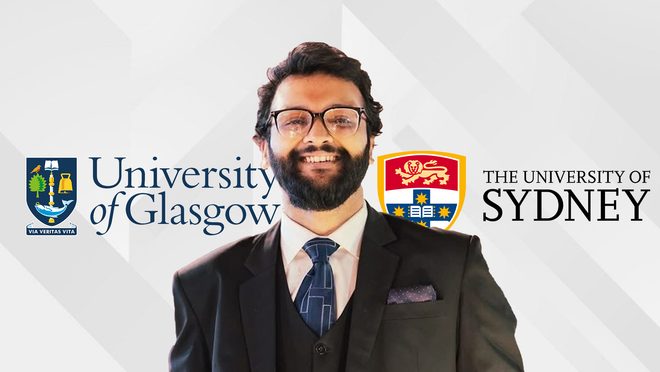
A cotutelle, or joint doctoral degree, is generally an arrangement between two institutions, typically in two different countries, where a PhD candidate is enrolled simultaneously and supervised by both institutions in order to complete a single dissertation paper.
The joint supervision model not only provides access to diverse libraries across the two institutions and supervisors but encourages cross-jurisdictional collaboration in the field of law.
Arnab noted, “When I came across my current supervisor in an interview from the University of Glasgow, it was recommended by him that I explore the collaborative PhD format offered jointly by the University of Glasgow and the University of Sydney. I was inspired to apply because my research interests extend beyond the boundaries of a single legal system.”
The beginning
“I spent most of my childhood in Chattogram, where I completed my schooling before enrolling in the School of Law at BRAC University. At BRACU, I quickly realised that legal education extended far beyond textbooks. Moot court competitions, legal research, student leadership at club levels, and later my role as a course assistant for a semester challenged me to think critically about the law, not merely as a collection of rules, but as a powerful institution capable of shaping society as a whole.”
After completing his LL.B., Arnab returned to Chattogram to pursue an LL.M. at Premier University. It was during this particular period that his research interests became much more focused.
“I saw how states silence dissent, suppress civil society, and legitimise extraordinary state action under the guise of “national security” and “public order.”
Those questions eventually evolved into his doctoral research proposal on the weaponisation of criminal law in postcolonial South Asia.
Receiving the Collaborative PhD Scholarship from UofG and USYD was therefore not something instantaneous, but the result of years of curiosity, perseverance, and intellectual growth.
Arnab shared that the thought of this ambitious endeavour developed over time. He added, “I often say that I entered law school hoping to find answers, but I left with far better questions, and those questions continue to guide my journey today.”
The application process
“From the very beginning of my journey, my goal was to pursue doctoral studies at a university ranked within the top 100 of the QS World University Rankings.”
Like every other PhD applicant, he found that searching for a supervisor was the most demanding part of the entire process.
“Initially, I made a research proposal on my designated topic last year before approaching any potential supervisors. Subsequently, I started sending out cold emails, where I got to know several different aspects of the proposal itself, which demanded changes or alterations,” shared Arnab.
He got positive replies from professors across multiple universities, including Cambridge, UBC, Warwick, and Birmingham, who were keen on supervising the project, and some even suggested further refinement of his arguments as well.
“There were some negative replies as well, pertinent to not being able to manage funds for the time being, not being interested in the topic and not being free enough to take a PhD candidate for this year. I considered these rejections as a form of redirection.”
After getting a green signal from supervisors, next came the application phase.
Application modules for a PhD in Law vary across universities, depending on their own admission requirements, but generally include submission of a research proposal, SOP, CV, previous academic qualifications, proof of English language proficiency, LORs, and interviews.
After several months of dedicated effort, multiple rounds of interviews, and a commitment to the overall process, Arnab finally received his funding confirmation letter last month.
“I have come to realise that pursuing a PhD, regardless of the institution or core subject, is a marathon rather than a 100-metre sprint. It requires perseverance, commitment, patience, and countless sleepless nights, as each stage helps you grow both academically and personally,” shared Arnab.
The Goal
When asked if Arnab has a book, article, or person that has had a lasting influence on the way he thinks about law or research, he replied, “If I had to name one book that truly sparked my interest in criminal law, it would be Understanding Criminal Law by Prof. Joshua Dressler. It fundamentally changed the way I thought about criminal responsibility and showed me that every legal rule has a story, a philosophy, and a consequence behind it.”
He feels excited to learn from leading scholars and become part of two outstanding law schools with different intellectual traditions. He hopes the opportunity to work across two universities from two different jurisdictions will broaden his perspective and strengthen the comparative nature of his research.
Arnab’s long-term goal is to build a career in academia. He notes, “I hope to teach, supervise research, and continue working on questions relating to criminal law, criminology, human rights, comparative constitutional law, postcolonial legal theory, critical legal studies, and national security laws.”
He is particularly interested in examining the intersection of criminal justice, democratic governance, and the rule of law in the Global South. At the same time, he hopes his research extends beyond universities and contributes meaningfully to debates on legal reform, judicial accountability, constitutional governance, and evidence-based public policy.
“After completing my PhD, I intend to pursue postdoctoral research to further strengthen my expertise before returning to academia as a teacher and researcher.”
Finally, he was asked if someone reads this interview five years from now, what is one idea or message he hopes they remember about your journey.
To which he replied, “I hope they remember that meaningful opportunities often begin with curiosity rather than certainty. I did not have every step of my journey planned from the beginning, but I kept asking questions, remained committed to learning, and embraced every opportunity to grow.”
He also hopes people realise that students from Bangladesh can make meaningful contributions to global academic conversations.
“Regardless of where we come from, irrespective of gender, thoughtful research, perseverance, and intellectual honesty can open doors that once seemed beyond reach.”
He concluded by saying, “If my journey encourages even one young legal mind to believe that their ideas matter and that they, too, can contribute internationally, and represent Bangladesh, I would be truly grateful.”