Education has no gender, says education minister Milon
Education has no gender, says education minister Milon
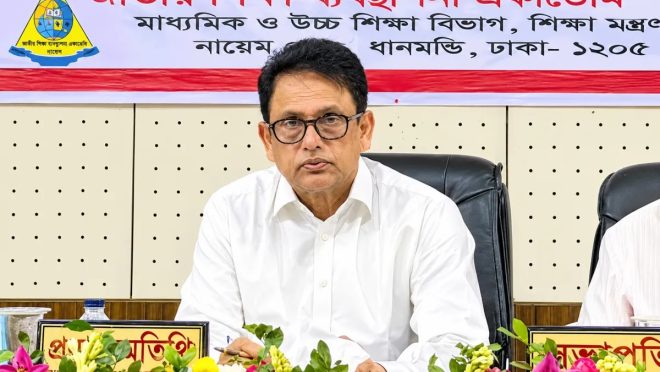
Education Minister Dr ANM Ehsanul Hoque Milon has said education has no gender, questioning whether anyone should be denied access to learning based on their gender identity.
“Does education have any gender? Has anyone ever said that people of a particular gender can study while others cannot? I believe education has no gender,” he said.
The minister made the remarks on Monday (2 November) while attending the certificate distribution and closing ceremony of the 210th Basic Training Course at the National Academy for Educational Management (NAEM) in Dhanmondi, Dhaka, as the chief guest.
Referring to criticism over his earlier comments on gender, Milon said an online newspaper had accused him of supporting transgender identity.
He said his earlier remarks concerned the representation of different gender identities in education, during which he had cited data showing that transgender people accounted for less than 1% of those who qualified.
The minister criticised what he described as attempts by some media outlets to distort speakers’ remarks and take them out of context.
“People should listen and understand before making comments. Creating panic in this way is very detrimental,” he said, urging media outlets to highlight positive developments alongside negative issues.
Speaking about the SSC and HSC examination results, Milon said the country’s education system had suffered a setback since the Covid-19 pandemic.
He said the practice of passing students without proper assessment had gradually weakened academic standards. He also pointed to the impact of political developments and what he described as a growing tendency among students to become involved in politics instead of concentrating on their studies.
The minister said the BNP government was working to improve students’ learning and writing skills, adding that weaknesses in higher education also needed attention.
Milon stressed the importance of proper training and orientation for teachers, noting that education cadre officers generally join their jobs without undergoing a structured training programme beforehand.
He compared this with other Bangladesh Civil Service cadres, saying administrative officers receive training after joining the service, while members of the armed forces and police undergo professional training before taking up their responsibilities.
“Training makes people better. But teachers do not have that kind of training arrangement,” he said.
The minister said the government wanted to introduce a merit-based approach to training programmes, prioritising participants who perform well in presentations, classroom activities and assessments.
He added that the basic training course needed to be made more comprehensive to keep pace with changing teaching models, modules and pedagogical approaches.
Milon also said the government was considering how to make the best use of resources allocated to the education sector.
He said Prime Minister Tarique Rahman had allocated the highest amount to education, while the ministry was working to ensure the effective use of available resources.
“We are working to build a future Bangladesh. The Prime Minister is working relentlessly towards that goal, and I have been given responsibility for this ministry to contribute to that effort,” he said.
He called on everyone involved in education to think critically and explore ways to improve the country’s education system.
“The collective thinking of all of us will be the driving force behind building the future Bangladesh,” he added.
NAEM Director (Training and Implementation), course adviser and convener of its Central Evaluation Committee Professor Prem Rizvi attended the programme.
The event was chaired by NAEM Director General Professor Dr Wasim Md Mezbahul Haque.