Why China appears less worried about an AI dystopia than the US
Why China appears less worried about an AI dystopia than the US
While US technology executives and researchers have warned that artificial intelligence could pose an existential threat to humanity, public anxiety around AI appears lower in China.
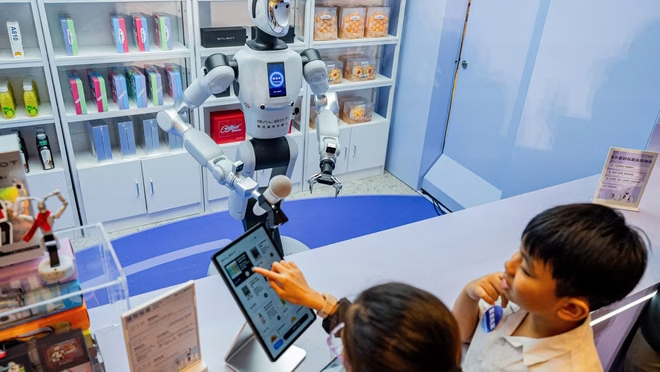
AI is already deeply integrated into everyday life there. Citizens use AI-powered government services, students receive instant feedback on assignments, and some hotels use robots to deliver parcels.
A Morgan Stanley survey found that 80% of Chinese respondents used AI at least weekly, compared with 54% in the US. An Ipsos survey also found that 83% of Chinese respondents viewed AI-powered products and services as exciting, compared with 33% in the US.
Trust in government may be one factor behind the difference. An Edelman survey found that 86% of Chinese respondents trusted their government to do what is right, compared with 39% in the US, as reported by CNN.
“In China, I think there is this very strong confidence from the public that if any sh*t hits the fan, the government will step in,” said Lian Jye Su, chief analyst at Omdia.
AI as convenience
Chinese tech companies have rapidly introduced affordable AI tools across apps and industries, including e-commerce, filmmaking and manufacturing.
“Most Chinese people meet AI as a cheap product first and as a debate second,” said Poe Zhao, an analyst at Hello China Tech. “When a technology shows up as a useful, low-cost service, people judge it by what it does for them, not by what it might do to them.”
That does not mean China ignores AI risks. Chinese officials have warned about cyberattacks, misinformation, theft of sensitive information, social instability and threats to political security.
However, Chinese discussions tend to focus more on controlling misuse and maintaining social stability than on the possibility of human extinction.
China’s technological rise may also shape public attitudes. Advances in electric vehicles, batteries and supercomputers have strengthened the perception that technology can bring economic growth and national strength.
“In China, there is this very pro-AI culture,” Su said. “Technology has always been viewed as a national pride.”
The result is a different relationship with AI. There is more emphasis on its immediate benefits and practical uses, and less public focus on its most extreme potential risks.