The curious case of Burberry’s disappearing exclusivity
The curious case of Burberry’s disappearing exclusivity

Burberry’s famous check has a slightly awkward problem, it is too recognizable.
For a luxury brand, that sounds like a dream. You see the beige, black, white and red pattern and immediately know what you’re looking at. No logo necessary. The checks are enough.
But luxury has always depended on a slightly ridiculous contradiction: you want people to recognise what you are wearing, but you also want them to know that not everyone can have it. Burberry eventually found out what happens when the symbol becomes a little too successful.
The British fashion house, founded in 1856, built its reputation on practical, weather-resistant clothing. Its check originally appeared as a lining, a quiet little detail for people who already knew what they were looking at. Then, particularly in the 1990s and 2000s, the check moved outside.
Scarves, bags, shirts, caps, coats; suddenly the Burberry check was everywhere. It became so recognisable that you could probably identify it from the back of a bus.
Great for brand awareness, less great for luxurious exclusivity.
Burberry became closely associated with British celebrity culture and football casuals, while counterfeit versions of the pattern multiplied. The very thing that made the check valuable as a status symbol also made it ridiculously easy to copy.
And this is where fashion gets classist. The moment too many people can afford the look, the people who made it desirable start looking for something else.
The rich do not necessarily want something because it is expensive. They often want it because it feels rare and not everyone can have it. Once everybody knows exactly what you are wearing, the magic can start to wear off.
There is a strange cycle in fashion: the rich make something desirable, everyone wants it, the mass market adopts it, and eventually the rich start looking for something else because what they found desirable is now ubiquitous
Burberry’s problem was not necessarily that people stopped liking the check, instead that people liked it too much.
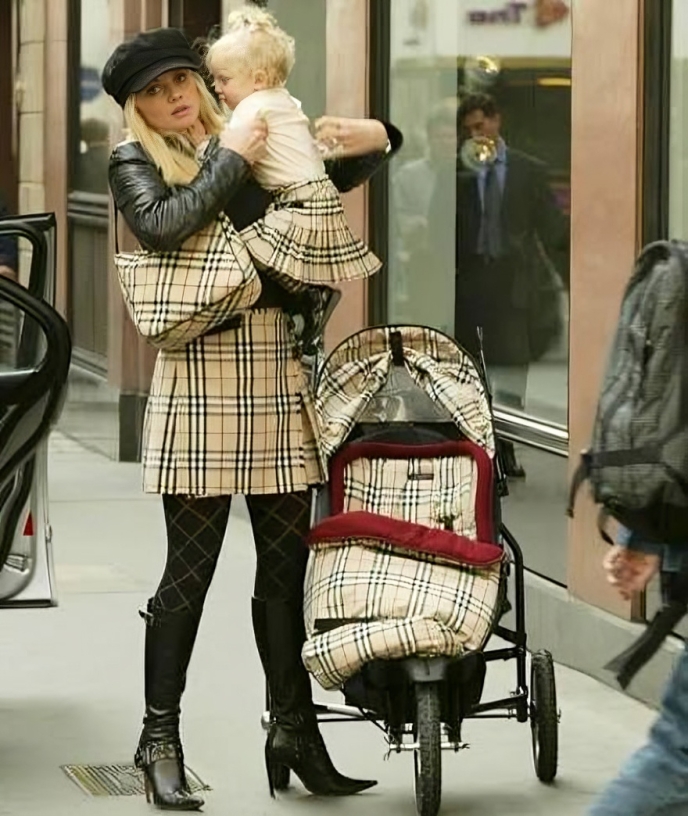
The photo that officially turned the rich away from Burberry. Photo: Collected
That is partly why the brand has spent years shifting attention back towards its heritage, particularly the trench coat, British craftsmanship and its identity as a distinctly British fashion house.
The distinction between heritage and nostalgia matters here.
As CNN’s Fiona Sinclair Scott noted after Burberry’s Spring-Summer 2027 show, creative director Daniel Lee is trying to use the brand’s history without simply dressing it in a costume from its own past. The latest collection reworked familiar Burberry elements, while a collaboration with British textile designer Celia Birtwell brought bright florals and a softer, more playful mood.
It is less “remember when Burberry was cool?” and more “we have 170 years of history, so what are we actually going to do with it?”
Because nostalgia can turn a fashion house into a museum, but heritage gives it something to build from.
Burberry’s check will probably never disappear. It is too deeply attached to the brand, and trying to get rid of it would be like McDonald’s deciding it no longer wants the golden arches.
But Burberry now has a more difficult job than simply making people recognise it.
The trick is making the check feel special again, without making it look like it is trying desperately to prove that it is.