From Cuet to $4m: The journey behind ResearchBuddy
Let’s say someone gave you the choice between continuing to study at university in Bangladesh or embarking on a risky startup, but one that would solve a serious academic problem for many.
From Cuet to $4m: The journey behind ResearchBuddy
Let’s say someone gave you the choice between continuing to study at university in Bangladesh or embarking on a risky startup, but one that would solve a serious academic problem for many.
That was the very decision that ResearchBuddy founder Mohammad Fahim Uddin found in front of him. When asked, he told me a story that was full of struggle, but just as much inspiration, with a recurring tale of resilience shining through the adversities that life threw at him.
The story almost could’ve felt complete when he joined Chittagong University of Engineering and Technology (Cuet). One would imagine a stable life ahead, now that he could pursue a degree in EEE from a public university. During his time at Cuet, Fahim found a significant gap in the accessibility of research.
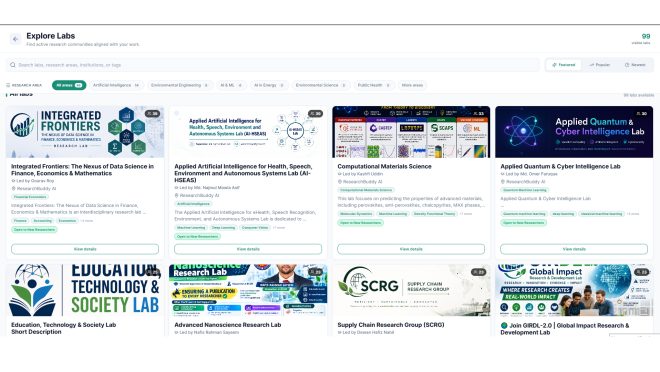
There were people who were willing to conduct research, and there were those willing to offer them that opportunity, but a connection between the two simply failed to happen. With the help of his other co-founders, Jahirul Islam Fahim, Nahiyan Bin Noor, and Ishmam Ahmed Solaiman, ResearchBuddy kickstarted its journey. Along with his wife Zerin, Fahim and his team brought together the entire functioning of the startup.
“During my third year, my grandmother passed away, and I accumulated backlogs in several subjects. As ResearchBuddy began to grow, the pressure increased further. Eventually, I had to make a choice between returning to Cuet and focusing almost entirely on academics, or staying with my family and continuing to build the business. I chose the latter. It was one of the hardest decisions of my life,” said Fahim.
The primary goal of ResearchBuddy was to improve the research ecosystem of Bangladesh, because a major chunk of the researchers faced three significant obstacles. The first being access, where a competent student may not find the necessary supervisor to conduct research. Along with that, there is a severe lack of infrastructure, meaning that people have to use an uncoordinated combination of Drive, Zoom, etc., instead of a proper research workflow. Lastly, even if research sees the light of day after these problems, there is a publishing wall, as traditional research is quite expensive, leading to a financial hindrance towards the eventual publication of the research.
ResearchBuddy tries to solve these issues by combining AI research tools. A researcher finds a supervisor, joins their lab, does structured research with AI tools, and publishes. Fahim said, “The fundamental purpose of a university is not only to teach but it is also to generate knowledge through research. Unfortunately, more than 8,000 researchers have joined our platform, over 1,000 researchers have conducted research through more than 100 supervisors, and more than 1,500 researchers have completed their programs. Many have gone on to receive opportunities and scholarships for higher education abroad, and more than 50 research works from our community have been published in journals and international conferences.”
ResearchBuddy has already reached users in 20+ countries, having won the ICT Innovation Grant and Crossref membership. The eventual goal for ResearchBuddy is to provide a researching platform for the countless students globally, and to create an operational system where people can bypass the current obstacles, making research faster and more efficient in the process.
“ResearchBuddy is particularly challenging because we’re working in an ecosystem where trust, ethics, academic quality, and credibility matter enormously. I actually enjoy those difficult problems. For me, the motivation comes from taking something complicated and trying to make it work.”
A particular story that stands out is that of Abdikani Kadiye, a Somalian researcher, who discovered ResearchBuddy and was very interested in joining one of the virtual labs, which was conducted by Sheikh Abrar, a PhD fellow at Penn State University.
“Initially, he was unable to pay us due to an international payment processing problem. He then contacted a friend of his in India to pay us, but again faced a problem. He tried TapTap, nSave, and many other methods to pay us, but failed. But he never gave up. Then, he contacted a Bangladeshi in Sweden and was finally able to make the payment. Not only this, he also brought some of his friends, who joined our various labs. This proves that we’re not only solving local problems but also global problems.”
Fahim also told us about how many of the local students who had no facility or prior experience in research were helped by his startup.
Fahim shared the story of Upendra Chakma, who is from Khulna University, where there is limited scope for research. His university did not have the proper facilities. However, he had a dream of pursuing higher education after his bachelor’s degree, where a strong research profile is a gateway.
Upendra joined ResearchBuddy, published a paper, and has now received scholarships from two universities, the University of Tokyo and IIT Madras.
Rahul Barua, who is from National University, faced similar challenges. Now, he has published three research papers, one of which received a best paper award at an IEEE conference.
Now, ResearchBuddy is valued at around US$4 million, according to Fahim.
“The first thing I feel is gratitude. I see the journey as a miraculous blessing from Allah. There were so many points where things could have gone differently, and I know I couldn’t have come this far without Allah’s help. I’m also deeply grateful to my wife, Zerin, who has supported me throughout this journey and has been part of building the business.”
One of the aspects of ResearchBuddy that CEO Fahim mentions with a smile is how it took off the pressure of finding a job. He fondly recalls how the business was already generating revenue for him, and how he could support his family without needing to build a corporate career from scratch.
However, he was also quick to correct himself, saying that the pressure has not gone away, but rather shifted into a more sophisticated form. His worries no longer include survival or academia, but a much larger goal of scaling ResearchBuddy into a global entity.