Nobel Prize 2026: Turning light into a tool for brain research
Three scientists, Karl Deisseroth, Peter Hegemann, and Georg Nagel, were jointly awarded the 2026 Nobel Prize in Physiology or Medicine. They earned it for their discoveries concerning light-gated ion channels and optogenetics, a brilliant approach that essentially gives researchers a remote control for individual brain cells using light.
Nobel Prize 2026: Turning light into a tool for brain research
Three scientists, Karl Deisseroth, Peter Hegemann, and Georg Nagel, were jointly awarded the 2026 Nobel Prize in Physiology or Medicine. They earned it for their discoveries concerning light-gated ion channels and optogenetics, a brilliant approach that essentially gives researchers a remote control for individual brain cells using light.
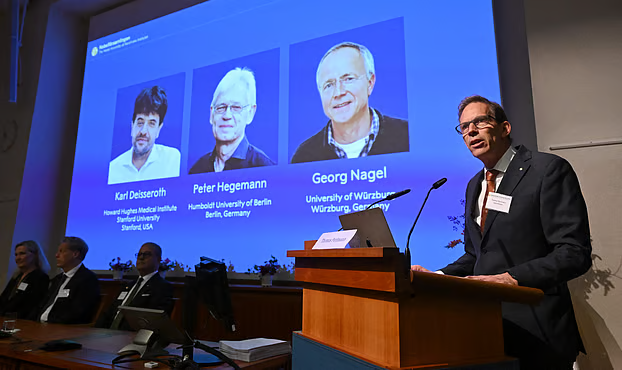
The medicine award always leads the charge for Nobel week, keeping alive a tradition Alfred Nobel mapped out back in 1895. The Nobel Assembly at Stockholm’s Karolinska Institutet selected the winners, who will share the 12 million Swedish kronor (roughly $1.2 million) reward.
Deisseroth directs a bioengineering and psychiatry lab at Stanford University. Hegemann leads biophysics research at Humboldt University in Berlin, while Nagel works as a senior professor at the University of Würzburg.
This year’s award shows how a simple study of microscopic pond algae solved a century-old blockade in brain research.
The human brain contains around 86 billion neurons that send rapid electrical signals through a crowded network. Finding out the exact job of just one group of cells was nearly impossible with old tools.
Drugs could target specific cell types, but they moved too slowly through brain tissue, drenching wide areas and causing unintended side effects everywhere.
Microelectrodes gave instant timing. But again, electricity flows wildly through wet brain tissue, shocking target cells and innocent neighbouring cells alike. Researchers could record signals, but proving direct cause and effect in a living brain was almost impossible.
The answer came in the form of green pond algae. Algae need sunlight to make food. To swim towards light, they rely on small proteins called channelrhodopsins that act like natural switches. When hit by blue light, these proteins pop open. Positively charged particles move into the cell, which starts a movement signal that steers the algae towards the sun. During the late 1980s and 1990s, Hegemann and Nagel mapped out exactly how these biological switches worked.
Using a harmless virus as a tiny delivery truck, Deisseroth’s team got specific mouse neurons to build these light switches on their own outer surface.
When researchers shined a quick pulse of blue light through a flexible glass cable into the brain, the engineered neurons fired instantly. When they turned off the light, the neurons stopped firing.
Over the past 20 years, labs worldwide have used optogenetics to point out the exact cell pathways behind Parkinson’s tremors, severe depression, addiction, and chronic pain. Doctors are even testing these algal genes in human eyes today, trying to bring back basic sight in people suffering from age-related blindness.
By borrowing a survival trick from microscopic pond algae, Deisseroth, Hegemann, and Nagel turned a basic biological switch into an essential tool for modern medicine.
With the Medicine award now decided, Nobel Week 2026 has officially kickstarted. Over the course of the next few days, the remaining honours will follow in succession: Physics on Tuesday, Chemistry on Wednesday, Literature on Thursday, Peace on Friday, and Economic Sciences rounding out the week on 12 October.