The final goodbye
“One day, the noise of insults will be drowned out by the sound of applause.”
The final goodbye
“One day, the noise of insults will be drowned out by the sound of applause.”
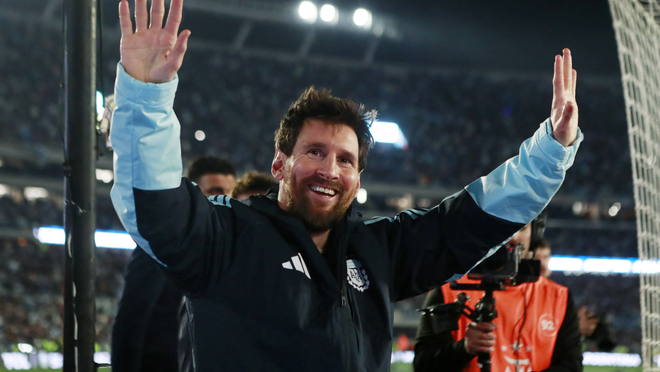
The line from Patiala House was written for a story about cricket, but watching Lionel Messi’s farewell in Buenos Aires, it felt as though the dialogue had been waiting for him all along.
For years, Messi heard the noise. He heard the criticism, the disappointment and the accusations that he could win everything with Barcelona but somehow could not win with Argentina. But on 6 October 2026, inside Buenos Aires’ Estadio Monumental, that noise was gone. In its place was something far more powerful: thousands of people standing together, crying, applauding and chanting one name: Messi.
Before the applause, there was pain
There was a time when Argentina did not know how to love Lionel Messi. He had reached three major finals in three consecutive years, the 2014 World Cup, Copa América 2015 and Copa América Centenario 2016, and lost all three. The 2016 defeat to Chile was particularly cruel. Messi missed his penalty in the shootout, and shortly afterwards announced his retirement from international football.
For a country desperate for another trophy, Messi became an easy target. His greatness was not enough. His goals were not enough. His genius was not enough. There were fans who burned his shirt, hurled insults at him and questioned his commitment to the national team. Some even argued that he could be the greatest player in Barcelona’s history while somehow failing to be the same Messi for Argentina.
Then Messi did something that defines him better than any trophy ever could: he came back. Just 66 days after announcing his retirement, he returned to the national team. He did not return because the criticism had disappeared. He returned because Argentina still mattered to him. That may be the greatest lesson of Messi’s career. Sometimes giving everything does not guarantee that you will win. Sometimes you will give everything and still lose. But losing does not have to be the end of your story.
The greatest comeback was not on the pitch
Messi eventually won the Copa América in 2021. Then came the Finalissima. Then Qatar. The 2022 World Cup was not simply a tournament victory; it felt like the final chapter of a story that had taken years to write. The same player who had once walked away from Argentina with tears in his eyes was now lifting the World Cup as captain. He had finally won the trophy the country had demanded from him for so long.
But even then, what made Messi special was not simply that he scored. It was how he played for others. Messi has always been more than the person who finishes an attack. He creates the attack. He gives assists. He draws defenders towards himself. He creates space for teammates. He brings others into the game. His greatness has never been about making the entire game revolve around himself; strangely, it has often been about making the people around him better.
And perhaps that is why his final Argentina performance felt so appropriate. Against Benin, Messi scored and created opportunities for his teammates, finishing his international journey in the same way he had played so much of it, not simply as the star, but as a footballer who continued to create for others. Even at the end, Messi was making room for his teammates.
His legacy is bigger than the goals
Argentina will remember the 2022 World Cup. It will remember the Copa América titles, the goals against Mexico, the magic against Croatia, the penalty against France and the moment Messi finally lifted the World Cup. But his influence on Argentine football goes much deeper.
Many of the players now wearing the Argentina shirt grew up watching Messi. For them, he was not simply the captain standing beside them in the dressing room. He was the player they watched as children, the player who made them believe that they too could one day wear the Argentina shirt. Messi did not merely leave behind statistics; he left behind a generation of footballers who wanted to become better because they had watched him.
That is what a true legacy looks like. A great player leaves records. A great leader leaves trophies. But an extraordinary human being leaves people who want to become better because they watched him.
Look at what he does after he scores
There is another Messi moment that says more about him than any statistic ever could. He scores, celebrates with his teammates and then raises both hands towards the sky. It is his quiet way of remembering his grandmother, Celia, who played an important role in his childhood and early football journey. She was one of the people who believed in the little boy before the rest of the world knew his name.
Think about that for a moment. The world’s biggest stadiums. Millions watching. World Cups. Ballon d’Ors. Championships. Global fame. And after all of it, Messi still remembers the grandmother who stood behind him when he was just a child with a football dream.
That gesture carries a lesson that has nothing to do with football. Remember the people who believed in you before the world knew your name. Remember the people who supported you when you had nothing to give them except a dream. Messi’s gesture towards the sky is, in its own quiet way, a reminder to be better grandchildren, to remember our roots and to never become so successful that we forget the people who helped us begin.
The man behind the No. 10
There is another side of Messi that rarely appears in statistics. The superstar who has spent more than two decades under cameras has kept his family at the centre of his life. He has built his life alongside Antonela Roccuzzo, his childhood sweetheart, and their three sons. In a world where fame can easily become an identity, Messi has repeatedly shown that football is only one part of who he is.
The stadium may belong to Messi for 90 minutes, but when the match ends, there is another life waiting for him. There is family. There is home. There are responsibilities that have nothing to do with football. Perhaps that is another lesson people draw from his life: be successful, but do not let success make you forget who you are. Be present for the people you love. Be a better partner. Be a better father. Remember that the people waiting for you at home matter more than the people applauding you outside.
What kind of person did Messi become?
Messi has spent more than two decades being judged as a footballer. Was he the best? Did he score enough? Did he win enough? Was he better than Maradona? Was he better than Ronaldo? Those arguments will continue long after he stops playing.
But there is another question that feels more important now: What kind of person did Lionel Messi become?
He was a boy who failed in finals and came back. He was a player who was criticised but continued to serve his team. He became a superstar who could have demanded everything from those around him, yet so often chose to create opportunities for them. He became a global icon who still remembered his grandmother. He became a father who returned home after becoming one of the most famous people on Earth. And he became a captain who finally gave his country the trophy it had been waiting for.
That is why people love Messi. Not only because he can dribble past five defenders. Not only because he can score goals nobody else can imagine. Not only because he won the World Cup. They love him because, somewhere along the way, Messi became proof that greatness and humility can exist in the same person.
And then came the goodbye
On 6 October, Buenos Aires did not boo him. It did not question him. It did not demand another trophy. It simply said, “Gracias, Leo.”
More than 85,000 people filled the Monumental for his farewell. The stadium erupted when he appeared. The No. 10 received a standing ovation. There were tears, fireworks and chants. For a few hours, the football stadium seemed to become something more than a stadium. It became a place where an entire country could collectively say goodbye to someone who had accompanied it through more than two decades of joy, heartbreak, disappointment and glory.
And then Messi did what Messi had done for 21 years. He played. He assisted. He scored. He looked towards the crowd. And eventually, he said goodbye.
His final Argentina numbers are almost impossible to comprehend: 208 appearances and 126 goals, making him Argentina’s most-capped player and leading scorer. But perhaps those numbers are not the ones we should remember most.
Remember the boy from Rosario. Remember the grandmother who believed in him. Remember the player who lost. Remember the man who came back. Remember the captain who finally lifted the World Cup. Remember the teammate who made space for others. Remember the father who goes home and plays with his children. Remember the husband. Remember the human being.
The applause that will remain
Football will eventually find another great player. Argentina will eventually find another No. 10. Someone else will score goals. Someone else will lift trophies. But there may never be another Lionel Messi.
And when the noise of the streets finally fades, when the stadium lights go dark and the last chant of “Messi, Messi, Messi” disappears into the night, what will remain is not simply the memory of a footballer. It will be the memory of a man who showed millions, without ever giving a lecture, that you can lose and still return; that you can become the greatest and remain humble; that you can be celebrated by millions and still remember one person in the sky; and that you can become a hero without ever trying to look like one.
Perhaps that is the most beautiful thing about Messi’s legacy. He did not simply show us how to play football. He showed us how to lose, how to return, how to love, how to remember, how to give and how to stay humble.
He teaches us to be better teammates. He teaches us to remember our grandparents. He teaches us to value the people who stood beside us before we became successful. He reminds us that being a good partner and a good father can matter just as much as being successful outside the home. And above all, his journey reminds us that greatness is not only about what we achieve; it is about the kind of person we become while achieving it.
That is why Lionel Messi was never just a footballer. He became something much larger.
He became a story of resilience for those who have lost, a story of humility for those who succeed, a story of gratitude for those who remember where they came from, and a story of humanity for everyone who watched him grow from a boy with a dream into one of the greatest athletes the world has ever known.
The line from Patiala House finally found its meaning in Buenos Aires: The noise did eventually become applause.
And perhaps that final applause was never really for the goals. They were for the journey.
Thank you, Lionel Andres Messi Cuccittini, for everything.