What it takes for women to return to work
“If you get a second chance, take it, even if you don’t feel completely confident or ready. I think sometimes we wait until we feel that we are 100% prepared, but that moment may never come. You can rebuild your confidence while you are working.”
What it takes for women to return to work
“If you get a second chance, take it, even if you don’t feel completely confident or ready. I think sometimes we wait until we feel that we are 100% prepared, but that moment may never come. You can rebuild your confidence while you are working.”
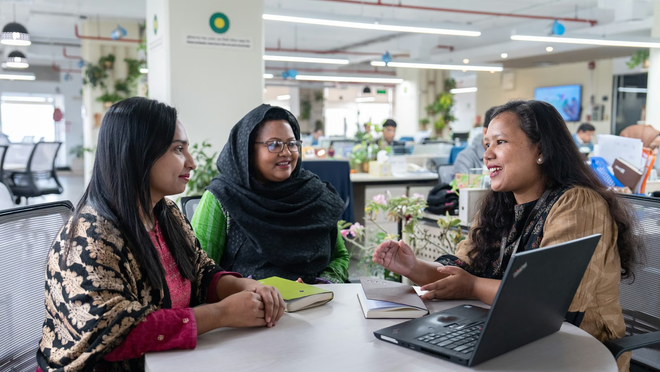
A career break is not the end of a professional journey. Two graduates of BRAC’s BRIDGE Returnship Programme share that beyond updating skills, adapting to new workplace practices and finding suitable opportunities, there is often a more personal struggle — learning to believe in yourself again
For Anika, a year-long career break brought uncertainty despite her years of experience in sales. Job interviews and the challenges of returning to work as a mother gradually affected her confidence. Mahia, who had several years of banking experience, faced similar doubts about adapting to a changing corporate environment and performing at her previous level.
Their experiences reflect the challenges many women face when returning to work. For both, BRAC’s BRIDGE Returnship Programme became an opportunity to rebuild their confidence, reconnect with their professional strengths and realise that returning to work did not mean starting over.
A career is rarely a straight line. For some women, it takes an unexpected pause as they navigate marriage, motherhood, family responsibilities or other personal circumstances. While stepping away from professional life may be a necessary decision at a particular stage of life, returning to work can bring a different set of challenges.
Beyond updating their skills, adapting to new workplace practices and finding suitable opportunities, there is often a more personal struggle: learning to believe in oneself again.
When self-doubt overshadows experience
For Anika, returning to work was not easy despite her experience in sales. Although she knew her professional strengths, her career break had affected her confidence, and finding a new job made her more aware of the challenges women face when re-entering the workforce.
Despite several interviews, Anika felt that being a mother and having a career break overshadowed her years of sales experience. The experience gradually eroded her confidence.
“Honestly, it meant a lot to me. My career break was around one year, which may not sound like a very long time, but being without a job had a significant impact on my confidence,” Anika said.
Mahia faced similar doubts about returning to professional life. Despite several years of banking experience, a year-long career break left her questioning whether she could readjust to the demands of the corporate world.
“Before my career break, I already had several years of professional experience, particularly in the Banking sector. But after spending a year away, I sometimes questioned myself: ‘Can I still do this? Can I adapt again? Will I be able to perform at the level I used to?’” Mahia said.
Her concern was less about losing her skills than adapting to new systems and workplace expectations while maintaining her performance. She realised that professional competence and confidence do not always return at the same pace.
An opportunity to start again
For Anika, joining the BRIDGE Returnship Programme marked an important turning point. The recruitment process began with an application where candidates shared their educational and professional backgrounds, previous experiences and preferred departments.
When Anika was invited for an interview, she found the experience comfortable and meaningful because the questions focused largely on her professional experience, skills and accomplishments rather than simply on her career break.
After joining the programme, she found that the same approach continued. Her supervisor and mentor took time to understand her strengths, identify areas for improvement and provide guidance as she settled back into professional life.
“What made the experience even more meaningful was the support I received throughout the programme. From my supervisor and mentor to the other people I worked with, I felt that they understood that I already had professional experience,” Anika said.
Mahia experienced a similar transition. After being away from professional life for around a year, she knew she had the experience but needed time to regain the rhythm of the workplace. The programme allowed her to gradually understand new processes, take on responsibilities and rebuild her confidence.
“It helped me transition back into professional life in a very practical and supportive way. After being away for around a year, I knew I had the professional experience, but I also knew that getting back into the rhythm of a workplace would take some time,” Mahia said.
For both women, the programme created an environment where their career breaks were not treated as the defining part of their professional identities. Instead, the programme gave them space to reconnect with their existing skills, learn where needed and move forward with renewed confidence.
Rebuilding confidence, one step at a time
For Anika and Mahia, returning to work was about more than employment. It was about recognising that a career break does not erase a woman’s experience, skills or potential.
Returning to a professional environment can bring new systems, responsibilities and expectations, along with the pressure to prove oneself immediately. The programme allowed Anika and Mahia to adjust gradually, making learning and growth part of the return process.
For Mahia, one of the most important realizations was that she did not need to prove her capabilities all at once.
“There were also new things to learn, new systems to understand and a different work environment to adjust to. But I realized that professional skills don’t simply disappear because you take a break. You may need some time to refresh them and get back into the rhythm,” Mahia said.
Anika experienced a similar transformation. With encouragement from her supervisor, mentor and colleagues, she began to see her career break as one part of her professional journey rather than something that had defined it.
“For me, it was not just about getting a job again. It was about getting my confidence back, proving to myself that I still had the ability to contribute, learn and grow and realizing that a career break had not taken away my professional identity,” Anika said.
A career break is a pause, not an ending
The experiences of Anika and Mahia point to a larger challenge: helping women reconnect with the workforce after stepping away from personal or family responsibilities.
A career break should never define the rest of a woman’s professional life. What matters is having a meaningful opportunity to return when the time is right.
“I would tell women not to think of a career break as the end of their career. Life happens. Marriage, motherhood, and family responsibilities are all important parts of life, and sometimes women have to make difficult choices and put their careers on hold,” Anika said.
She also believes women should not wait until they feel completely ready before taking their next opportunity.
“If you get a second chance, take it, even if you don’t feel completely confident or ready. I think sometimes we wait until we feel that we are 100% prepared, but that moment may never come. You can rebuild your confidence while you are working,” she said.
Mahia’s experience reinforces that message. Returning after a career break can create the feeling of being left behind, but her journey showed that professional growth does not have to follow a straight path.
“I would tell her that there may be days when she feels that everyone else is moving forward while she is standing still. There may be moments when she questions whether she will ever be able to return to where she was,” Mahia said.
Reflecting on her own journey, she added, “Sometimes you don’t need to start your career all over again. You just need someone to give you the opportunity to continue from where you left off.”