IUB hosts session on Palestine’s political future
IUB hosts session on Palestine’s political future
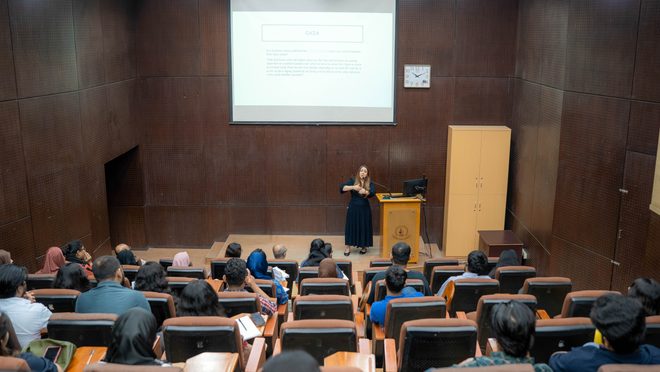
The Department of Global Studies and Governance (GSG) at Independent University, Bangladesh (IUB), hosted an academic session titled “What Is Next for Palestinians?” on 12 October, 2026, at the university’s BC 7002 lecture hall.
The session was organised primarily for students enrolled in the Middle Eastern Studies course (GSG 380) and was also open to others interested in Palestine’s political landscape.
Dr Sanaa Alsarghali, a Palestinian legal scholar and political researcher, was the keynote speaker. She is an associate professor of constitutional law at An-Najah National University in the West Bank and holds a UNESCO Chair in Human Rights, Democracy and Peace. The session was moderated by Dr Marufa Akter, associate professor in the GSG Department.
Dr Alsarghali discussed Palestine’s political landscape, governance structures, territorial divisions, restrictions on movement and the challenges facing Palestinians.
She outlined key historical developments, including the 1967 Israeli occupation, the 1991 Madrid Conference and the First and Second Intifadas. She also examined how subsequent political frameworks failed to deliver Palestinian statehood and shaped the political and administrative realities of Palestinian life.
Discussing the Oslo Accords, Dr Alsarghali highlighted their role in shaping administrative and territorial divisions between the West Bank and Gaza. She also explained how Israeli identification and permit systems restrict Palestinians’ freedom of movement, affecting border crossings, employment, residency rights, marriage and family unity.
She raised concerns about restrictions on Palestinian education, including limitations on learning about their history and national identity. The unresolved issue of refugee resettlement was also discussed, with a focus on commitments that remain unfulfilled.
Turning to internal governance, Dr Alsarghali examined divisions between Hamas in Gaza and the Palestinian Authority in the West Bank. She also discussed the feasibility of a single-state framework under the current political circumstances.
Emphasising the need for Palestinian unity, she called for political reconciliation, open communication and a common strategy among Palestinian factions. She also cautioned against foreign interference in Palestinian politics, saying it could undermine political autonomy and democratic processes, including national elections.
Dr Alsarghali concluded by questioning the effectiveness of established international peace frameworks, including the Board of Peace, and the roles of the bodies responsible for implementing them. She urged students to critically examine conventional approaches to peacebuilding and consider the challenges of securing a viable political future for Palestine.
The session ended with an interactive question-and-answer segment, allowing students to engage directly with the issues discussed. Dr Md Shanawez Hossain, associate professor and head of the GSG Department, presented Dr Alsarghali with a token of appreciation.