Why every protest needs a Batman
When people come together to demand a different world, they almost always build masks, rituals and symbols that look a lot like acts of faith. Batman is the clearest example we have of why.
Why every protest needs a Batman
When people come together to demand a different world, they almost always build masks, rituals and symbols that look a lot like acts of faith. Batman is the clearest example we have of why.
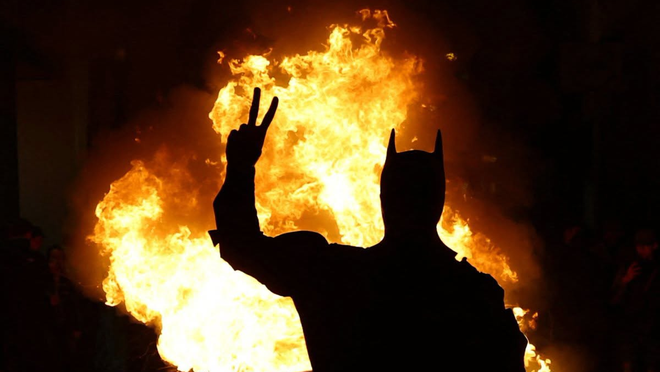
Bob Kane and Bill Finger introduced Batman in Detective Comics in May 1939, and the origin has barely changed since. A boy walks out of a theatre with his parents. A man in an alley wants their money, and both parents are shot. Every belief starts somewhere, and for Bruce Wayne it starts there.
He grows up rich, with every option a grieving person could want, and picks the strangest one. In the best-known telling, a bat breaks through his study window while he is deciding what to become. He takes the animal that frightened him and wears it.
The costume does not just hide him. It makes a new person. That is the step where a private feeling becomes something other people can see. Protesters do a smaller version of it. They wear the same colour, carry the same flag, cover their faces and repeat the same words.
The rallies in Germany this weekend, called by a group named “GenZ regelt!” across about 30 cities, began as a name and a slogan before any face attached to them. For a few hours, a crowd of separate people becomes one thing with a life beyond any of them.
Then there is the rule. Batman does not kill. He breaks into buildings, beats men in dark rooms and tails citizens without a warrant, and he still will not kill, even the Joker, who has given him plenty of reasons. The rule is not a limit on his mission. It is the mission. He is defined less by what he fights than by what he refuses to become. Every movement that lasts has some version of this, usually unwritten. A symbol is powerful when it tells people what they are against, and more powerful when it tells them what kind of people they are trying to be.
That is why the symbol outlives the person. Bruce is mortal, tired and contradictory. Batman is not supposed to be. A protester can go home, a leader can be arrested and someone can die, but the flag stays, the chant stays and the mask gets picked up by someone else. Batman Begins (2005) says it plainly: a man can be stopped, and a symbol cannot. The Guy Fawkes mask came from the comic V for Vendetta and ended up on the faces of Anonymous and Occupy. The One Piece straw hat flag appeared in Indonesia and Nepal in 2025.
Movements have the other things congregations have as well: icons, repeated words, sacred stories, colours and martyrs. Bangladesh has seen the last of these up close. In July 2024, the image of Abu Sayed, a student at Begum Rokeya University, standing with his arms spread in Rangpur before he was shot, became the picture people carried. Not every movement is a religion. But people seem to need a way to make an abstract belief visible, and the visible thing is what they follow.
It also costs them. Strip the costume away and what Batman practises is renunciation. Bruce gives up friends, sleep and a name he can use in the dark. He serves something he cannot finish, because Gotham will never be cured. A protest asks a smaller version of the same from ordinary people.
A student in a crowd sets his own name aside, repeats the same slogan, wears the same colour and takes a risk he cannot fully count. He gives up comfort, time, anonymity and sometimes safety, for something that may never reward him personally. The reason is not always ideology. Sometimes it is belonging, and sometimes it is the need to believe that one small body in a crowd can become part of something that matters.
This is where Batman is most useful, because he is not a clean metaphor. In The Dark Knight (2008), Batman takes the blame for Harvey Dent’s crimes so the city can keep a clean hero. It works. Gotham passes a law in Dent’s name and puts away hundreds of criminals. It is also a lie, and everything built on it depends on nobody checking. Movements protect their images too, and sometimes the truth pays for it.
Symbols can also be taken. In The Dark Knight Rises (2012), Bane tells Gotham the city belongs to the people, opens the prison and holds trials in public. The plan underneath is a bomb. A symbol belongs to whoever uses it best, and that is not always the crowd that raised it. The choice of face tells something too. Joker imagery appeared at protests in Lebanon and Chile in late 2019, months after the film came out. Whatever each wearer meant, it suggests a crowd choosing the face the powerful fear over the face an audience loves.
And there is the question the fans avoid. Bruce Wayne is a billionaire. Gotham’s problems are poverty, a failing asylum and a police force that can be bought, and he could fund a fix for each. He funds the cape instead.
In September, I called protests democracy’s backup system, the thing a country falls back on when its courts, councils and press have stopped working. Batman is that idea in one man. He is what a city invents when its ordinary channels fail, and the longer he is needed, the worse the news about the city.
So yes, every protest needs a Batman. It needs the mask, the rule and the willingness to be hated for it. What it cannot afford is to need him for long. Gotham has had one since 1939, and it is still Gotham.