BRAC University conference examines colonial legacies in language education
BRAC University conference examines colonial legacies in language education
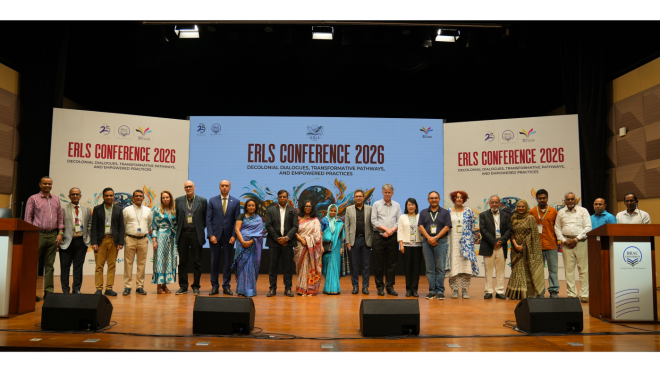
A two-day international conference opened at BRAC University on 6 November, 2026, bringing together scholars, practitioners and students to examine assumptions about language, knowledge production and education, with a focus on historical and colonial legacies.
Organised by the BRAC Institute of Languages (BIL), “Epistemic Reconfigurations in Language Studies” drew more than 250 participants from Bangladesh and abroad and featured 145 presentations, according to the press release. Held at the university’s main campus in Merul Badda, Dhaka, the conference included three keynote presentations, two invited speakers, two “Rising Stars” and three colloquium sessions.
Addressing the inaugural ceremony as guest of honour, Lulzim Pllana said, “The ability to communicate across languages and cultures, exchange ideas, and learn from different perspectives will be essential in shaping a more connected and collaborative future.”
Mamun Ahmed, chairman of the University Grants Commission of Bangladesh, attended as chief guest.
“In an increasingly interconnected world, knowing another language is not simply an academic qualification. It can open doors to education, employment, cultural exchange, research collaboration and stronger international relations,” he said.
Arshad Mahmud Chowdhury, pro-vice-chancellor of BRAC University, chaired the inaugural ceremony.
“For a long time, knowledge and academic practices from the Global North have often been treated as the primary sources of authoritative knowledge. Meanwhile, the languages, histories, experiences and intellectual traditions of the Global South have not always received the recognition they deserve,” he said.
“Decolonial thinking invites us to examine this imbalance. It encourages us to question established assumptions, recognise our own intellectual traditions and create space for diverse voices and perspectives,” he added.
In her welcome speech, Lady Syeda Sarwat Abed, adviser and founder of BIL, said, “We believe that language education should be inclusive, relevant and transformative, while remaining deeply connected to the cultural and social contexts in which learners live.”
Shaila Sultana, director of BIL and convenor of the conference, highlighted the institute’s work beyond classroom teaching in her closing remarks.
“We take language learning and teaching beyond traditional classrooms and into essential workplaces. We are expanding practical programmes, including communication workshops for healthcare workers and nurses, as well as language labs that support safer migration,” she said.
The keynote speakers were David Block of Universitat Pompeu Fabra in Spain, Ana Deumert of the University of Cape Town in South Africa and Peter I De Costa of Michigan State University in the US.
The invited speakers were Yongyan Zheng of Fudan University and Anwar Ahmed of the University of British Columbia in Canada. Nasrin Pervin of North South University and Mohammad Mosiur Rahman of the University of Liberal Arts Bangladesh were the conference’s “Rising Stars”.