A perfect CGPA, no doubts: Nova’s journey to a fully funded neuroscience master’s
A perfect CGPA, a full merit scholarship, and a place among just 16 scholars selected from more than 1,000 applicants worldwide. This is the story of Nazmoon Nahar Nova.
A perfect CGPA, no doubts: Nova’s journey to a fully funded neuroscience master’s
A perfect CGPA, a full merit scholarship, and a place among just 16 scholars selected from more than 1,000 applicants worldwide. This is the story of Nazmoon Nahar Nova.
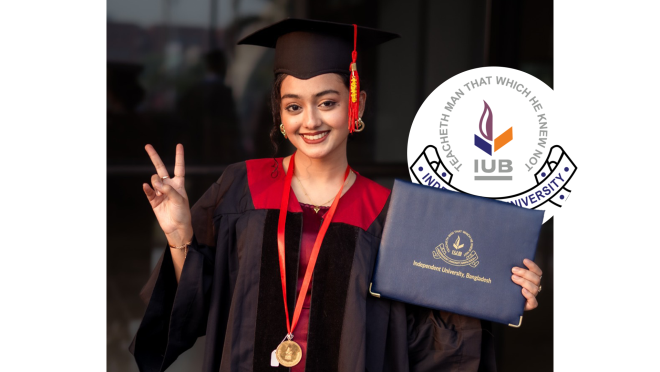
Being an IUB Pharmacy graduate, the journey towards a Master’s in Neuroscience was not simply about academic excellence.
It began with a childhood fascination with the human brain, grew into a desire to address the limited therapeutic options for neurological disorders, and eventually became a clear research ambition: to understand the brain better and contribute to the development of more effective neurotherapeutics.
Despite having no research publications, Nova chose to apply, challenging the self-doubt and discouragement that often accompany highly competitive international opportunities.
Through the Neurasmus programme, that ambition is now taking shape, offering a glimpse into how curiosity, perseverance, and a clearly defined academic purpose can open doors to world-class research.
Nova always wanted to work in healthcare, and she realised that treatment development interests her more than diagnosis. Hence, she chose to pursue Pharmacy.
“The primary reason I chose IUB was the 100% Merit scholarship it offered based on my O-Level and A-Level results. Thanks to IUB’s generous scholarship schemes, I not only completed my whole BPharm without cost, but also received yearly monetary academic awards for my academic excellence, a consistent CGPA of 4.0.”
Nova grew up being hooked on Jason Silva-hosted ‘Brain Games’ on the National Geographic channel. The brain has always fascinated her in how it makes us ‘us’. It was in Nova’s final year of BPharm when she noticed that, unlike other illnesses, brain disorders don’t have many effective therapeutics. The reason largely lies in us not understanding the disease (and brain itself) enough. And hence, she found her North Star: understanding the brain better to make effective neurodrugs.
The first time Nova heard about EMJM was from a very favourite faculty member of hers, Mashmum Ma’am, in her second year. Monthly stipend, no tuition fees, and multiple European universities jointly giving a degree, it was an opportunity lucrative enough to aim for. Post-graduation, as Nova started her search for relevant programmes in the EMJM catalogue, she stumbled across what she wanted to study: Neuroscience (Neurasmus).
Nova wanted to understand the brain comprehensively, and not just in its diseased state. EMJM was something she had shortlisted anyway, but what gravitated her the most to Neurasmus is its comprehensive and interdisciplinary curriculum. Not to mention, the cutting-edge research facilities cumulatively offered by the consortium are something she could not find elsewhere.
I asked her about the application and selection process, including its most challenging stages.
Primary screening involved selection based on candidate profiles. The latter two were interviews. The first interview was based on a research paper (on neurocircuitry) that depicts discussing methods and criticising the paper. The final interview (40 selected for this) was more about proving one’s potential and fit to the programme (motivation, career objectives, and the classic ‘why should we choose you’). At the end, globally, 16 of 1,000+ applicants were chosen to be this year’s Neurasmus scholars.
The real challenge for Nova was not preparing for the interviews, but it was battling self-doubt.
“I was heavily discouraged by many not to apply because I had no publication. I am so glad I did not listen! And that is because there were a few who did believe in me, which gave me the strength to apply.”
Beyond academic results, the experiences she believes strengthened her application were that she was able to prove that she is genuinely interested in neuroscience and that the application is not ‘generic’.
“I used my CGPA to showcase my tenacity and perseverance, not that I know everything.”
Her undergraduate thesis was on ‘Neuroprotection’, which testified that Nova is indeed serious about neuroscience. While she does not have a publication, she actively pursued training and research skills that she showed are transferable in the neuroscience field.
“A personal experience I highlighted in my motivation letter is being brought up and studying abroad at multiple schools through undergrad. This equipped me with adaptability and familiarity with international cohorts, qualities needed to survive and thrive in Erasmus!”
Nova mentioned that she was lucky to have faculty members like Naima ma’am and Akib Sir, who inspired her to try and dream big.
“My IUB life gifted me with faculty members outside my department, Ashraful Islam Sir and Qudrate Khoda Sir, whose belief in me enabled me to believe in myself.”
For recommendation letters, Nova believed in personalising them with specific incidents that depicted her qualities was what helped the most.
“I believe me proving how the next chapter should naturally be neuro, helped the most. It was not. I love the brain but I understand there is a problem (rising neurological burden with insufficient therapies) that I can help solve with Pharmacy and Neuroscience knowledge.”
In the areas of Neuroscience, the most interesting ones she’s onto in exploring during the programme were Neurodegeneration, Neuroprotection, and ultimately how to translate the therapeutic findings from the lab to real clinical settings.
Nova’s long-term goal is to work as a Research and Development neuroscientist in the pharmaceutical sector. In Neurasmus, she will be completing multiple internships in advanced research institutes, gaining a mechanistic understanding of diseases and how therapeutic approaches are developed.
“My current internship at CERVO Brain Research Institute, for example, is teaching me Alzheimer’s and Parkinson’s modelling and crucial analytical techniques.”
The programme involves training, international conferences, and lab collaborations, all of which would help her to create a network to catapult her job prospects.
Shifting the attention from just CGPA and making them aware of the opportunities early on is the foremost advice from Nova for young minds in Bangladesh. And while increasing research facilities, educating students on what research is and how to think critically instead of just the ‘publish papers and you can go abroad’ approach is equally important.
Preparing early is an advantage in being a recipient of Erasmus Mundus, alongside connecting to the alumni of the programme one is aiming for. And most importantly, belief.
“Once you believe that it is possible, tailor your profile to the programme’s values. Show that you and the programme are a strong fit by aligning whatever experience you have. Don’t let the lack of any one of them discourage you. As I was told: you never know”, concluded Nova.