An itsy-bitsy bit of colonialism in the classroom
An itsy-bitsy bit of colonialism in the classroom
One of my favourite jokes lately is to pick an object, and say “krishiprodhan deshe eta anlo ke”.
Back in the day, I went to this reputed English Medium school in Gulshan and one of the rules they had was that you could not speak in Bangla. I don’t know if the rule remained in High School, but during my time in grade 3, the rule was as strict as ever.
So much so that some of the children would be made to stand. Sometimes they’d even have their games class cancelled. Imagine the one thing you wait for all week as a kid getting taken away because you said a word in Bangla. It was almost as if “krishiprodhan deshe ei bangla anlo ke”.
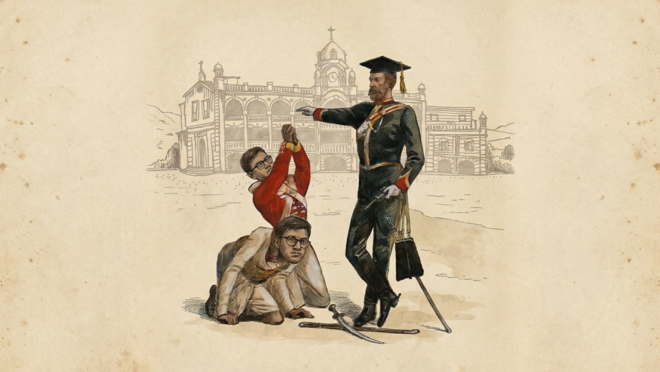
I feel like a war veteran when I think of the memories, more precisely like a clerk under colonial rule. I remember scribbling in my diary during recess, when a classmate of mine was having tiffin on the table behind me. What I suppose was some curry and ruti, he offered it to one of his friends. To his bad luck, the poor kid uttered words that I simply could not tolerate in my worst nightmares. Jhol. Yes, jhol.
“Try it with the….uh…jhol?”
Did he really just say that? The J-word? I walked up to the teacher and briefed her about the situation. She pushed her chair back hard, and demonically rushed towards the poor ruti eater.
His punishment was a ten-minute-long lecture on ethics, linguistics, and having to stand watch me eat my own tiffin. I probably didn’t know either what other word could have been used for jhol, but I was such a pivotal part of this machinery that I couldn’t be bothered less.
What I truly pity is how you could study all your life, get a degree, then get a job in this economy, and when your kid asks you “how was your day at work?”, all you can answer is that you lectured a kid for saying the word jhol.
I want to take a peek into the minds that built this beautiful system, where a person is punished for speaking their native tongue, for not abiding by the law, and somehow disguise all of that absurdity into a facade that no one ever questions.
If you thought all of that was peculiar, wait till I tell you about what I got bullied for back in middle school. The upside of that strict English law was that I got incredibly fluent in it. I’d perhaps even sneeze in English. But the real cultural shock came when I moved to a different part of Dhaka, a place which wasn’t quite Gulshan. The new kid in town, the centre of attention for everyone in fifth grade. Recess was now an interview session, with all the different friend groups interviewing me for a place they thought I wanted in their group.
First up, the sweet but problematic semi-nerds. These people are obnoxiously sweet, so sweet that they almost engulf you with their expectations. Highly sensitive, every single word you utter to such a group is a walk on eggshells, and the worst part is when things go south, everyone believes THEM because they’re too sweet. Oh, and they’re secretly judgemental too. One of them asked me which fruit I liked the most, I said pear. They cheered that answer, then left forever. Good riddance.
Up next is the part where I get insulted. Before you sympathise with me, let me tell you that this isn’t one bit about sympathy. It’s more embarrassing than anything. This one group of boys walked up to me that day, and asked me if I knew what KBC was. “The 9PM show on Sony?” I replied. They laughed at my face and walked away.
For the next few months, I’d try mingling with these groups, never to be a part of any. What was rather annoying was that this particular group of classmates never let me in on any of the conversations. I wondered why, until I overheard them speaking about me. “Hey! Don’t talk about this in front of Siyam! He can’t even curse.”
Cultural shock. The word I looked for back then was it. All this long, I was being isolated because I did not know enough slang in Bangla. I can’t figure out which is more embarrassing, getting insulted for not knowing slang, or whining in your adulthood about a rather first-world experience that would hardly ever be considered as bullying.
How does someone not know a “gaali”? Well, I did, but in English. Not proper ones, none of us knew those at that age, neither those boys, I believe. The most damaging one I knew was stupid.
If you look at it with the right lenses, that old machinery runs remotely too. The institutionalised English in me could’ve easily been replaced by some fresh Bengali slurs. But no, the colonial clerks would let go of anything but their slang-y heritage.
I wonder if they ever thought “Siyam can’t curse, let’s teach him a few”. The protectors of legacy made sure that they preserved theirs, and forced me to preserve mine. What I truly pity is how you could be the coolest kid in town, watch the best of shows, get the best of grades, and when your teacher asks “where are your friends?”, all you can say is I can’t curse.
Life is a circle.