Think Like a Freak: The courage to ask foolish questions
Think Like a Freak: The courage to ask foolish questions
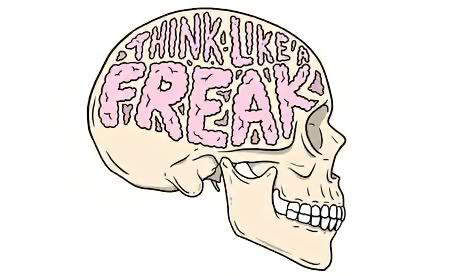
There are very few books that genuinely change the way you look at the world.
Steven D. Levitt and Stephen J. Dubner’s Think Like a Freak belongs firmly in that category.
As an economics student, I initially approached this book expecting another discussion on incentives and markets. After all, Levitt and Dubner are the minds behind Freakonomics, a book that became famous for connecting economics with seemingly unrelated subjects such as crime, parenting, and even cheating in sports.
What I discovered in Think Like a Freak, however, was something much more valuable. It is not really a book about economics. It is a book about rethinking the way we think.
And that is why it is one of the most relevant books for students today.
We live in a world where information is abundant but independent thinking is scarce. Social media rewards quick opinions. News channels reward outrage. In such an environment, Levitt and Dubner argue that the greatest skill is not intelligence alone but the ability to think differently.
The central message of the book can be summarised in one sentence: stop thinking like everyone else.
One of the first ideas that struck me while reading the book was the authors’ insistence on admitting what we do not know. In universities, students are often rewarded for having answers. In professional environments, confidence is mistaken for competence. Yet Levitt repeatedly emphasises that intellectual progress begins with acknowledging ignorance.
At first glance, this appears counterintuitive. Why would admitting ignorance be a strength? The answer lies in how knowledge is acquired. If we assume we already understand a problem, we stop asking questions. We become trapped inside our assumptions. People call this confirmation bias. Whatever term we use, the result is the same. We stop learning.
The authors therefore encourage readers to replace certainty with curiosity. This principle reminded me of one of the most important lessons economics teaches, although not always explicitly. Every conclusion depends on assumptions. Change the assumptions and the conclusion may change as well. The best economists are not necessarily those who know the most answers but are often those who ask the most interesting questions.
That idea forms the backbone of Think Like a Freak.
Throughout the book, Levitt and Dubner repeatedly demonstrate that people often focus on the wrong questions. Rather than asking why a solution is not working, they suggest asking whether we are trying to solve the correct problem in priority.
This may sound obvious, yet many policy failures emerge from precisely this mistake. Public debates frequently focus on symptoms rather than root causes. We become obsessed with treating visible outcomes while ignoring the incentives and structures that created them. This is where the book’s economic perspective becomes particularly powerful.
Why do people cheat? Why do organisations become inefficient? Why do voters support certain policies? Why do students procrastinate despite knowing the consequences? The answer is rarely because people are irrational. More often, people respond rationally to the incentives they face.
This concept may appear simplistic, but it explains an astonishing range of human behaviour.
One of the book’s most memorable examples involves competitive eater Takeru Kobayashi. Rather than accepting the traditional approach to eating contests, he completely redefined the problem. He asked a different question from everyone else. By doing so, he transformed the competition and shattered records. The lesson extends far beyond hot dogs.
Innovation rarely emerges from working harder on the same problem. More often, it emerges from redefining the problem itself.
This theme resonates strongly in today’s world. Whether in economics, business, public policy, journalism, or even academic research, progress frequently comes from challenging assumptions that everyone else accepts as obvious.
The authors also emphasise the importance of thinking like a child. Initially, this sounds almost absurd. After all, years of education are supposed to make us more sophisticated thinkers.
Yet children possess a quality that adults often lose. They ask questions without worrying whether those questions sound foolish.
Ironically, many breakthroughs begin with precisely these kinds of questions. Another fascinating aspect of the book is its discussion of persuasion. One of the most uncomfortable truths Levitt and Dubner present is that facts alone rarely change minds.
As students, we often assume that better evidence automatically leads to better decisions. Reality is much messier. People are emotional creatures. Political identities, cultural values, personal experiences, and social pressures frequently outweigh statistical evidence. Consequently, the authors argue that storytelling often succeeds where data fails.
This insight is especially relevant in an age of misinformation and polarised discourse. The challenge is not merely discovering the truth but communicating the truth effectively.
Perhaps the most controversial chapter in the book is the one on quitting. Modern culture celebrates perseverance almost as a religion. We are constantly told to keep going, never surrender, and never quit.
Through an economic lens, quitting can sometimes be the most rational decision available.
If a project is failing, continuing solely because we have already invested time and resources may be irrational. Economists refer to this as the sunk cost fallacy.
This chapter was particularly refreshing because it challenged one of society’s most accepted assumptions. The authors do not glorify quitting. Instead, they argue that intelligent decision-making requires distinguishing between persistence and stubbornness.
At times, the authors’ reliance on incentives can oversimplify complex social realities. Human beings are influenced not only by incentives but also by culture, morality, history, emotions, and identity. Some readers may find certain examples overly reductionist. Others may disagree with specific conclusions.
Yet these criticisms do not diminish the book’s value. In fact, they reinforce its central lesson.
The authors do not want readers to agree with everything they say. They want readers to question everything, including the book itself. That, in my view, is what makes the book different from countless popular economics books.
It does not provide a formula for success. It does not promise wealth, happiness, or productivity. Instead, it offers something far more useful: a framework for independent thought.
In an era increasingly dominated by algorithms, echo chambers, and ideological certainty, that may be one of the most valuable skills a person can acquire.
For economics students, policymakers, and anyone interested in understanding human behaviour, Think Like a Freak is not merely a book recommendation but an invitation to challenge conventional wisdom, embrace curiosity, and develop the courage to ask questions that others are afraid to ask.
The world is full of people who think conventionally. Levitt and Dubner make a compelling case that progress belongs to those willing to think like a freak.