ICE Center at DU hosts international policy seminar on entrepreneurship development in higher education
ICE Center at DU hosts international policy seminar on entrepreneurship development in higher education
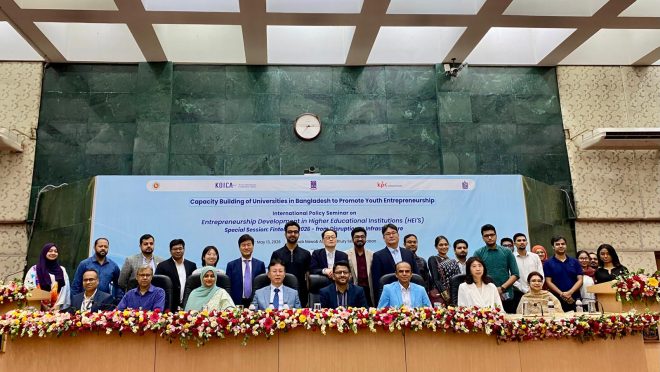
The Innovation, Creativity and Entrepreneurship (ICE) Center at the University of Dhaka successfully hosted an International Policy Seminar on 13 May 2026, focusing on “Entrepreneurship Development in Higher Educational Institutions (HEIs) in Bangladesh.” The half-day seminar, held at the Nabab Nawab Ali Chowdhury Senate Bhaban, brought together senior policymakers, university leaders, development partners, and international experts to advance Bangladesh’s agenda on entrepreneurship education.
The event was organised under the Creative Bangladesh Project, a government-to-government initiative between Bangladesh and the Republic of South Korea. The project is implemented by the ICE Center with support from KOICA Bangladesh, the University Grants Commission (UGC), and the Ministry of Education. Dr Aditi Shams, Associate Professor at the Department of International Business, University of Dhaka, and Deputy Project Director of the Creative Bangladesh Project, delivered the welcome remarks.
Professor Dr Mohamad Al-Forkan, Vice-Chancellor of the University of Chittagong, addressed the seminar as the Chief Guest, emphasising the need to create a supportive entrepreneurial ecosystem to enable students to think creatively and develop a problem-solving mindset.
Dr Jahangir Alam Chowdhury, Treasurer and Vice Chairman of the ICE Center, University of Dhaka, chaired both sessions and highlighted the rise of female entrepreneurs in the economy. He stressed that policies facilitating the adoption of fintech must be inclusive and address the needs of women entrepreneurs.
Presentations on the state of entrepreneurship development in HEIs were delivered by Mr Dae Jin (Derik) Kim, Project Manager, PMC, KPC & TUK Consortium, KOICA, and Mr Md Rashedur Rahman, Founding Executive Director of the ICE Center and Project Director of the Creative Bangladesh Project. They emphasised the vital role of public universities in building an innovation-driven entrepreneurial ecosystem in Bangladesh, which aligns with the vision of the Creative Bangladesh Project. Mr Rahman stated, “The University of Dhaka, as the apex institution, has both the responsibility and the opportunity to model this change and inspire adoption across the entire higher education system. We must move beyond producing graduates solely for employment towards developing graduates who can create opportunities for themselves and others.” He urged all public and private universities in Bangladesh to institutionalise entrepreneurship education to achieve a national multiplier effect.
Special guest addresses were delivered by Mr Junsu Kim, Deputy Country Director of KOICA Bangladesh, and Ms Bodrun Nahar ndc, Additional Secretary of the Secondary and Higher Education Division, Ministry of Education. They highlighted the government’s commitment to fostering innovation and entrepreneurship in higher education. Ms Hosna Ferdous Sumi, Senior Private Sector Specialist at the World Bank’s Finance, Competitiveness and Innovation Global Practice, participated in stakeholder discussions, stressing the importance of institutionalising project outcomes to ensure the sustainability of the entrepreneurial ecosystem.
Fintech in 2026: thematic session
The second session of the seminar featured a dedicated thematic discussion titled “Fintech in 2026 – from Disruption to Infrastructure.” Mr Gwang Hee Won delivered the keynote address on the evolving fintech landscape. The session included open-floor discussions and contributions from representatives of Bangladesh Bank, the private sector, academic institutions, and international organisations, exploring how fintech can drive youth entrepreneurship in Bangladesh.
About the Creative Bangladesh Project
The Creative Bangladesh Project aims to strengthen entrepreneurship education across universities in Bangladesh through curriculum reform, faculty capacity building, incubation support, and multi-stakeholder collaboration. Partner universities include BUET, Bangabandhu Medical University, Bangladesh Agricultural University, University of Rajshahi, University of Chittagong, and KUET. The project is approved by ECNEC and implemented in partnership with the UGC and the Ministry of Education.