Bikes, ‘Teslas’ and Dhaka’s two-tier traffic law
From personal bike commuters to bike-sharing riders, everyone apparently encounters the dysfunctionality and discrepancy in Dhaka’s traffic laws. Commuting in Dhaka always throws challenges at you at every split second, which demands a lot of patience to ride safely. And in no way does this gap between this principle and reality become more apparent than when commuting in Dhaka as a motorcycle user.
Bikes, ‘Teslas’ and Dhaka’s two-tier traffic law
From personal bike commuters to bike-sharing riders, everyone apparently encounters the dysfunctionality and discrepancy in Dhaka’s traffic laws. Commuting in Dhaka always throws challenges at you at every split second, which demands a lot of patience to ride safely. And in no way does this gap between this principle and reality become more apparent than when commuting in Dhaka as a motorcycle user.
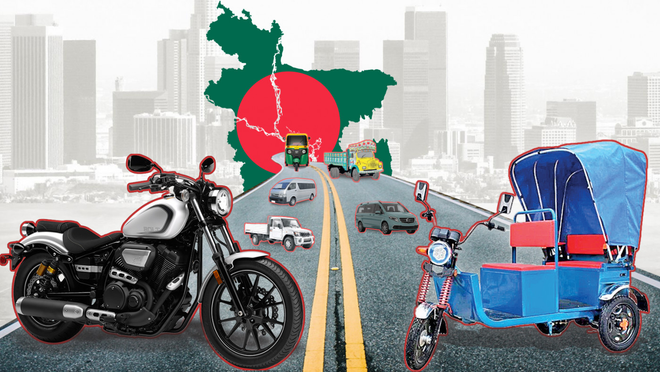
As a regular rider, I, like many other everyday commuters, get a firsthand view of the realities of the traffic system and the inconsistent manner in which traffic laws are enforced. Much like myself, there are thousands of bike riders, both professional and everyday users, commuting on a regular basis while being tormented by the fragmented application and arbitrary enforcement of traffic regulations.
When the heat becomes unbearable, the air unbreathable, and traffic police become excessively vigilant yet unreasonable towards a particular group of commuters, a troublesome scenario becomes hard to ignore.
Motorcyclists are routinely stopped and asked to provide required documents such as tax tokens, registration papers, and driving licences. While I am fully respectful of this approach, I, along with many other commuters, cannot help but question why the same scrutiny is not applied to auto-rickshaws that almost always run in the opposite direction, even in the presence of traffic police. Where are their tax tokens and other required documents? Why are they not stopped, questioned, or fined for violating traffic rules?
It seems that no traffic law itself can effectively be enforced on our newly invented auto-rickshaws, which locals mockingly call “Teslas” because of their reckless speed and ruthless driving.
Imagine a rider heading off to his office at around 10 in the morning, during the busiest hour of the day, being given signals and asked to show his papers even though he has done nothing wrong. On the other end of the spectrum, right in front of police officers, rickshaws are coming from the wrong direction of the road. Neither are the pullers stopped, nor are they asked to give explanations for breaking traffic laws.
If asking for papers from private vehicle users falls under the duties of traffic police, stopping actions like using the wrong side of the road is also something that should be given attention to or brought to book.
Traffic controllers are unlikely to pay the least heed to this, regardless of the difficulties it causes for other commuters. Consider this scenario: a red light clearly visible; all the vehicles come to a pause and wait, except the “Teslas”, a rule too oppressive for the mighty “Teslas” to cater to. They place themselves always ahead of others.
Breaking traffic laws in every possible way, they go on. AI-based monitoring appears incapable of holding them accountable, while traffic police officers themselves often do little to stop them.
Not only are riders dealing with “Teslas”, but every other vehicle user is also heavily suffering from their torture. They hardly tend to follow lanes on the street while being everywhere on the road.
Moreover, the vast majority of the intra-city buses are unfit for the road and emit thick black smoke. Although they are frequently fined for violating traffic regulations, they hardly seem to be fined for environmental violations. The city remains inundated with these unroadworthy vehicles. Bus drivers often stop wherever they please to pick up or drop off passengers, leaving bikers travelling at speed with little indication of where a bus might suddenly stop or turn. To make matters worse, many drivers change lanes or take turns without using indicators, creating a serious hazard for other road users.
The problem extends beyond vehicles. Half of the roads are occupied by street vendors. The government, despite having plenty of plans, has repeatedly failed to successfully relocate them to designated areas, leaving significant portions of the roads obstructed. Meanwhile, people who pay taxes for commuting are regularly harassed during their daily commutes. Not a single street vendor seems to be questioned for these illegal encroachments. Yet, as a bike owner, you must be cooperative and can be brought under scrutiny for something as minor as changing a mirror or putting stickers on your bike.
This comparison might sound absurd, yet I would put it forward as a cogent argument. These lawbreakers are kept unquestioned, while those who pay taxes every year are frequently subjected to disproportionate scrutiny and enforcement.
Dhaka’s roads never fail to surprise riders with puddles and uncovered manholes. A moment of inattention can lead a rider and their bike into a hazardous accident. A lot of riders, especially those who ride during the rain, are victims of these open manholes, facing serious issues, while some have even lost their lives.
At the end of the day, the question is not whether Dhaka has traffic laws. The question is whether those laws apply to everyone. Because a law that is selectively enforced is not justice; it is privilege in disguise.
The streets of Dhaka do not need another rulebook. They need consistency. They need accountability. Above all, they need a system where the road belongs neither to the most reckless nor to the most privileged, but to everyone who has the right to use it.
.