TBS, Rajshahi University hold mobile journalism workshop, sign deal to connect students with newsroom
TBS, Rajshahi University hold mobile journalism workshop, sign deal to connect students with newsroom
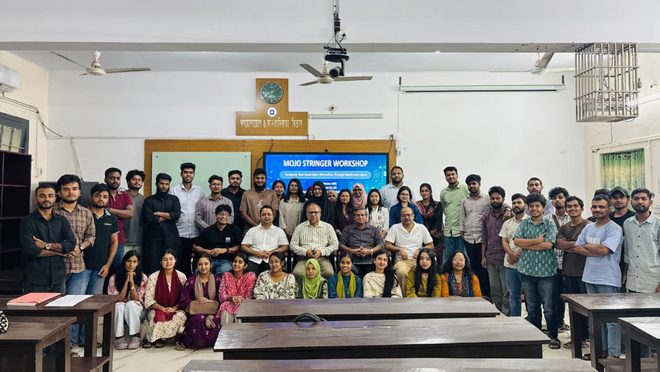
The Business Standard and Rajshahi University’s Department of Mass Communication and Journalism held a mobile journalism workshop today (7 October) and signed an agreement to give students opportunities to work with a professional newsroom and publish their reporting.
The workshop, titled “Classroom to Newsroom: Mobile Journalism Training Workshop and Stringer Initiative”, trained students in gathering, producing and presenting news using mobile phones, according to the press release.
Held under the theme “Developing the next generation of storytellers through mobile journalism”, the programme ran from 9:30am to 1:30pm in Room 123 of the department.
Department Chairman Professor Dr Mozammel Hossain Bakul and TBS Head of Multimedia Majumdar Babu signed the memorandum of understanding on behalf of their respective institutions.
The workshop formed part of the agreement, which will enable students to work with TBS, establish connections with its newsroom and publish news reports and other content they produce.
Bakul chaired the programme. Rajshahi University Pro-Vice-Chancellor for Administration and Acting Dean of the Faculty of Social Sciences Professor Dr Md Abdul Alim attended as chief guest.
Workshop Convener and Senior Professor Mashihur Rahman and Associate Professor Kazi Mamun Haider were also present.
Mashihur delivered the welcome address, followed by remarks from Majumdar Babu. University of Chittagong Department of Communication and Journalism Associate Professor Rajib Nandi, the workshop’s lead trainer, introduced the “Classroom to Newsroom” project.
Majumdar Babu and Rajib conducted the main training sessions. University of Chittagong communication and journalism students Irfan and SR Shawon also delivered separate presentations on different aspects of mobile journalism on behalf of TBS.
A total of 57 students, ranging from the department’s second year to the first semester of its MSS programme, participated.
In his welcome address, Mashihur said students learnt various aspects of journalism at university but often faced a gap in understanding how and where to apply that knowledge in practice.
Collaboration between academia and the media industry could help address this gap, he said. Such initiatives would give students access to training, masterclasses, lectures, seminars, joint activities and practical experiences such as field reporting.
He urged participants to view the workshop as an opportunity to become involved in professional work, rather than solely as a training session.
Majumdar Babu said, “We have a plan to connect you with the newsroom. Through this initiative, you will work with TBS and for TBS. Students will learn who works in the TBS newsroom and how it operates. They will no longer have to travel around Dhaka looking for these connections. They will have the opportunity to work with TBS and establish contact with the newsroom while remaining at university.”
He added that students would be able to prepare and publish reports for TBS alongside their studies. Their work would be reviewed by the newsroom, and they would receive payment for published contributions.
This would allow students to gain professional experience by working with a newsroom before completing their university education, he said.
During the workshop, Rajib said mobile journalism was not limited to reporting with mobile phones; it also involved using other portable devices. Drones, DSLR cameras and other portable cameras could also be used, he said, although the accessibility and versatility of mobile phones had made them particularly important.
“The way we tell stories is changing, and the devices are changing. But storytelling remains,” Rajib said.
He emphasised the importance of producing responsible content by maintaining journalism’s established ethics and values while embracing new technology.
Speaking as chief guest, Alim recalled the difficulties students once faced in accessing newspapers at university. They would brave the rain to read newspapers and record important information in their diaries, he said.
Now, news from around the world was available with a single tap on a mobile phone, making access to information much easier for students.
He said the agreement with TBS would help students gain practical experience and better prepare them for work at national and international levels.
Bakul said journalism had evolved alongside technology, from computer-based typesetting and software-assisted news editing to television, online and multimedia journalism. Mobile phones had now become an important reporting tool.
Knowing how to take photographs or record videos on a phone was therefore not enough; students also needed to learn the journalistic skills involved in using it, he said.
The agreement with TBS would establish a direct connection between academia and the media industry, allowing students to contribute in different ways.
Such initiatives would strengthen their professional skills and help reduce the gap between university education and the workplace, Bakul added.
Third-year student Abu Saleh Shoaib moderated the programme. Students KM Siddiq, Tasin Siddika Rupa and Pranta Kumar Das supported event management.