Two IUB projects named among Top 50 at Bangladesh Innovation Fair 2026
Two IUB projects named among Top 50 at Bangladesh Innovation Fair 2026
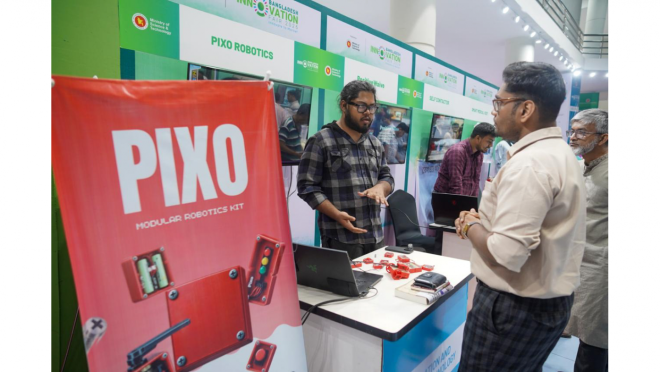
Independent University, Bangladesh (IUB) showcased eight innovations at the Bangladesh Innovation Fair 2026, including a magnetic robotics kit for children, an electric powertrain for sustainable mobility and agriculture, and a satellite-based system that identifies schools exposed to brick-kiln pollution.
Two of the projects – PIXO, developed by IUB360, and the Affordable 60V Electric Powertrain, developed at the Green Energy Research Centre (GERC) – were selected among the Top 50 innovations at the three-day national event, held at Novo Theatre in Dhaka from 12 to 14 September, according to the press release.
The fair, organised by the Ministry of Science and Technology, brought together more than 1,000 innovations, participants from over 50 universities, more than 100 industry experts and over 50 corporate organisations.
Prime Minister Tarique Rahman visited the electric powertrain project at the fair.
The team explained the technology to the Prime Minister and discussed its potential applications in sustainable transportation and agriculture.
“Through our electric powertrain work, we are trying to show that Bangladesh does not always have to depend on imported technology; we can design, develop and adapt our own solutions for mobility, agriculture and industry,” said IUB Electrical and Electronic Engineering alumnus Md Imtiaz Abedin, leader of the electric powertrain project.
Green Energy Research Centre Director Professor Dr Khosru Mohammad Salim said, “When students are genuinely excited about what they are building, they learn faster, experiment more boldly and contribute with greater commitment.”
“That combination of research, passion and practical engineering is what makes a project successful,” he added.
Elsewhere in the exhibition, PIXO offered a different approach to technology education.
Developed as an ecosystem of smart magnetic robotics blocks that connect without wires, PIXO allows children to explore coding, electronics, engineering and robotics through hands-on activities.
“With Pixo, our vision is simple: we aren’t just designing robotics kits – we are building confidence, preparing the thinkers, makers and innovators who will lead tomorrow’s robotics revolution,” said Yusa Islam, co-founder of PIXO and a final-semester student of Computer Science and Engineering (CSE).
The other six IUB projects presented at the university’s IUB360 Exhibitor Stall demonstrated a range of issues being addressed through technology and research.
KilnWatch uses satellite imagery to map brick kilns around schools across Bangladesh, helping identify educational institutions exposed to clusters of kilns.
CryptoCube takes an interactive approach to cybersecurity education.
“Through interactive games, story-based missions, puzzles and a touchscreen interface, students learn concepts like encryption, password security and secure communication by playing instead of memorising theory,” said Md Abid Hasan Fuhad, leader of the CryptoCube project and a 10th-semester CSE student.
CogniLink is a wearable device that tracks finger movements and converts selected words or phrases into spoken audio, with potential applications for people facing speech or mobility-related challenges.
SwitchLoRa explores wireless voice communication by combining software-defined radio with LoRa technology.
GorbhoShongi takes a different approach, using a Bangla and English application to support mental well-being during pregnancy and after childbirth.
RefinAir monitors indoor air quality by combining sensors, airflow simulations, satellite information and pollution mapping with automated air purification to monitor and manage indoor environments.
IUB Board of Trustees Chairman Didar A Husain and Vice-Chancellor Professor M Tamim visited the exhibition stalls and spoke with the participating teams, while senior faculty members joined the young innovators to encourage them.
To build on the innovation momentum, IUB launched the Innovation to Impact Award this year, an initiative of IUB’s eCentre of Innovation and Incubation – IUB 360 – supported by the Board of Trustees and senior leadership.
The award aims to identify, support and nurture promising innovative projects and prototypes developed by IUB students and help take them to the next stage.
“Innovation is ultimately about creating meaningful change. I am grateful to the IUB Board of Trustees and senior leadership for their continued support for our drive to build a culture where ideas can be developed, tested and translated into impact,” said IUB Strategic Adviser for Innovation Dr João Fialho.
IUB has separately described the Innovation to Impact initiative as a pathway for mature student and faculty projects to move towards validation, incubation, industry collaboration and practical application.
“What we saw at the Bangladesh Innovation Fair 2026 is exactly the kind of work we want to take further. A good project should not end with a competition, exhibition or academic requirement,” said Dr Saadia Binte Alam, associate professor of CSE and director of the Centre of Innovation and Incubation – IUB 360.
“The Bangladesh Innovation Fair 2026 reminds us that innovation begins with an idea, but its true value is realised when that idea creates an impact,” said Dr AKM Mahbubur Rahman, associate professor and head of the Department of Computer Science and Engineering at IUB.
“At IUB, we want to build an environment where students and faculty are encouraged not only to develop innovative projects, but also to take those projects forward through mentorship, collaboration, entrepreneurship and real-world deployment,” he said.
“The CSE department at IUB is always proud to take important and visionary steps in creating that pathway – connecting creativity with opportunity and academic innovation with societal impact,” he added.
IUB Vice-Chancellor Professor M Tamim said the university is actively trying to embed innovation in its institutional culture.
“We want our students and researchers to look at the problems around them, ask what they can do differently, and turn their ideas into solutions that have real impact,” he said.
“Seeing eight IUB projects at this fair, and two of them recognised among the Top 50, gives us further reason to keep investing in this direction,” he added.