Zachai: A map through the chaos of university admissions
Every year, somewhere between the last HSC lab exam and the first admission test, a strange season begins in the life of a Bangladeshi student.
Zachai: A map through the chaos of university admissions
Every year, somewhere between the last HSC lab exam and the first admission test, a strange season begins in the life of a Bangladeshi student.
The house fills with relatives asking which university you are aiming for, your phone fills with screenshots of circulars forwarded by friends, coaching groups and one uncle who has no idea what a GPA deduction is, and somebody swears that Mist has changed its dates while a cousin insists that the medical form is already out.
You open a folder full of unlabelled PDFs, you stare at it for a long, helpless moment, and the oldest question in the country settles on your chest: where on earth can I actually get in? Most of us who lived through it remember that feeling as clearly as our roll numbers, and it is exactly the feeling that a Buet CSE’22 student named Jani set out to take away from the juniors coming behind him.
Jani, or Rafsan to his family, though his nani and friends insist on calling him Jani, and so shall we, is a Level 3 student of CSE at Buet from the HSC 2022 batch. His journey began with a childhood dream of becoming a pilot. Later, he learned of his mother’s dream of seeing him pursue engineering, and he took that dream with him from DRMC to Notre Dame College, and finally into what he fondly calls the four-year sentence that is the jailhouse of Buet CSE.
But the story we’re here to tell began after he got in. While tutoring on the side, he kept hearing the same questions from his students: “Bhaiya, how many marks do I need to get into this university? What’s the marks distribution like?”
At first it puzzled him, because that information was supposedly just a search away, but then the real problem became clear. In his own admission season the Guchho system had kept the number of separate exams low, whereas today, in his words, “the entire system has become overwhelmingly fragmented.” CKRUET, which once held a single combined test, now runs three separate exams, and when that pattern repeats across every university, medical college and specialised institute, the result is a maze that no panicking seventeen-year-old should have to cross alone.
Jani also realised that raw dates and numbers were only half the answer, because a student needs to know where they actually qualify, how much a slightly lower GPA quietly subtracts from their merit score, and what written mark they must chase on exam day.
So he decided to take that whole headache onto his own shoulders, and since he is the kind of person who admits that “once an idea takes root in my head, it keeps nagging at me until I actually turn it into reality,” he dove straight into building it.
The result is Zachai, a platform he built entirely by himself, from scratch, over a stretch of steady time and patience, and one that he describes as “a personal admission strategist in your pocket for science candidates.”
The idea is wonderfully simple, because you plug in your SSC and HSC results and within seconds Zachai tells you where you are eligible to apply, calculates the GPA penalty you are starting with, and shows you the exact score you should target on exam day to secure a seat. Anyone who has ever tried to do these calculations on paper, with a calculator, three open tabs and a rising sense of dread, will understand the relief of hearing Jani say, “Zachai completely eliminates that guesswork.”
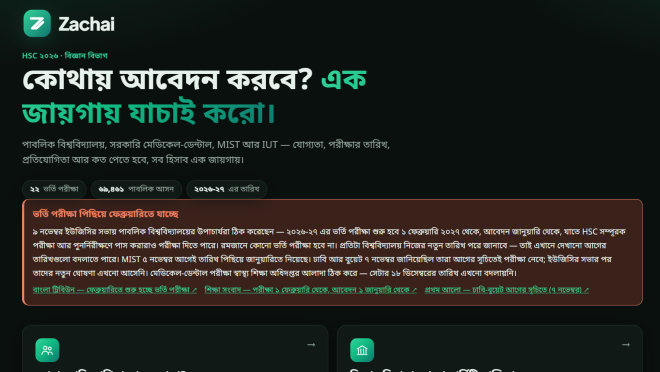
Open the website and the promise appears right on the first screen, in a bold Bangla line asking where you will apply and inviting you to check it all in one place. Built for HSC 2026 science candidates, the platform covers public universities, government medical and dental colleges, Mist and IUT, and its opening numbers alone make the season feel more manageable: 22 admission tests, 69,461 public seats and the dates for the 2026-27 session.
Scrolling down opens six clearly marked doors, each solving a different piece of the puzzle. The first shows the competition you are really facing, with the number of seats and competitors worked out step by step, so that the vague fear of “everyone is applying” turns into a real figure you can plan around.
The second lists the full range of universities open to science students and tells you which exam leads to which of them, while the exam info section gathers the date, eligibility and mark distribution of every single test in one place.
The circulars page then collects every admission notice published so far, which means you can find out in seconds whether your dream university has announced anything instead of scrolling through forty forwarded screenshots.
Then come the two features that students will probably fall in love with first. The first is “nijeke zachai koro”, where you simply enter your results and see where you can apply and exactly how many marks your GPA costs you before you have even sat for an exam. The second is “varsity exam e amake koto pete hobe”, where you pick a university and learn how much your GPA already gives you and how much you must score in the admission test itself to land a seat.
Together these two tools turn a foggy, anxious guess into a concrete target, which is perhaps the most valuable thing a candidate can hold in the weeks before an exam. And because a good elder brother is always honest, the site ends with a gentle reminder that its information is drawn from newspaper and circular reports, and that every student must confirm the details with their university’s official circular before applying.
What may be the most charming decision behind Zachai is its language. The entire platform is written in warm, simple Bangla. Jani’s reasoning is sharp, since almost every official circular, news report and admission discussion in this country already happens in Bangla, and his audience includes candidates from every corner of the nation, many from Bangla-medium backgrounds. As he puts it, “Admission season is already terrifying and stressful enough,” and the last thing a nervous student needs is formal English or tech jargon on top of it.
He did not want a cold corporate website, and he says plainly, “I wanted it to feel like an elder brother sitting next to them, cutting through the noise and sorting out their confusion in their own language.” That is why the buttons sound like a friend speaking, and why the whole experience feels less like using software and more like having a senior sit beside you with a cup of tea.
It helps that Jani knows the pain from the inside, and the funniest proof of it is how he used to manage his own information. While many of us kept a Drive folder and hoped for the best, his setup was a simple folder in the Downloads directory of his laptop named “uni circulars,” and he cheerfully admits, “That humble folder was pretty much my entire database!”
His secret weapon was the three or four students he tutors at any given time, who acted as a living alert network and sent him every new notice the moment a university dropped one.
Zachai is, in a sense, that folder and that network grown up, opened to every student in the country and wrapped in a clean, friendly interface.
Jani keeps the door open for the people he builds for, too. He placed a WhatsApp link in the footer of the site so that anyone struggling with a circular or caught in admission confusion can message him directly, and the messages that arrive are rarely complaints. Students mostly come looking for practical preparation advice and clarity on specific issues, which he considers a great sign, and he tries to help every one of them as much as he can.
Outside Zachai he also built Gunjon, an anonymous messaging platform for voice notes, texts, GIFs and photos, just for the fun of his generation, and his teams have placed second globally in the ISETS-ESCAP Youth Competition, which earned them a fully funded trip to present at the UN conference in Bangkok, and second regionally in the Nasa Space Apps Challenge. It is a good reminder that the person answering your admission questions is a builder who knows what it means to grind on a project until it works.
Better still, Zachai is only getting started. Jani wants to grow it step by step into a complete admission preparation platform, and the very next feature on his list is an intelligent reminder and accountability system that compares your daily study target with what you actually achieved and nudges you towards spending your hours better. He knows exactly why it matters, because in his own words, “During admission season, discipline and time management are where most candidates slip up without even realising it.”
A tool that holds up that mirror gently, every single day, could become the study partner that many candidates never knew they needed.
Before I let him go, Jani had a message for the juniors, and he promises it is no cliché. His message to them is to “use this brief admission window to actually study with genuine focus, without fooling yourself, and make smart, calculated decisions rather than running blindly,” and then he adds the line that deserves to be copied onto every candidate’s study table: “Raw hard work means nothing without exam temperament.”
Learn the strategy of the exam hall and the management of time before you walk in, he says, and if you hit a wall, “you can always reach out to Jani like an elder brother. If this boro bhai is free, In Sha Allah, I’ll always help you out.”
So if you are a science candidate staring at a mountain of circulars, perhaps the best first step is also the simplest one.
Open Zachai, enter your SSC and HSC results, find out where you can apply, see what your GPA is already giving you, and learn what you need to score approximately on exam day. Then take a deep breath, go and study with real focus, and take comfort in knowing that a Buet senior who once kept his entire database in a Downloads folder has already done the hard sorting for you.