WUB expands research infrastructure, secures 133rd position in WURI 2026
WUB expands research infrastructure, secures 133rd position in WURI 2026
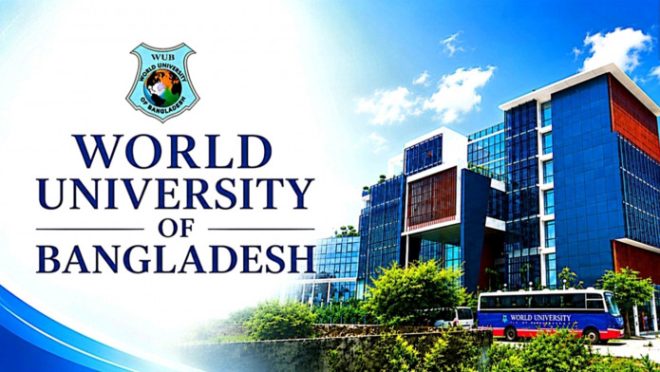
World University of Bangladesh (WUB) has shared details of its research and technology-driven academic model, highlighting more than 55 laboratories, Outcome-Based Education (OBE), digital learning facilities and its recent position in international rankings, including 133rd place in the WURI Ranking 2026.
According to the university, its Faculty of Engineering and Technology has developed its academic activities around applied learning, industry linkage and digital infrastructure.
University officials said the approach is intended to help students connect classroom learning with practical skills needed in the national and international job markets.
Laboratories and curriculum
WUB currently operates more than 55 modern laboratories for students of Civil Engineering, Computer Science and Engineering (CSE), Electrical and Electronic Engineering (EEE), Mechatronics and other departments.
Students regularly take part in laboratory work, project design and research-based academic activities as part of their studies.
The university’s engineering programmes follow an Outcome-Based Education framework.
Under this approach, students are assessed not only through examination results but also through problem-solving ability, technical skills, innovative thinking, research readiness and professional preparation.
Digital learning and quality assurance
The university runs an integrated digital learning platform that supports live classes, lectures, assignments, academic assessments and discussion forums.
Students also have access to an e-library with research journals, e-books and academic publications from local and international sources.
Academic quality is monitored through the Institutional Quality Assurance Cell (IQAC).
The cell conducts academic audits, reviews teaching methods and organises training, workshops and awareness programmes to keep academic activities aligned with national and international standards.
Faculty and research
WUB currently has more than 200 full-time faculty members, including more than 50 PhD-holding teachers and researchers.
The university provides research grants, financial support for project participation, journal publication and conference attendance, while encouraging both faculty members and students to engage in research activities.
Industry partnerships
WUB has signed more than 100 Memoranda of Understanding (MoUs) with national and international organisations.
These partnerships create opportunities for internships, industry-linked training, joint research and international exposure.
Students also participate in project-based work with software companies, consulting firms, construction organisations and technology-related sectors.
In addition, the university organises seminars, workshops, technical competitions and career development programmes to strengthen students’ employability.
For working professionals and diploma engineering students, the university offers weekend academic arrangements.
Classes and necessary laboratory sessions are held on Fridays and Saturdays.
The university also provides free transport facilities for students.
Rankings
WUB achieved the 133rd position globally in the WURI Ranking 2026 for Innovative Universities and was placed fourth among universities in Bangladesh.
In category-based rankings, the university secured seventh place in Financial Impact-Driven Technology Transfer (C8), eighth place in Digital and AI Transformation in Strategy and Management (B3), 15th place in Funding for Sustainability (B5), 21st place in Future-Oriented Responses to Global Uncertainty and Geopolitical Risk (A7), and 24th place in Industrial Application (A3).
The university was also listed in the QS Asia University Rankings 2026 and the UI GreenMetric World University Rankings 2025.
University officials said these rankings reflect WUB’s continued efforts to raise its academic and research standards internationally while contributing to technological development and human resource capacity in the country.
WUB said it will continue working to develop engineers and technology professionals capable of meeting national and global demand through modern infrastructure, international-standard curriculum, research-oriented education and academic-industry collaboration.