
The women quietly driving Bangladesh’s scientific progress
Four Bangladeshi women scientists are breaking barriers in research while exposing the institutional and social challenges that keep women underrepresented in science
The women quietly driving Bangladesh’s scientific progress
Four Bangladeshi women scientists are breaking barriers in research while exposing the institutional and social challenges that keep women underrepresented in science
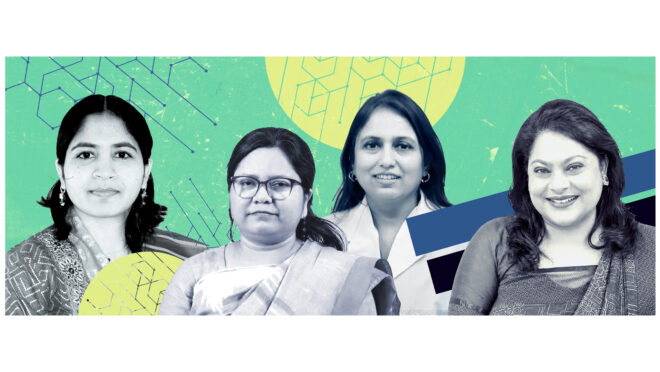
When the Association of Academies and Societies of Sciences in Asia set out to feature women in STEM driving global Sustainable Development Goals (SDGs) for their AASSA WISE publication, tracking down candidates in Bangladesh turned out to be surprisingly difficult.
The work was definitely happening. In university departments and research centres across Dhaka, female scientists were putting in long hours over lab benches, editing crop genomes to survive coastal salinity, working through non-linear physics equations, and tracking public health crises. Still, institutional gaps and modest careers have a way of keeping extraordinary work unnoticed.
Once the silence broke, it uncovered a wealth of talent.
In recognising Aliya Naheed, Kamrun Nahar, Sharmin Sultana, and Sabrina Elias, AASSA WISE turned the spotlight on four researchers who had been carrying the country’s scientific progress on their shoulders all along.
Aliya Naheed, a Fellow at the Bangladesh Academy of Sciences, redesigned coastal health infrastructure with low-salinity water systems across 30 villages.
In the salt-soaked reaches of Koyra, survival comes in a glass of saltwater. Non-communicable diseases claim 70% of lives across the country, mostly through premature strokes before age 70.
“When people consume high levels of sodium every day, even through basic drinking water, it spikes their blood pressure,” Naheed explained.
Leading Bangladesh’s first human genomic study on diabetes in lean and normal-weight individuals, she noted, “In Western countries, diabetes is heavily linked to obesity, but in Bangladesh, we see a massive rise in diabetes among thin, non-obese individuals.” Over 77% of local patients fail on standard treatments because the drugs were created for Western bodies.
With a Johns Hopkins MPH and a PhD from Tulane University, Naheed spent 15 years in infectious diseases, introducing rapid field tests for cholera, shigella and typhoid. Her successful cholera test was then commercialised by the Pasteur Institute. Her fiercest effort targets gender disparity in research.
“Across Asia, and honestly, in most countries, women rarely pursue long-term careers in science.”
Naheed co-founded icddr,b’s Women’s Science Forum in 2007, and after earning recognition among 49 Asian scientists, the Harvard-trained researcher demands entry pipelines and retention tracking.
“In my 33 years of experience, I had to figure everything out on my own,” she said. “If we share these real experiences openly, the next generation will have a much smoother path forward.”
“Titles like ‘scientist’ or ‘professor’ are just external administrative folders,” said Dr Sabrina Elias, who prefers calling herself an enthusiastic explorer of life. A researcher and educator by profession, she enjoys music, sketching and computer games as much as she has enjoyed moving from molecular biology to plant genomics, bioinformatics and microbial genomics. She believes curiosity is what shaped her career.
That curiosity now serves Bangladesh’s rice fields. After her MSc, she worked with Prof. Zeba Seraj at the University of Dhaka on government-funded projects on salt tolerance in rice, since salinity threatens food security in the coastal area. Her doctoral work identified genes behind salt tolerance in native varieties that lack enough yield.
Today, with support from the Bangladesh Academy of Science, her team uses genome editing to develop rice with reduced heat sensitivity. “Understanding a gene is only the beginning,” she said. A collaboration with CVASU also produced LAMP-based tools to detect fish fry in the Halda River, linking her work to zero hunger, good health, climate action and quality education.
Her early career included the jute genome project, “Swapnojaatra,” where molecular biologists, bioinformaticians and computer scientists solved problems together from scratch. “Large scientific questions cannot be answered by a single individual or even a single laboratory,” she said.
Sabrina sees women’s progress in STEM but noted fewer women in leadership, with many of her brilliant female classmates having left their careers. Some institutes advertise “male-only” jobs even in research. She calls for mentors, flexible workplaces and visible women leaders. Her own obstacle is continuity, since her private university cannot yet offer PhD students.
“Science is never an individual journey,” she said, thanking her mentors, her students and her parents.
Dr Sharmin Sultana is a theoretical physicist at Jahangirnagar University who studies solitons, waves that travel long distances without losing their shape. Her work in plasma physics and nonlinear waves relies on mathematical modelling, using equations such as Korteweg-de Vries and nonlinear Schrödinger.
Sharmin believes her research is fundamental, not commercial, but links it to SDG 4, SDG 5 and SDG 9, and to Bangladesh’s future in space science, advanced communications and energy.
“Something that begins as an equation on a page can eventually become part of a technology that people use without ever knowing where the underlying idea came from,” she said.
She went to Germany on the Alexander von Humboldt Fellowship, then chose to return home. The fellowship let her continue independent research and build a group in Bangladesh.
“If everyone who receives an international opportunity leaves permanently, it becomes much harder to build a strong scientific ecosystem here,” she argues. She has supervised more than twenty graduate students, and many now pursue PhDs in the US, Australia and Germany. Her advice to them is not to fear difficult problems or be discouraged by failure.
She has also felt like an outsider as a woman in a male-dominated field. Women in STEM must still negotiate expectations around family, mobility, marriage and motherhood, and physics has few visible female role models. Her answer was to let her work speak, and she now calls for stronger mentoring, transparent promotion and funding processes, and supportive workplaces. She wants women to lead projects and sit on scientific committees, not just attend conferences.
“Sometimes you have to become the example that you were looking for,” she says, hoping that one day no one will need to say “a female physicist.”
While high-tech labs focus on microscopic biology, Dr Kamrun Nahar works where salt creeps into farmland and heavy metals taint the dirt. As an Agricultural Botany Professor at Sher-e-Bangla Agricultural University and a BAS Fellow recognised by AASSA WISE, she figures out how dying crops survive harsh weather. She earned her PhD in Plant Science at Japan’s Kagawa University, and now directs climate adaptation projects backed by the Climate Change Trust Fund, BANBEIS, and the Science Ministry. Heavy chemical fertilisers just aren’t doing the job anymore.
“We must use biochemical protectants like melatonin or beneficial bacteria,” she said. Testing these natural options allows her to shield rice from drought and salinity while stopping toxic arsenic from reaching human plates, pushing UN Sustainable Development Goals for food safety straight from the root.
“Sanitation issues in remote sub-districts cause severe, chronic health problems for female scientists,” Dr Nahar pointed out, refusing to treat those physical hazards as just part of the job. Fieldwork across remote villages regularly throws female researchers into unpredictable situations, where they have to navigate street harassment, and unsafe travel after dark.
After receiving recognition in Seoul among Asia’s leading scientists, she continues pushing for workplace daycare, safe lodging, and mixed-gender field teams to protect women on assignment. Without childcare, safe transit, and supportive family partners, Bangladesh simply won’t be able to keep the women fighting for its food supply. “A holistic approach is needed where family, institutions, and society play their roles,” she insisted.
Finally, if we take a step back, we see that every one of these women got here mostly alone. The problems they work on are not small. Salt in coastal drinking water, diabetes in thin people, rice that can survive heat, arsenic in farmland, Bangladesh lives with all of these every day. Half of the people solving these are also fighting for a safe place to sleep during fieldwork.
Every year so many women leave research fields, jobs, careers. The women who left are the data that nobody really records. Nobody knows which crop, which test or which equation went with them. These four women are not remarkable because they overcame the odds. They are remarkable because they kept working on things like salt, sugar, heat and arsenic while the odds stayed exactly where they were.