AI uncovers 9,389 chemical reactions that could improve CO2-to-fuel conversion
AI uncovers 9,389 chemical reactions that could improve CO2-to-fuel conversion
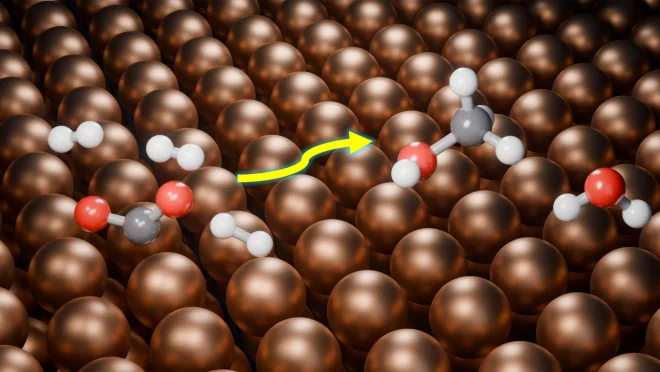
Researchers at the Indian Institute of Science (IISc) have used artificial intelligence (AI) and computer simulations to identify 9,389 chemical reactions involved in converting carbon dioxide (CO2) into useful fuels and industrial chemicals, uncovering pathways that conventional models had overlooked.
The findings, published in Nature Communications, could help scientists develop more efficient catalysts to convert CO2 into products such as methanol, a chemical widely used in industry.
The team initially built a database of 152 chemical reactions using quantum mechanics simulations before training machine learning models to estimate the energy barriers of additional reactions. The expanded network examined possible transformations involving 105 chemical species on a copper catalyst.
When researchers used the smaller reaction network, their model incorrectly predicted formic acid as the main product and underestimated CO2 conversion. Incorporating thousands of additional reactions brought the predictions closer to experimental results, identifying methanol and carbon monoxide as major products.
The expanded model predicted approximately 40 times more CO2 conversion than the original model.
The research also revealed an unexpected pathway in which molecular hydrogen (H2) could transfer directly to intermediate compounds without first splitting into individual hydrogen atoms. Further quantum mechanics calculations supported the finding, which challenges conventional assumptions about hydrogen’s role in catalytic reactions.
The researchers said the discovery could help guide the design of catalysts that interact more effectively with molecular hydrogen, potentially improving methanol production from CO2.
The computational framework could also be applied to other industrial processes, including CO2 reduction using different catalysts, nitrogen reduction and water splitting, offering a way to investigate complex chemical reactions more comprehensively.