Early research, Q1 publications and persistence: The formula behind an NSTU student's US PhD success
PhD applicants from universities across Bangladesh are increasingly securing success, especially over the last decade.
Early research, Q1 publications and persistence: The formula behind an NSTU student's US PhD success
PhD applicants from universities across Bangladesh are increasingly securing success, especially over the last decade.
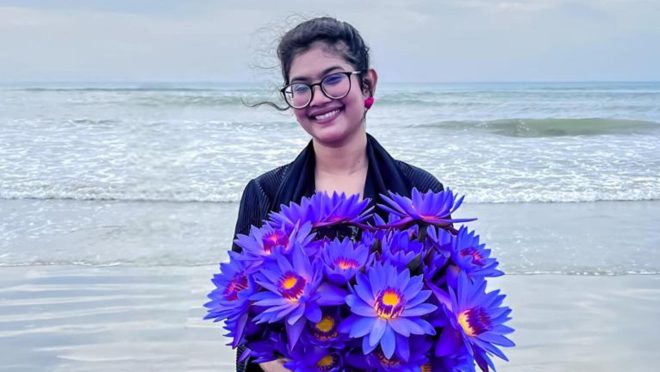
From universities in the country’s major cities to those in more remote areas, the journey towards a PhD has seen remarkable progress.
A similar story comes from a PhD recipient from Noakhali Science and Technology University, a university that has added another remarkable achievement to its growing list of academic successes. Saleha Begum, a student of the Department of Applied Mathematics, has secured a fully funded scholarship to pursue higher studies in the United States.
Earning a full scholarship in today’s highly competitive international admissions process requires far more than outstanding grades. It demands a well-rounded profile and a clear vision for future academic and professional goals. Saleha’s success stands as a testament to years of dedicated preparation and determination to continue her education at world-renowned institutions. As she prepares to begin the next chapter of her academic journey in the United States, she shared her long, paved journey.
For the Fall 2026 intake, Saleha received fully funded PhD offers from the University of California, Merced, Tulane University, and Texas Tech University. In addition, she was awarded the prestigious TTU Hutcheson Graduate Endowed Arts and Sciences Scholarship at Texas Tech University.
Saleha’s research involvement mainly focused on evolutionary game theory, machine learning, time series analysis, and mathematical modelling.
Asked about her research papers, she said she had published conference papers and journal papers before getting the scholarship, and some of her work has appeared in Q1 journals. She also has additional manuscripts under review.
“I realised my work had reached the Q1 standard when experienced researchers and journal reviewers recognised that it offered a novel contribution, solid mathematical analysis, and thorough validation.”
It gave her the insight that publishing in a Q1 journal requires patience, continuous revision, and strong mentorship.
While organising a research proposal, there are some factors that need to be kept in mind: a clear and meaningful research problem, a thorough literature review to identify the research gap, well-defined objectives and research questions, a suitable methodology, expected contributions and potential impact, and a realistic timeline and feasibility.
Above all this, what she highlighted the most is that the proposal should answer why the research matters and how it advances existing knowledge.
There are a few things that act as game changers when it comes to securing a scholarship. One of them is finding the right supervisor. Realising which supervisor was suitable for Saleha was quite easy, as she had already developed a clear idea of what to look for while choosing.
“I usually look at their recent research publications, whether their research interests match mine, and their current projects and funding. I have also sent emails to current students to learn about the department and its culture.”
Writing a recommendation letter or SOP is important when applying for scholarships. One usually does not write one’s own recommendation letter unless a professor specifically asks for a draft. Even then, a recommendation letter should highlight academic ability, research potential, work ethic, and character.
For most US universities, applicants do not upload recommendation letters themselves. Instead, during the application process, applicants provide their recommenders’ names and email addresses. The university then sends them a secure link, and the recommenders upload their letters directly. This makes the process more confidential and ensures the letters are authentic.
For the Statement of Purpose (SOP), Saleha focused on her academic background, research experience, why she is a good fit for the programme, why she chose that university and supervisor, and, last but not least, her future research goals.
“Every SOP should be tailored to each university rather than using one generic version.”
There are universities beyond the top rankings that offer scholarships. Therefore, careful selection is very important, especially for those who dream of getting into world-renowned or QS-ranked institutions.
Saleha selected universities based on faculty members whose research matched her interests, the availability of funding, research facilities and ongoing projects, publication quality, and departmental reputation.
Apart from these, she also focused on location and career opportunities after graduation.
“I did not apply based only on university rankings. Finding a good research fit was my highest priority,” said Saleha.
When I asked whether the funding she is receiving is enough to cover her daily needs, her answer was positive.
“Yes, my PhD offers are fully funded, including a full tuition waiver, a graduate assistantship stipend, summer funding, and health insurance.”
Saleha also said that the stipend is designed to cover essential living expenses such as housing, food, transportation, and other daily necessities. While budgeting is still important, it is generally sufficient for a graduate student’s basic needs.
Saleha started her preparation quite early. Her research journey began in the third year of her undergraduate studies, when she became actively involved in research. During that time, she focused not only on building a strong academic record but also on developing the technical skills needed for research.
“I learned several programming languages and research tools, including Python, R, MATLAB, and C++, which have been invaluable in my research projects.”
Her preparation focused on building a strong academic record, getting involved in research as early as possible, learning research-related programming languages and software, improving her research writing skills, publishing research papers, preparing a strong CV and Statement of Purpose (SOP), contacting potential supervisors, taking the IELTS, and carefully preparing all application materials.
Throughout her undergraduate studies, she consistently worked hard academically. She graduated first in her batch and received both the Dean’s Award and the Superior Performance Award in the 14th National Undergraduate Mathematics Olympiad. Alongside her studies and research, she also participated in extracurricular activities, which helped her develop leadership, communication, and teamwork skills.
“When I started my first semester of my MSc at BUET, I took the IELTS and immediately began preparing my PhD applications. At that point, I only had my first-semester MSc results, yet I applied with confidence because I had already built a solid research profile through my publications and research experience.”
As a result, she received multiple MSc and PhD offers with both full and partial funding from universities across the United States. In fact, her master’s degree is not even finished yet.
For her, preparation was a long-term process that started years before she submitted her applications. It was built through consistent effort, research experience, and continuous learning rather than just a few months of preparation.
Some strategies that helped her were starting research early, reading research papers regularly, seeking guidance from mentors, applying to multiple universities instead of relying on one, customising each application, staying consistent, and not giving up after setbacks.
“I also believe that patience, persistence, and continuous learning are just as important as academic achievements in securing a fully funded PhD opportunity,” concluded Saleha.