From Dhaka to Tokyo: The road to a fully funded degree in Japan
For Mayesha Maliha Proma, studying abroad was never just an ambition. It was a carefully nurtured dream that began in childhood and gradually turned into a clear goal.
From Dhaka to Tokyo: The road to a fully funded degree in Japan
For Mayesha Maliha Proma, studying abroad was never just an ambition. It was a carefully nurtured dream that began in childhood and gradually turned into a clear goal.
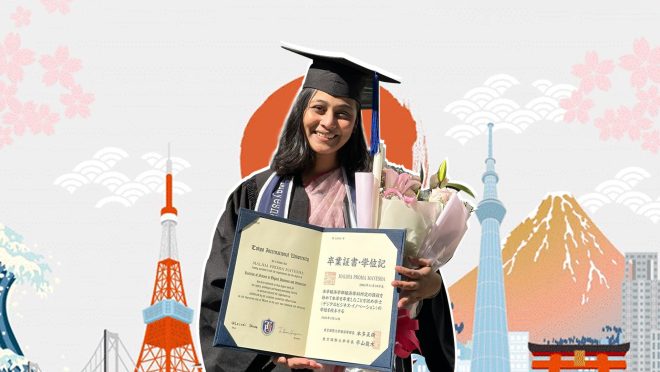
Proma describes her background as “very normal” in Bangladesh. She attended Viqarunnisa Noon School and College. Academically, she was between being a consistent top performer and struggling.
Sometimes she ranked in the top ten, and at other times she did not. There were even times when her principal reached out to her mother about her grades.
However, everything shifted during grades 11 and 12. She became more focused, serious, and intentional about her future.
Then COVID-19 disrupted everything. She never got to sit for her HSC exam, a milestone she had imagined for years. While she acknowledges that an exam does not define her, she still feels she missed out on a personal closure. That unfinished chapter did not stop her from beginning the next one.
A dream that started early
Her dream of studying abroad started well before university applications. As a child, she wanted to become a pilot. By grades 6 or 7, she was seriously weighing her options between aviation school and aeronautical engineering, but her desire to study abroad remained constant.
Interestingly, she did not have a specific person inspiring her dream. It felt natural. Yet, she recognised early that, as a girl, pursuing such ambitions would require preparation beyond academics. So, she began to prepare her family. She discussed funding and planning with her father. Sometimes, she would even talk to her brother first so he could help persuade their father. Slowly, what began as a childhood wish turned into a long-term plan.
Japan was not her initial choice. Proma had applied to universities in the US and Europe and had received some acceptances. But funding was always a barrier. She admits that at the time, she did not fully understand how to build a strategic application or find the right programme, and she sometimes underestimated her potential.
Then, on 19 December, everything changed. She received her acceptance from Tokyo International University (TIU), along with a 100 per cent tuition waiver. For the first time, she felt she had something solid to show her family.
Shortly after, she received the Monbukagakusho Honors Scholarship for Privately-Financed International Students from the Japanese government. This scholarship provided around 50,000 yen per month for one year to help cover living expenses.
Her best friend also received an 80 per cent scholarship at the same university. Suddenly, Japan no longer seemed distant or intimidating; it felt achievable. A trusted person reassured her father that Japan is safe, organised, and ideal for students. That reassurance made the decision easier.
Initially, she pursued the scholarship opportunity. After four years, she now considers it one of the best choices she has ever made.
Scholarship built on balance
Her financial support came from two key sources. She received a 100 per cent tuition reduction scholarship from Tokyo International University, renewable for four years as long as she maintained a consistent CGPA. She also received the Monbukagakusho Honors Scholarship, which covered living expenses for one year, totalling about 50,000 yen monthly.
Together, these allowed her to study in Tokyo without putting financial pressure on her family.
Applying to Tokyo International University felt much simpler compared to her US and European applications. Most documents were submitted online, and she was mentally prepared from her previous applications.
However, she faced rejections earlier, particularly from her dream universities in 2020 and 2021. Looking back, she realises that the problem was not a lack of effort but a lack of strategy. She did not fully understand how to showcase her fit for the programme or connect her goals with the institutions’ strengths.
Those rejections became valuable lessons. Now, she understands them clearly and works in the study abroad sector with her start-up, Abroadmates, to help future applicants avoid similar confusion.
The biggest challenge was not the paperwork. It was the mental pressure.
Applying abroad required balancing documents, deadlines, finances, family discussions, and self-doubt. Proma describes living between hope and fear. Even when everything seemed in order, the outcome was still uncertain.
To manage stress, she developed simple coping routines. She would take evening walks from 7 pm to 9 pm, visit places like Mohammadpur or Dhaka University, enjoy street food near Charukola, and have long phone conversations with her best friend. These breaks helped her clear her mind and return to work more calmly.
Giving up was never an option. Studying abroad was not just a goal; it was the only future she had envisioned. The question was never “Should I stop?” but always “How do I make this work?”
First impressions of Japan
Her initial months in Japan felt almost unreal. She was impressed by the clean streets, punctual systems, organised public life, and polite social interactions. She felt safe and never encountered judgement or discomfort.
At the same time, adapting required discipline. Living in a system-driven society meant she had to become more organised herself. Over time, she learned to appreciate that structure.
What made her application strong?
According to Proma, there was no single “magic” factor. Her application was well-rounded. It included consistent academics, strong IELTS and Duolingo scores, meaningful extracurricular leadership, clear and focused career goals, and a genuine and honest Statement of Purpose.
In her Statement of Purpose, she highlighted how school activities shaped her confidence. She wrote about being one of the first girls in her family to take this path and connected her journey to her broader dream of empowering women from Bangladesh and beyond.
She stresses the importance of honesty. Scholarship committees review thousands of applications, and inconsistencies are easy to spot. Being authentic helps a profile stand out.
Advice for future students
Her advice is simple but crucial: start early.
High school years are critical for building leadership, depth in extracurricular activities, English skills, and maturity. Scholarships reward consistent development, not last-minute efforts.
She also urges students to remember that studying abroad is about more than just being admitted. It requires balancing academics, part-time work, and daily responsibilities. This adaptability comes from years of discipline.
The most important mindset, she says, is long-term consistency. Language skills, leadership abilities, and resilience cannot be developed overnight.
Looking back, Proma feels that her time in Japan transformed her completely. The toughest step was leaving home. Once she managed that transition, she realised she could rebuild herself anywhere.
This article is written in partnership with Abroadmates, the all-in-one mentorship platform for study abroad.
To know more, book a session with Proma at https://www.abroadmates.com/mayesha-maliha-proma